

Starknet opens governance vote on exploring transition to independent post-quantum layer 1
Starknet has launched a seven-day non-binding governance poll asking STRK stakers and delegators whether to research transitioning the network from an Ethereum layer-2 rollup into an independent post-quantum layer-1 blockchain.
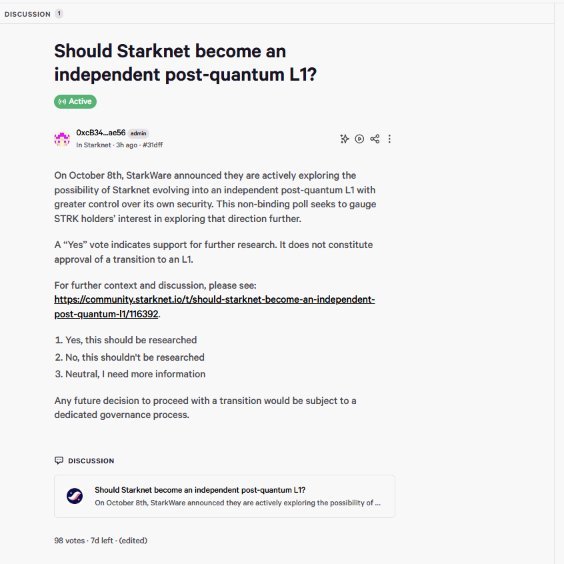
Starknet has opened a non-binding governance poll asking community members whether the network should explore transitioning from an Ethereum Layer 2 to an independent post-quantum Layer 1. The Snapshot poll, which opened at 09:32 UTC on Oct. 15, 2026, and runs until Oct. 22, allows STRK stakers and delegators to weigh in without a quorum requirement. Voters can select between three options: researching the transition, voting against further research, or choosing neutral to request more information.[1][3][4][6][7]
According to a forum post by Starknet Foundation team member Henri, the proposed shift centers on quantum security. While Starknet's own native components can achieve quantum resistance relatively quickly, its bridge and data availability layers remain tied to Ethereum's upgrade schedule. Moving to a standalone layer 1 would remove that dependency. The proposal notes that Starknet already utilizes hash-based STARK proofs and native account abstraction, though no fixed timeline for any network migration has been established.[2][5][7]
The ballot is strictly exploratory and does not approve an immediate departure from Ethereum. A successful "Yes" result will initiate deeper research followed by more detailed proposals and dedicated governance votes, while a "No" vote will maintain post-quantum development within Starknet's current Layer 2 architecture. Under any outcome, STRK will remain the ecosystem's native token with no new token issued, and bridges connecting Ethereum to Starknet will stay open.[3][5][6][7]
The vote follows discussions initiated on Oct. 8 by StarkWare co-founder and CEO Eli Ben-Sasson, who floated the idea around a presentation at Token2049 before StarkWare publicly endorsed the transition as its clearest path forward. Snapshot data reported by Unchained showed overwhelming early community support, with 99.9% of roughly 179.8 million in voting power backing research within the first several hours of voting.[7]
Key facts
- The Starknet Snapshot poll opened at 09:32 UTC on Oct. 15, 2026, and is scheduled to close at 09:32 UTC on Oct. 22.
- The non-binding vote is open to STRK stakers and delegators and carries no quorum requirement.
- Voters can select 'Yes, this should be researched,' vote against research, or choose 'Neutral, I need more information.'
- The proposal states that backing the research does not constitute approval of an L1 transition, which would require a dedicated governance process.
- The primary rationale cited is post-quantum security, as Starknet's Ethereum-dependent bridge and data availability layers are bound to Ethereum's upgrade timeline.
- STRK will remain the ecosystem's native token with no new token issued, and Ethereum bridges will stay open under any voting outcome.
- By approximately 14:40 UTC on Oct. 15, 293 votes were cast, with 99.9% of roughly 179.8 million in voting power supporting 'Yes.'
Sources · 7 sources
- CB
Crypto Banter@crypto_banterPost on X ·
🚨STARKNET OPENS VOTE ON BECOMING AN INDEPENDENT L1! ethereum:0xca14007eff0db1f8135f4c25b34de49ab0d42766 stakers and delegators can now participate in the first non-binding governance vote on whether Starknet should transition from an Ethereum L2 to its own Layer 1. The move is framed around gaining full control over post-quantum security upgrades. The vote is open now.
Open source - CT
Coin TelegraphArticle ·
Starknet opens vote on potential Ethereum L2 exit over quantum risks Starknet is asking STRK holders whether to explore becoming an independent layer-1 blockchain to reduce its dependence on Ethereum’s quantum-security upgrade timeline.
Open source - TB
The Block@TheBlockCoPost on X ·
THE BLOCK: Starknet is launching a seven-day, non-binding initial governance poll on whether to explore becoming an independent post-quantum Layer 1. A yes vote would trigger further research, followed by more detailed proposals and polls. A no vote would see post-quantum development continue on Starknet as an Ethereum Layer 2.
Open source - TB
The BlockArticle ·
Starknet opens seven-day vote on independent Layer 1 over quantum risks Starknet opened a seven-day poll on Thursday asking STRK holders whether to research an independent post-quantum Layer 1.
Open source - BS
BSCN@BSCNewsPost on X ·
Starknet's layer-1 proposal just went live! @Starknet has today gone live with a non-binding poll, seeking feedback from $STRK holders on the future of the network. The official poll is titled "Should Starknet become an independent post-quantum L1?" Though lacking in detail, it confirms that $STRK will remain the heart of the platform's ecosystem, with no new token to be issued.
Open source - CN
crypto.news@cryptodotnewsPost on X ·
JUST IN: Starknet puts potential shift to independent Layer 1 up for vote The non-binding proposal would move $STRK away from its current Ethereum L2 role toward a standalone network designed with post-quantum security in mind. https://t.co/tjvtVVdJFA
Open source - UN
UnchainedArticle ·
Starknet Opens Its First Vote on Becoming an Independent Post-Quantum Layer 1 Anyone staking or delegating STRK can now vote on whether Starknet , StarkWare’s Layer 2 on top of Ethereum, should research breaking away to run as a standalone post-quantum blockchain. The non-binding Snapshot poll opened at 09:32 UTC on Oct. 15 and closes at the same time on Oct. 22 . Voters can pick “Yes, this should be researched,” vote against further research, or choose “Neutral, I need more information.” StarkWare called it the first governance vote on the potential transition. The ballot is narrow by design. Backing the research “does not constitute approval of a transition to an L1,” the proposal reads, and “any future decision to proceed with a transition would be subject to a dedicated governance process.” Get Unchained’s crypto news in your inbox with the free Unchained Daily newsletter . Security Is the Stated Reason Henri of the Starknet Foundation laid out the reasoning in a forum post attached to the poll. The components Starknet runs itself can be made quantum-resistant soon, he wrote, while its bridge and its data availability layer move on Ethereum’s schedule. Operating as its own Layer 1 would end that reliance. The post noted that Starknet already uses hash-based STARK proofs and native account abstraction, and said no timeline for a switch has been set. Two things will not change under any outcome: “STRK is the token, with no new token,” and bridges from Ethereum into Starknet remain open. A “Yes” result would kick off research that would produce more detailed proposals and further polls. A “No” means post-quantum work continues with Starknet as a Layer 2. A “Neutral” result keeps the forum thread open until the missing answers arrive. Early Tally By about 14:40 UTC on Oct. 15, 293 votes had been cast, and 99.9% of roughly 179.8 million in voting power backed “Yes,” according to Snapshot data . The poll has no quorum requirement. “Becoming an L1 is a big deal. So is post-quantum security. We want to hear what the community thinks,” StarkWare co-founder and CEO Eli Ben-Sasson wrote on X . How It Got Here Ben-Sasson first floated the idea on Oct. 8, alongside a talk at Token2049, asking whether an L1 “for post-quantum agility” was a good or bad idea. Starknet’s own account said that day it was considering the move with 2027 as its target for full quantum resistance. Two days later, StarkWare posted that “Starknet becoming an independent L1 is our clearest path forward.” Results will be visible as soon as voting closes. Related Listen: Why a Hidden Public Key Still Can’t Protect Your Bitcoin From Quantum Computing The post Starknet Opens Its First Vote on Becoming an Independent Post-Quantum Layer 1 appeared first on Unchained .
Open source