
Zcash builder Zakura proposes per-swap viewing keys to protect NEAR Intents privacy
Zcash developer Zakura has proposed generating a distinct viewing key for every shielded address used in NEAR Intents swaps to prevent potential future quantum computers from uncovering a user's full transaction history.
Zakura, an engineering team developing Zcash node and wallet software, published a design to assign every shielded address posted during cross-chain NEAR Intents swaps its own viewing key, according to Unchained and CoinDesk. The proposal, which is under review and has not yet shipped, aims to prevent a future quantum computer from linking a user's broader payment history through addresses exposed on public ledgers.[3][1][2]
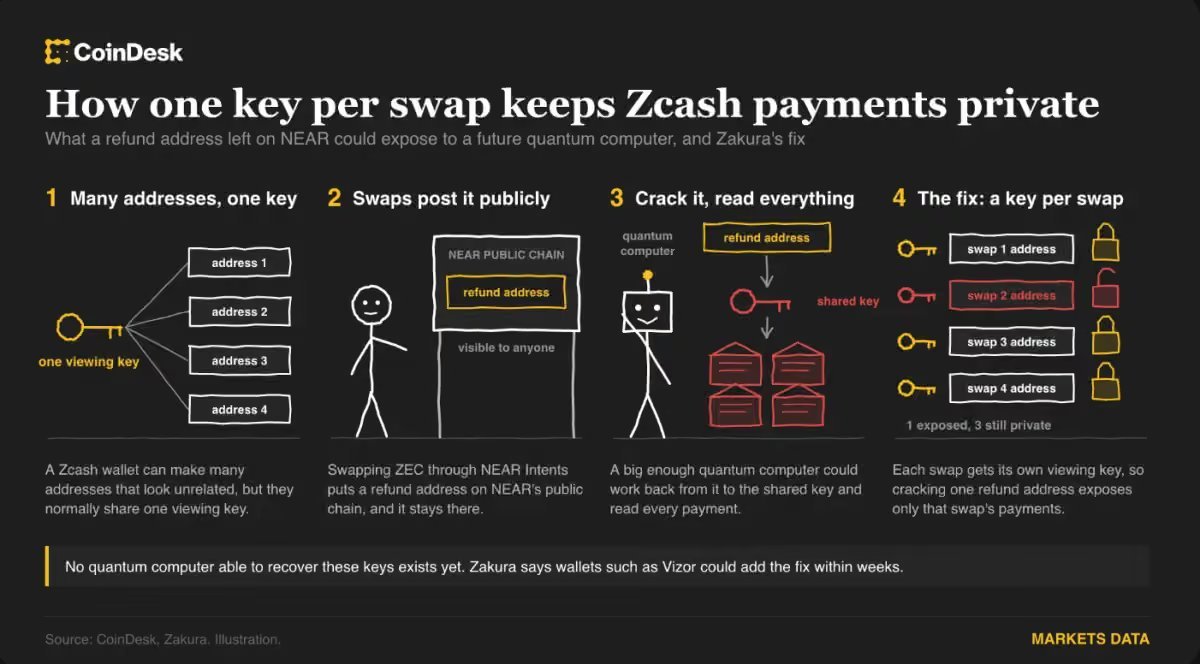
Under Zcash's existing setup, an account's addresses all rely on one incoming viewing key. When users conduct cross-chain transactions through NEAR Intents, the service publishes shielded refund addresses on NEAR's public chain once a deposit is logged, and swaps into ZEC publicly display the receiving address. Zakura's Adam Tucker wrote that while classical computers cannot derive the viewing key from an address, a quantum computer running Shor's algorithm could calculate the key and expose the amount and memo of every payment the account has received. No such quantum machine exists today.[3][4]
To bridge the privacy gap ahead of Zcash's planned Tachyon upgrade and a January quantum-resistance deadline referenced by CoinDesk, the design derives a fresh viewing key per swap from a hashed index while keeping the spending key unchanged. This architecture keeps funds within a single account, avoiding hardware wallet constraints on devices like Keystone and Ledger. Wallets will use encrypted memos and private information retrieval to verify payouts without revealing queried addresses to servers. Zakura expects software wallets such as Vizor to adopt the feature in the coming weeks, with hardware wallets following once firmware updates are ready.[3][4]
Key facts
- Zakura published a design giving every shielded address posted during a NEAR Intents swap its own viewing key to mitigate future quantum risks.
- The proposal is currently under review on Zakura's engineering page and has not yet shipped.
- NEAR Intents publishes shielded refund addresses and swap receiving addresses on its public blockchain once transactions are logged.
- A theoretical quantum computer running Shor's algorithm could derive an account's viewing key from a published address, though no such computer exists today.
- The proposed fix derives viewing keys from a hashed index while keeping a single spending key, preserving compatibility with Keystone and Ledger hardware wallets.
- Software wallets using Zakura's libraries, such as Vizor, are expected to implement the fix in the coming weeks, followed by hardware wallets once firmware supports it.
Sources · 4 sources
- CO
CoindeskArticle ·
Zcash developers plan a fix to keep ZEC swaps private from future quantum computers The team behind Zakura wants every swap through NEAR Intents to get its own key, so a refund address left on NEAR’s public chain can’t expose a user’s wider payment history.
Open source - DE
Decrypt@DecryptMediaPost on X ·
Zcash Developer Zakura Proposes Fix to Stop Quantum Computers Linking Shielded Swaps https://t.co/dKgLLVOTZu
Open source - UN
UnchainedArticle ·
Zcash Builder Zakura Proposes Per-Swap Viewing Keys to Close a Quantum Privacy Gap Zakura , a team building Zcash node and wallet software, published a design that would give every shielded address posted during a NEAR Intents swap its own viewing key, limiting what a future quantum computer could learn from any single one. Zakura’s engineering page lists the work as in review, and it has not shipped. Adam Tucker, who wrote the post, said that until Zcash’s planned Tachyon upgrade arrives, “a single published shielded address lets a quantum attacker link every payment that address’s key has ever received.” Get Unchained’s crypto news in your inbox with the free Unchained Daily newsletter . Why Swaps Expose Addresses Each Zcash shielded account relies on one incoming viewing key behind all of its addresses. Classical computers cannot work that key out from an address, but a sufficiently powerful machine running Shor’s algorithm could, exposing the value and memo of every payment the account has received, according to the post. No such machine exists yet. In ordinary use, a Zcash holder gives an address privately to whoever is paying them. NEAR Intents, a cross-chain swap service, works differently. When a user swaps ZEC for another asset, the wallet supplies a shielded refund address, and NEAR publishes the address on-chain once the deposit is logged, and it stays there whether or not the user gets money back. Swaps into ZEC publish the receiving address too. The addresses look unrelated, but one key sits behind all of them. How the Proposed Fix Works Zakura’s approach changes only the randomness that goes into the viewing key, deriving a fresh key for each swap from a hashed index. The spending key stays the same, so funds remain in a single account. Tucker wrote that opening a new account per swap was ruled out because Keystone hardware wallets sign only from the first account and Ledger devices spend from one account per transaction, “which wasn’t an acceptable UX to us.” More keys would normally mean a slower restore from seed, with one full chain scan per key. Under the design, the wallet leaves itself an encrypted memo noting each swap’s index, checks published filters, then uses private information retrieval to look up matching NEAR bridge payouts without the server learning which addresses it asked about. For swaps into ZEC, the wallet checks addresses in order and stops after 30 unused ones in a row. Zakura expects software wallets using its libraries, such as Vizor , to be able to add it “in the coming weeks.” “Hardware wallets will follow once their firmware supports it,” the post said. Related Listen: How NEAR Intents Identified a Suspect and Got Its Stolen Funds Back The post Zcash Builder Zakura Proposes Per-Swap Viewing Keys to Close a Quantum Privacy Gap appeared first on Unchained .
Open source - CO
CoinDesk@CoinDeskPost on X ·
INSIGHT: @Zcash developers propose giving every $ZEC swap through NEAR Intents its own private key, closing a gap that a future quantum computer could exploit to piece together a user’s payment history before the January quantum-resistance deadline. https://t.co/CfA4WBemam
Open source