

Vitalik Buterin unveils 'paranoid mode' privacy wrapper for AI agents
Ethereum co-founder Vitalik Buterin has created an experimental privacy system for his AI agent harness, using Tor, zero-knowledge payments, cover traffic, and local prompt rewriting to limit identity and data leakage.
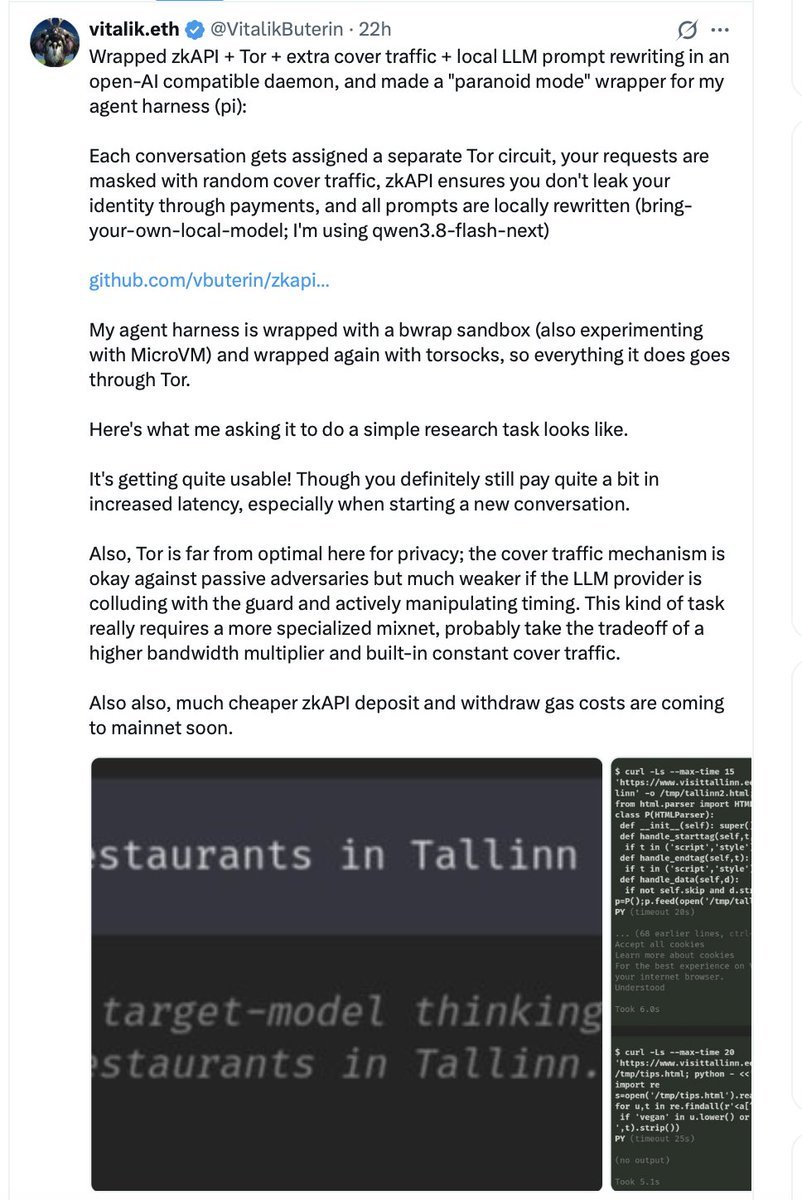
Ethereum co-founder Vitalik Buterin has showcased a personal "paranoid mode" privacy wrapper built for his AI agent harness, known as pi. As shared in posts highlighting his setup, the configuration bundles zkAPI, Tor, random cover traffic, and local prompt rewriting into an OpenAI-compatible daemon to reduce data and identity leaks when querying external AI systems.[1][2][4][5]
To obscure requests, the system assigns a separate Tor circuit to each conversation and masks queries with randomized background cover traffic. All user prompts are first rewritten locally using a bring-your-own-model setup—with Buterin currently running qwen3.8-flash-next—to avoid leaking details directly to external providers. The harness is isolated inside a bwrap sandbox, alongside tests with MicroVM, and piped through torsocks to force all activity across Tor. Payments for AI services are handled through zkAPI, applying zero-knowledge cryptography so users do not expose their identity during transactions.[1][2][3][4]
While Buterin stated that the workflow is becoming usable, he cautioned that it introduces substantial latency, particularly when spinning up new conversations. He also noted that Tor is "far from optimal" for the workload, explaining that passive cover traffic provides weak defense if an AI provider colludes with an entry guard node to manipulate timing. Instead, he suggested a specialized mixnet with built-in constant cover traffic would offer stronger security, and noted that lower gas costs for zkAPI deposits and withdrawals will soon arrive on Ethereum mainnet.[1][3][4]
Key facts
- Vitalik Buterin developed a "paranoid mode" privacy wrapper for his AI agent harness, pi, packaged in an OpenAI-compatible daemon.
- Each conversation is assigned a unique Tor circuit, and requests are masked with random cover traffic.
- The tool uses zkAPI to preserve financial privacy and prevent identity leaks when paying for AI services.
- Prompts are rewritten locally prior to sending, with Buterin using the qwen3.8-flash-next model.
- The agent harness is isolated using a bwrap sandbox and routed via torsocks, while experiments with MicroVM are also ongoing.
- The privacy configuration introduces significant latency, especially at the start of new conversations.
- Buterin noted Tor is vulnerable to timing-correlation attacks by colluding providers and guards, suggesting a specialized mixnet is likely needed.
- Cheaper deposit and withdrawal gas fees for zkAPI are expected on Ethereum mainnet soon.
Sources · 5 sources
- WB
Wu Blockchain@WuBlockchainPost on X ·
Vitalik Buterin Unveils Privacy-Focused AI Agent Setup Combining zkAPI, Tor, and Local LLMs Ethereum co-founder Vitalik Buterin showcased his personal privacy-focused AI agent setup, integrating zkAPI, Tor, random cover traffic, and local LLM prompt rewriting into the pi agent harness. The system assigns each conversation a separate Tor circuit, uses zkAPI to protect payment privacy, and rewrites prompts locally with a Qwen model. Vitalik said the setup is becoming usable but still suffers from significant latency, especially when starting new conversations, while Tor remains vulnerable to timing-correlation attacks involving colluding providers and entry nodes. He suggested that a specialized mixnet may offer stronger protection and added that lower gas costs for zkAPI deposits and withdrawals on Ethereum mainnet are coming soon.
Open source - CP
Crypto Patel@CryptoPatelPost on X ·
Vitalik Buterin’s “Paranoid Mode”: Can AI Agents Finally Protect Your Privacy? Ethereum co-founder Vitalik Buterin has showcased an experimental privacy system designed to make AI agents harder to track. But what does this actually mean? 👇 UNDERSTAND IT IN SIMPLE WORDS: Normally, when you use an AI tool, the company providing that AI may see your prompts, while your network activity and payment details can potentially reveal more about you. Vitalik wants to make connecting these pieces of information much harder. Here’s how his system works: 🔹 Tor Network: Helps hide your original IP address from the AI service. 🔹 Cover Traffic: Adds extra network activity to make it harder to identify which requests are genuine. 🔹 zkAPI: Uses zero-knowledge cryptography to improve payment privacy when accessing paid AI services. 🔹 Local AI Model: Rewrites your prompts before sending them to an external AI, potentially removing identifying details. 🔹 Sandbox: Isolates the AI agent to add another layer of security. WHY DOES THIS MATTER? Imagine using an AI assistant without easily exposing your identity, personal details, and payment activity to the same service. That’s the vision behind this approach: making AI more private while allowing it to use external tools and services. THE REALITY CHECK: This is still experimental, not a guarantee of complete anonymity. AI providers can still see the prompts they process, and advanced tracking techniques may expose connections between activities. As AI agents become more powerful, privacy will become increasingly important. Crypto technologies like zero-knowledge proofs could help users pay for digital services with less exposure of their financial identity. Can we use AI without giving away so much of our privacy?
Open source - CB
Coin Bureau@coinbureauPost on X ·
🔥Ethereum co-founder Vitalik Buterin builds a “paranoid mode” for his AI agent using zkAPI, Tor and cover traffic. Each conversation gets its own Tor circuit, and requests are masked with random cover traffic. His zkAPI tool ensures users don’t leak their identity through payments. All prompts are also rewritten locally by the user’s own AI model. Buterin says it adds “quite a bit” of latency and that Tor is “far from optimal here for privacy.”
Open source - CO
Cointelegraph@CointelegraphPost on X ·
🚨 UPDATE: Vitalik Buterin unveils a “paranoid mode” for AI agents using Tor, zkAPI, cover traffic and local prompt rewriting to reduce identity and data leaks. https://t.co/YlbjYXIWmu
Open source - CO
CoinMarketCap@CoinMarketCapPost on X ·
LATEST: 🤖 Vitalik Buterin says he’s built a “paranoid mode” for AI agents that routes them through Tor, masks requests with cover traffic, uses zkAPI for anonymous payments, and rewrites prompts with a local LLM. https://t.co/nheZ4BlmBP
Open source