

Vitalik Buterin outlines Ethereum shift to 'cryptographic world computer'
Ethereum co-founder Vitalik Buterin published an essay mapping the network's evolution through 2030, proposing that the upcoming Hegota upgrade could be its last conventional fork before transitioning to advanced cryptographic proofs and parallel computation.
Vitalik Buterin published a blog post titled "The cryptographic world computer," arguing that Ethereum is evolving from a traditional blockchain into a hybrid system combining blockchain security with modern cryptography. In the essay, Buterin stated that the network will increasingly rely on data sampling and compact zero-knowledge proofs to let nodes cheaply verify computation rather than forcing every participant to download and re-execute every transaction.[3][7][2][6]
Buterin framed the planned Hegota upgrade—scheduled for next year or 2027—as likely Ethereum's last "normal" fork recognizable to developers from the network's early era. Subsequent upgrades are slated to center on recursive STARKs, automated formal verification, quantum-resistant cryptography, and multi-party block construction. Buterin noted that PeerDAS has already begun this shift, while an L1 zkEVM model under active research could allow specialized provers to execute blocks while ordinary nodes simply verify proofs.[3][7][9][1][10]
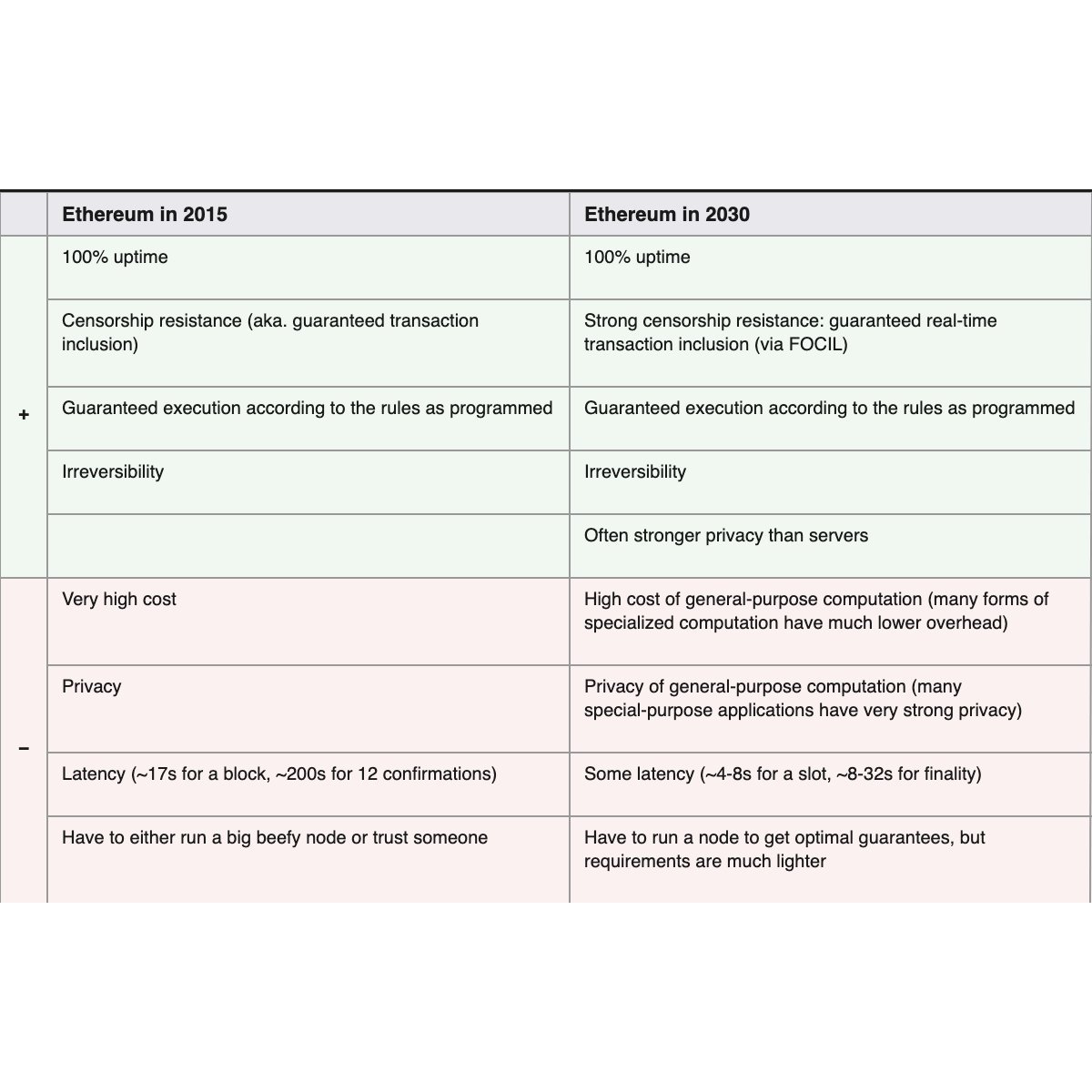
Under this architecture, Buterin projected Ethereum could achieve slots of 4 to 8 seconds and transaction finality in 8 to 32 seconds by 2030, down from roughly 200 seconds in 2015. While decentralization has traditionally imposed performance overhead, Buterin argued it could become a speed advantage by distributing storage and parallelizing computation. However, he identified managing and parallelizing access to Ethereum's growing state as the more systemically difficult challenge compared to proof generation.[3][7][8][5]
Key facts
- Vitalik Buterin published an essay titled "The cryptographic world computer," detailing Ethereum's planned transition through 2030.
- Buterin stated that the upcoming Hegota upgrade, planned for next year or 2027, will likely be Ethereum's last "normal" fork.
- Post-Hegota upgrades will focus on recursive STARKs, automated formal verification, and quantum-safe cryptography.
- The roadmap envisions replacing full transaction re-execution by all nodes with data sampling and compact zero-knowledge proofs.
- Buterin projected network slots of 4 to 8 seconds and finality times of 8 to 32 seconds by 2030, compared to roughly 200 seconds in 2015.
- Managing and parallelizing access to Ethereum's growing state was identified as a more difficult systemic challenge than proof generation.
Sources · 10 sources
- CR
CryptoSlate@CryptoSlatePost on X ·
Vitalik Buterin says Ethereum could scale by letting participants divide computation and verify each other’s work with cryptographic proofs. The proposed L1 zkEVM would let nodes check proofs instead of replaying every transaction. It remains under research. https://t.co/3mAaLMwalQ
Open source - WB
Wu Blockchain@WuBlockchainPost on X ·
Vitalik: Ethereum Is Evolving Beyond a Blockchain Into a “Cryptographic World Computer” Vitalik Buterin said Ethereum is evolving toward a system that differs fundamentally from traditional blockchains, combining SNARK-based verification, PeerDAS, optimized proof-of-stake, multi-party block construction, parallel computation and stronger privacy. He said Hegota, planned for next year, may be Ethereum’s last “normal” fork recognizable to someone from 2015, with subsequent upgrades centered on recursive STARKs, automated formal verification and quantum safety. Buterin described the long-term goal as a “cryptographic world computer” that combines blockchain security with cryptographic verification, privacy and decentralized off-chain computation.
Open source - CR
CryptoSlateArticle ·
Ethereum’s next scaling leap may come from making everyone stop doing the same work Ethereum co-founder Vitalik Buterin says advances in cryptography could turn decentralization from a performance cost into a scaling advantage for the network. In a Sept. 27 essay , Buterin described Ethereum's long-term destination as a “cryptographic world computer,” an architecture in which computation and data can increasingly be distributed across different participants while compact proofs allow others to cheaply verify that the work was performed correctly. The shift would mark a departure from the traditional blockchain model in which every node downloads transactions and repeats much of the same computation. Instead, Ethereum could push more work across a wider network of specialized participants without requiring every validator to reproduce it, potentially allowing decentralization itself to contribute to performance. “Perhaps the most important shift” is that decentralization is moving beyond being a burden accepted for safety and robustness and can, in limited cases, become a performance strength, Buterin wrote. Distributed networks can store larger quantities of data and run more computation in parallel, including work around the transaction mempool. That revives one of Ethereum's earliest ambitions. Developers in the mid-2010s considered distributing different pieces of computation across participants much as centralized systems divide workloads between servers. The obstacle was verification: dividing the work created the additional problem of establishing that every participant had performed its portion correctly. Modern cryptographic proofs increasingly provide that missing layer, Buterin said, while their computational overhead continues to decline. From repeated computation to verified work The change is part of a broader overhaul that Buterin argues will make Ethereum around 2030 qualitatively different from the blockchain systems that emerged with Bitcoin. Ethereum's future verification model would rely increasingly on data sampling and succinct cryptographic proofs rather than requiring every validator to download and independently execute everything. Consensus is also moving toward a more optimized proof-of-stake design, while block construction is being divided among multiple participants instead of being controlled by a single producer. Zero-knowledge technology is already central to that direction. Ethereum's proposed L1 zkEVM model would allow a specialized prover to execute a block and generate a proof of correct execution, which other nodes could verify much more cheaply than re-executing every transaction themselves. The technology remains under active research and has not been integrated into production Ethereum clients. The result, if the roadmap works as intended, would be a network where doing work and checking work become increasingly separate functions. Buterin argues that separation could allow Ethereum to retain the security benefits of broad verification while tapping distributed infrastructure for more computation, storage and potentially privacy. Infrastructure surrounding Ethereum could also compete more aggressively on latency even if the base chain itself never approaches the response times of centralized servers. He described the eventual system as a hybrid combining traditional blockchain properties with cryptographic verification, privacy and decentralized components operating away from the base chain. Applications may have to change with it The transition could also alter the economics of building applications on Ethereum . On a conventional blockchain, developers largely think about the amount of data or computation an application consumes. Buterin expects the structure of that computation to become increasingly important as Ethereum attempts to parallelize work across different participants. Applications that package large amounts of interdependent computation into one serial transaction could become comparatively expensive, while workloads separated into well-defined components that can be parallelized, aggregated or pruned could become cheaper. Related Reading Ethereum’s plan to triple network speed could silently break millions of existing smart contracts That would give developers an incentive to design applications around independent dependencies rather than treating Ethereum as a single machine on which arbitrary computation is executed sequentially. Over time, Buterin suggested, Ethereum could converge toward a model where information needed for ordering and state changes that cannot be rearranged remains onchain, while much of the surrounding computation is processed and aggregated before reaching a block. Such a model would push Ethereum closer to being a coordination and verification layer for distributed computation rather than a system in which the base chain itself performs every operation. The distinction remains largely prospective. Ethereum's roadmap contains several research efforts aimed at reducing what ordinary validators must store or compute, while many of the technologies needed for the broader architecture remain unfinished. State becomes the harder constraint Making computation verifiable does not remove the need to obtain the data on which that computation depends. Buterin identified managing and parallelizing access to Ethereum's growing state as the more systemically difficult challenge facing the architecture. State includes the account balances, smart-contract storage and other information required to determine what the network currently looks like before another transition can be calculated. Ethereum researchers are pursuing several approaches to reduce that burden. Weak statelessness, for example, would allow most validators to verify blocks without maintaining the full state database, while block producers retain access to the state needed to construct blocks and generate witnesses. The proposal remains in research and depends on other changes to Ethereum's architecture. That means cryptographic proofs can make the result of computation dramatically cheaper to check without making the upstream requirement for data disappear. The network must still develop reliable ways to store, retrieve and parallelize access to state as more work is divided among participants. Buterin said Ethereum has potential approaches to the problem, though designs will need to evolve alongside the applications eventually running on the network. The transition is already moving into Ethereum's protocol roadmap. Buterin said Hegotá, currently planned for 2027, could be the network's last “normal” fork recognizable to developers from Ethereum's earlier era. Later upgrades are expected to lean increasingly on recursive proofs, automated formal verification, optimized consensus and quantum-resistant cryptography. PeerDAS has begun that transition, he said. What follows will test whether Ethereum can distribute substantially more computation without recreating the old requirement that every participant repeat the same work, and whether its state infrastructure can keep pace with the cryptography making that division possible. The post Ethereum’s next scaling leap may come from making everyone stop doing the same work appeared first on CryptoSlate .
Open source - CO
Cointelegraph@CointelegraphPost on X ·
🚨 LATEST: Vitalik Buterin says Ethereum's 2027 Hegotá upgrade may be its last "normal" fork before a shift toward quantum-safe tech. https://t.co/jBvL3auFNV https://t.co/8brQT9bLLD
Open source - CB
Coin Bureau@coinbureauPost on X ·
🚨JUST IN: Vitalik Buterin unveils Ethereum's next era as a "cryptographic world computer." The Ethereum co-founder says the network is "really not just a blockchain anymore," but a system combining blockchains with modern cryptography to be cheaper, faster and more private. He says next year's Hegota upgrade is likely Ethereum's last "normal" one, with everything after focused on zero-knowledge proofs and quantum safety. By 2030, he expects transactions to finalize in as little as 8 seconds, down from around 200 seconds in 2015.
Open source - CB
Crypto Banter@crypto_banterPost on X ·
🚨VITALIK SAYS ETHEREUM IS NO LONGER JUST A BLOCKCHAIN! @VitalikButerin published “The cryptographic world computer” today. He said Ethereum after Hegota is a hybrid of a chain plus modern cryptography, not just a ledger. If the roadmap lands, Ethereum gets cheaper computation, more scale, and stronger privacy.
Open source - UN
UnchainedArticle ·
Vitalik Buterin Says Hegota Will Likely Be Ethereum’s Last ‘Normal’ Fork Ethereum co-founder Vitalik Buterin says the network’s upgrades will change in kind once Hegota ships next year, with each later fork centered on proofs and other advanced cryptography. In a blog post published Sunday and shared on X , titled “The cryptographic world computer,” Buterin wrote that Hegota is likely to be the network’s last “normal” fork. “Everything after that involves recursive STARKs, automated formal verification, highly optimized consensus algorithms, and making it all quantum-safe,” he wrote. Get Unchained’s crypto news in your inbox with the free Unchained Daily newsletter . A Hybrid System Buterin argued that a future Ethereum will be called a blockchain “to a large extent for historical reasons.” In practice, he wrote, it will combine Bitcoin’s founding ideas with cryptographic tools drawn from 50 years of academic research, some of which were not mature when Bitcoin launched in 2009. He annotated the Bitcoin whitepaper section by section. Nodes that now download and re-execute every block would instead sample data through PeerDAS and check a SNARK , a short proof that a computation was done correctly. Blocks built by a single miner or proposer would give way to construction split among multiple parties. A comparison table in the post puts Ethereum in 2030 at roughly 4 to 8 seconds per slot and 8 to 32 seconds to finality , against about 17 seconds per block and around 200 seconds for 12 confirmations in 2015. Decentralization as a Performance Gain The most important shift, Buterin wrote, is that decentralization is moving from “purely a burden incurred in the name of safety and robustness” to, in limited cases, a source of speed. A spread-out network can store data and run computation in parallel, he said. Early Ethereum designs tried to split up work this way but could not check each piece was done correctly. “Now, with modern cryptography, this problem is solved, and the overhead factor of that solution is decreasing month by month,” he wrote. Developers will face new incentives too, since computation crammed into one serial transaction will cost more than work split into parallel pieces. Making zero-knowledge proofs efficient and safe is hard but “already being heavily optimized with AI tools,” he wrote, while handling huge volumes of state and letting many processes read and write it at once is likely the harder task. The essay builds on “Lean Ethereum,” the rebuild Buterin has said would take three to four years and rival the Merge in scope, and on the strawmap roadmap Ethereum Foundation researcher Justin Drake introduced in February. Further out, Buterin said practical program obfuscation could bring “one further shift,” though the essay’s conclusions “will apply long before any of that becomes available.” Related Listen: Zcash, Ethereum, Aztec, Canton and More: Which Chain Will Win the Privacy Race? The post Vitalik Buterin Says Hegota Will Likely Be Ethereum’s Last ‘Normal’ Fork appeared first on Unchained .
Open source - TB
The Block@TheBlockCoPost on X ·
THE BLOCK: Vitalik Buterin says Ethereum is called a "blockchain" mostly "for historical reasons" and is turning into a "cryptographic world computer." Buterin projected slots of 4 to 8 seconds by 2030, and finality in 8 to 32 seconds in a new blog post. https://t.co/TaaTxUIAN0
Open source - DE
DecryptArticle ·
Vitalik Buterin Outlines 'Cryptographic World Computer' Plan for Ethereum Hegota will be Ethereum's last 'normal' fork, he argues, with everything after built on recursive STARKs and formal verification.
Open source - BS
BSCN@BSCNewsPost on X ·
Vitalik Reveals Ethereum’s Big 2030 Redesign Vitalik Buterin (@VitalikButerin) has outlined how Ethereum could look very different by 2030, in a new essay. He described the network as a hybrid architecture combining blockchains with modern cryptography. Crucial points include: - Future upgrades could introduce recursive STARKs, automated verification and quantum safe cryptography. - Buterin also expects Ethereum to process more work through decentralized and parallel systems. - Buterin expects Hegota, planned for next year, to be Ethereum’s last normal fork. - He also projected 4 to 8 second slots and 8 to 32 second finality by 2030. - Nodes could eventually verify cryptographic proofs instead of downloading and executing every block. - Buterin also expects aggregated signatures and multi participant block construction to reshape validation. - FOCIL could also give multiple validators a larger role in forcing transactions into blocks. - He said applications built around Ethereum could achieve much lower latency than Ethereum itself.
Open source