

US becomes net Bitcoin importer for first time since 2022, Chainalysis reports
According to a report by Chainalysis, the United States turned into a net importer of Bitcoin in the year ending June 2026, spurred by institutional purchases and transactions surpassing $10 million.
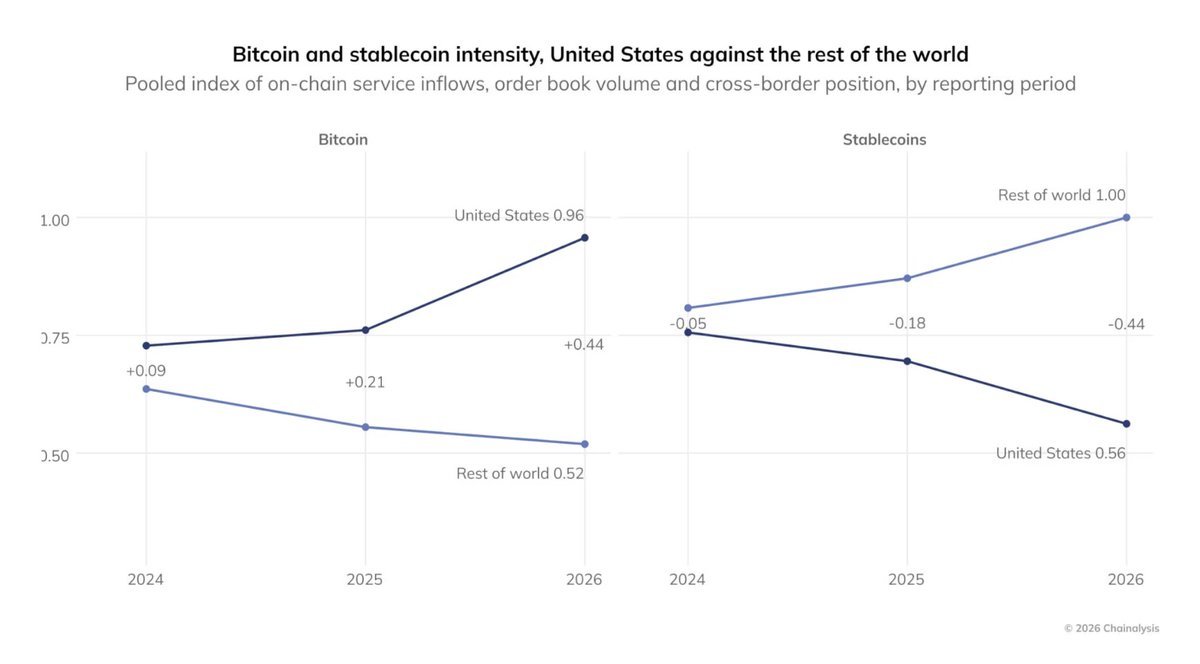
The United States became a net importer of Bitcoin in the year ending June 2026, marking the first such reversal since 2022, according to findings from blockchain analytics firm Chainalysis. Large transfers valued at more than $10 million drove the turnaround, as institutional players continued acquiring Bitcoin while retail investors acted as net sellers.[1][2][3]
The report revealed that the U.S. share of global Bitcoin transactions and activity has grown during every reporting period since spot Bitcoin exchange-traded funds launched in 2024. A chart published by Chainalysis shows U.S. Bitcoin intensity rising to 0.96 in 2026, compared to 0.52 for the rest of the world. In contrast, U.S. stablecoin intensity dipped to 0.56, while the rest of the world climbed to 1.00.[1][3]
Overall, the total U.S. crypto economy stood at $2.78 trillion, reflecting a 2.2% decline quarter over quarter. Despite that drop, U.S. dollar-backed stablecoins continued to see expanding use across international payments and cross-border commerce, generating billions of dollars in economic activity for American businesses and the federal government.[1][3]
Key facts
- The United States became a net importer of Bitcoin in the year ending June 2026, the first time it held that status since 2022.
- Transfers exceeding $10 million led the shift toward net Bitcoin imports into the U.S.
- Institutions continued purchasing Bitcoin while retail investors were net sellers.
- The U.S. share of global Bitcoin activity increased across every reporting period following the introduction of spot Bitcoin ETFs in 2024.
- The U.S. crypto economy totaled $2.78 trillion, down 2.2% quarter over quarter.
- A Chainalysis index placed 2026 U.S. Bitcoin intensity at 0.96 versus 0.52 for the rest of the world, while U.S. stablecoin intensity registered at 0.56 versus 1.00 internationally.
- U.S. dollar-backed stablecoins generated billions of dollars in economic activity for American companies and the government through international and cross-border payments.
Sources · 3 sources
- BS
BSCN@BSCNewsPost on X ·
US Becomes a Net Bitcoin Importer For First Time Since 2022 The US became a net importer of Bitcoin $BTC in 2026, according to Chainalysis. Since the introduction of spot Bitcoin ETFs in 2024, the US' share of total global Bitcoin transactions has grown every reporting period. While institutions were buying, retail was selling. At the same time, US dollar-backed stablecoins have continued growing in international payments and cross-border transactions. The transactions generated billions of dollars in economic activity for American firms and the government.
Open source - CO
CoinMarketCap@CoinMarketCapPost on X ·
LATEST: 📊 The US became a net Bitcoin importer for the first time since 2022 in the year ending June 2026, according to Chainalysis, with transfers above $10M driving the shift. https://t.co/iVEUuma8IJ
Open source - WB
Wu Blockchain@WuBlockchainPost on X ·
The U.S. Became a Net Importer of Bitcoin for the First Time in 2026, Marking the First Such Shift Since 2022 According to a Chainalysis report, the U.S. became a net importer of Bitcoin in 2026 for the first time since 2022, with institutions continuing to buy Bitcoin while retail investors were net sellers. Since the launch of spot Bitcoin ETFs in 2024, the U.S. share of global Bitcoin activity has increased in every reporting period. Meanwhile, the U.S. crypto economy totaled $2.78 trillion, down 2.2% quarter over quarter, while dollar-backed stablecoins continued to expand in overseas payments and cross-border commerce, generating billions of dollars in economic activity for U.S. companies and the government.
Open source