

Trezor warns of suspected hardware implant in Safe 5 sold by reseller CryptoBilis
Trezor has warned customers who bought devices from reseller CryptoBilis after receiving a responsible-disclosure report alleging a hardware implant inside a Trezor Safe 5 wallet. Although the company has not yet inspected the physical device, it is treating the report as credible and advising customers to move their funds.
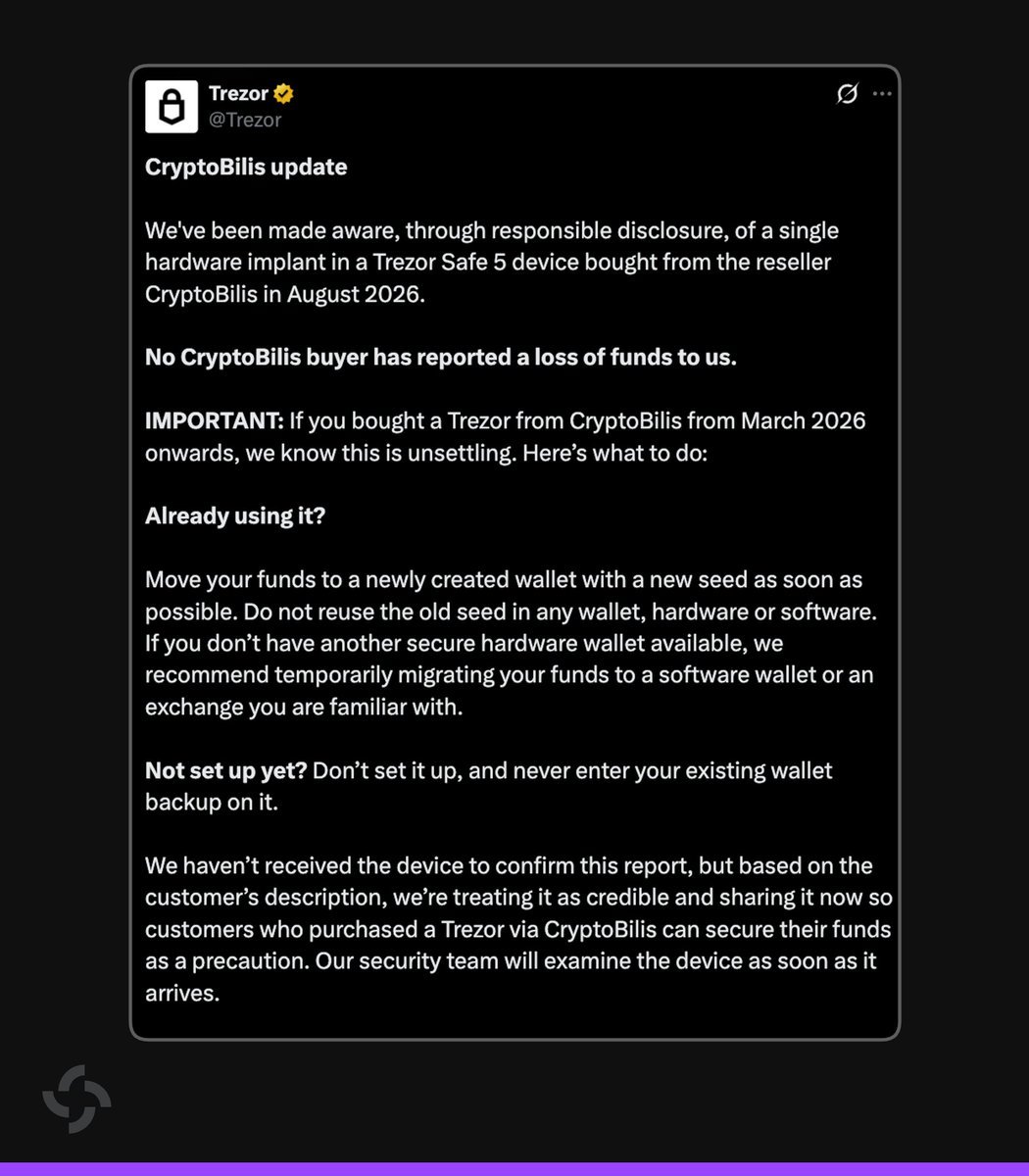
Hardware wallet manufacturer Trezor announced that it received a responsible-disclosure report alleging a hardware implant inside a Trezor Safe 5 wallet purchased from reseller CryptoBilis in August 2026. According to the disclosure, an extra circuit board with a cellular module and an antenna was installed between the main board and the display, designed to capture the screen's contents—including the wallet's recovery backup—and transmit the data over a mobile network when connected to power.[1][3][4][5]
Trezor stated that it has not yet received the affected unit in its lab for verification, but is treating the customer's report as credible while the device is in transit. The company emphasized that no CryptoBilis customer has reported losing funds from a Trezor wallet. In the meantime, Trezor has examined four other devices sourced from CryptoBilis and found no evidence of physical tampering on those units.[1][2][3][4]
The manufacturer urged anyone who purchased a Trezor device from CryptoBilis from March 2026 onward to migrate their assets to a newly created wallet with a fresh seed phrase, cautioning users never to reuse the old seed. Customers with unconfigured devices were instructed not to set them up or enter an existing wallet backup. Trezor also pledged to provide replacement units to affected buyers.[1][3][4]
Trezor previously severed ties with Malaysia-based CryptoBilis on October 9 after tampered Ledger hardware wallets distributed by the reseller were linked to more than $86 million in drained crypto assets across multiple blockchains. Trezor noted that its security team will conduct a thorough examination of the flagged Safe 5 as soon as it arrives.[1][3][4]
Key facts
- Trezor received a responsible-disclosure report alleging an unauthorized hardware implant inside a Trezor Safe 5 bought from reseller CryptoBilis in August 2026.
- The reported implant consists of an added circuit board with a cellular module and antenna designed to transmit screen data, including seed phrases, over a mobile network.
- Trezor is treating the claim as credible, although it has not yet examined the physical device in its security lab.
- No Trezor customers who purchased from CryptoBilis have reported losing funds.
- Trezor advised anyone who bought a device from CryptoBilis since March 2026 to move funds to a new wallet with a new recovery seed and to leave unconfigured units unused.
- Trezor inspected four other devices received from CryptoBilis customers and found no signs of tampering.
- Trezor removed CryptoBilis as an official reseller on October 9 following reports of tampered Ledger devices tied to an $86 million theft.
Sources · 5 sources
- PR
ProtosArticle ·
Trezor reveals Malaysian reseller sold wallet with spyware Trezor claims it has seen one of its crypto wallets sold by the official Malaysian-based reseller CryptoBilis containing a physical spyware implant. The tampered wallet was Trezor’s ‘Safe 5’ model, and was bought from CryptoBilis in August this year. Trezor told Protos that the implant involves an extra circuit board fitted between the main board and the screen, with a cellular module and an antenna. According to the user report, which Trezor has yet to thoroughly verify, the implant “reads what the screen shows, including the wallet backup, and sends it out over a mobile network whenever the device is plugged in.” This is similar to how the previous spyware device in Ledger devices functioned. Trezor says it will replace CryptoBilis-sourced wallets Trezor’s Chief Commercial Officer, Danny Sanders, claimed, “We haven’t had the device in our lab yet, but we’re treating the report as credible, and we’d rather warn people now than wait for confirmation and find out someone lost their funds in the meantime.” Buyers who purchased a wallet from CryptoBilis since March 2026 were told to move their funds out of their wallet and contact Trezor’s team, who will provide a replacement wallet. If you bought a Trezor with the reseller CryptoBilis after March 2026, move your funds to a new wallet right now. We’ve received a report of 1 device with tampering. We believe this is a credible implant and we are acting fast on it. As of now, we have no reports of lost funds. https://t.co/COWrfvFJmD — Danny (@Dantoshi) October 30, 2026 Read more: Trezor says mailing breach leaked 67K more users than first thought Trezor also told Protos that it has checked four other CryptoBilis-sourced Trezor wallets and “found no evidence of tampering.” Trezor may drop more resellers in the future Trezor dropped CryptoBilis as one of its official resellers on October 9 in the wake of an $86 million Ledger wallet hack that relied on spyware installed in CryptoBilis-sold wallets. It now claims that it is reviewing its other Asia-based resellers. Following the hack, Ledger dropped ties with official resellers across Malaysia, Indonesia, Singapore, Thailand, the Philippines, Vietnam, and Hong Kong. Ledger roasted over $849 device launch after $86M hack Read more: Trezor’s summer of hacks continues with Brevo email breach At the time of the Ledger wallet hack, Trezor claimed , “There is not a single piece of evidence that Trezor devices have been compromised.” It maintained in today’s report that “No funds have been reported as stolen.” Got a tip? Send us an email securely via Protos Leaks . For more informed news and investigations, follow us on X , Bluesky , and Google News , or subscribe to our YouTube channel. The post Trezor reveals Malaysian reseller sold wallet with spyware appeared first on Protos .
Open source - WB
Wu Blockchain@WuBlockchainPost on X ·
World’s Second-Largest Hardware Wallet Maker Trezor Warns of Suspected Hardware Implant in Device Sold by Reseller Trezor said it received a credible report of a suspected hardware implant in a Trezor Safe 5 device purchased from reseller CryptoBilis in August 2026. The company has not yet received the device for verification, and no CryptoBilis customer has reported losing funds. Trezor urged customers who purchased devices from CryptoBilis since March 2026 to move their funds to newly created wallets with new recovery seeds as soon as possible. The company removed CryptoBilis as a reseller on October 9 following reports of tampered Ledger devices. Four Trezor devices inspected so far showed no signs of tampering, and the investigation remains ongoing.
Open source - UN
UnchainedArticle ·
Trezor Treats One Report of an Implanted CryptoBilis Safe 5 as Credible Before Examining It Hardware wallet maker Trezor is treating a single customer report of a hardware implant in one of its devices as credible, even though it has not yet had the unit in hand, the company said on X on Friday. The device, a Trezor Safe 5 , was bought in August 2026 from CryptoBilis , a reseller Trezor cut ties with earlier this month. The customer flagged the device through Trezor’s responsible disclosure program. Trezor wrote that it had not received the device, but that “based on the customer’s description, we’re treating it as credible” and sharing it so buyers can secure their funds. Its security team will look at the unit once it arrives. The company also said, “No CryptoBilis buyer has reported a loss of funds to us.” Get Unchained’s crypto news in your inbox with the free Unchained Daily newsletter . What Trezor Has Checked So Far Trezor removed CryptoBilis as a reseller on Oct. 9 , following reports that tampered Ledger devices had been sold through it. Since then, Trezor has been inspecting its own devices that CryptoBilis customers sent in, and it said it “found no signs of tampering on any of the four devices we’ve received so far.” The implant described in the report is an added circuit board with a cellular module, according to a Trezor blog post . It captures what the wallet’s screen displays, including the recovery phrase, and transmits that over a mobile network once the device is plugged in. Trezor said the setup appears to work like the implants found in Ledger wallets. None of this has been confirmed by an inspection of the device. Guidance for CryptoBilis Buyers Trezor asked anyone who bought one of its wallets from CryptoBilis from March 2026 onward to move their funds to a new wallet with a fresh seed, and not to use the old seed again on any device or app. Owners without a second secure hardware wallet can temporarily hold funds on a software wallet or an exchange they know, the company said. Anyone with an unopened device should not set it up. Affected customers can keep the CryptoBilis unit and contact Trezor Support for a replacement. Trezor credited the customer and the security group SEAL 911 for their help with the response. Separately, an onchain analyst tallied more than $86 million reportedly drained from Ledger users across several blockchains, and the hardware wallet provider has said its confirmed cases all trace back to CryptoBilis . MediaMarkt Saturn pulled Ledger wallets from its shelves after a customer in Germany reported an implant. Related Listen: How to Check Your Ledger Nano X for a Spy Implant The post Trezor Treats One Report of an Implanted CryptoBilis Safe 5 as Credible Before Examining It appeared first on Unchained .
Open source - SO
SolanaFloor@SolanaFloorPost on X ·
🚨ALERT: @Trezor, the world’s second-largest hardware wallet maker, has reported a suspected hardware implant in a Safe 5 device sold by reseller CryptoBilis in August 2026. The company is urging customers who purchased devices from the reseller since March to move funds to new wallets with fresh recovery phrases. No losses have been reported.
Open source - BS
BSCN@BSCNewsPost on X ·
Trezor warns CryptoBilis buyers after a reported spy chip in one of its wallets @Trezor said a customer in Indonesia found an extra circuit board inside a Trezor Safe 5 bought from the reseller CryptoBilis in August. According to the report, the board can capture the wallet backup shown on the screen and send it out over a mobile network. Trezor is treating the claim as credible while the device is shipped to its lab. Anyone who bought a Trezor from CryptoBilis since March should move their funds to a new wallet with a new recovery phrase, and anyone who hasn't set up their device should leave it unused. Trezor dropped the reseller on October 9 after tampered @Ledger devices it sold were tied to drained funds. No CryptoBilis Trezor buyer has reported a loss so far.
Open source