

Strategy posts $21 billion Q3 gain on Bitcoin holdings and returns to profit
Strategy swung back to quarterly profitability for the first time in four quarters after booking a $21 billion unrealized gain on its digital asset holdings in the third quarter of 2026, accompanied by an estimated $4.1 billion income-tax benefit.
Strategy returned to profitability for the first time in four quarters after logging a $21 billion gain on its digital asset holdings for the three months ended Sept. 30. Quartz reported that a 43% surge in Bitcoin's price over the quarter helped end four consecutive quarters of losses, reversing an $8.3 billion loss in the second quarter and a $14.5 billion loss in the first quarter, according to Bloomberg data cited by unusual_whales.[2][3][4][6][7]
The $21 billion gain represents a fair-value mark carrying $1.88 billion in deferred tax, according to Decrypt, which also noted that Strategy purchased $29 million in Bitcoin and repurchased $176 million in STRC during the quarter. The company held a record 848,000 Bitcoin valued at approximately $73 billion, alongside $5.7 billion in U.S. dollar assets. CryptoSlate reported that Strategy disclosed an average purchase price of $75,440.70 per Bitcoin, including fees and expenses, as of Oct. 4.[5][7][8][9]
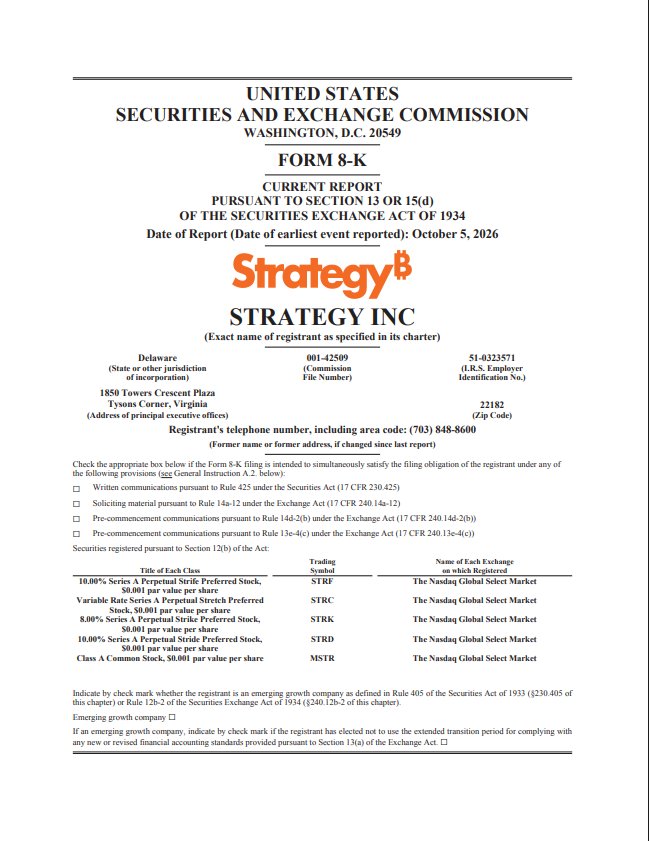
In an Oct. 5 regulatory filing, Strategy also estimated a $4.1 billion income-tax benefit because Bitcoin's fair value moved above its cost basis on Sept. 30. The company said the tax benefit stems from reversing a deferred tax asset associated with its Bitcoin holdings and releasing a valuation allowance. The accounting measure reduces reported tax expense rather than generating a cash refund, and the management-prepared figures have not been audited or reviewed by KPMG.[1][5][8]
Key facts
- Strategy reported a $21 billion gain on its digital asset holdings in Q3 2026, marking its first quarterly profit in four quarters.
- A 43% quarterly increase in Bitcoin's price erased four straight quarters of losses, following an $8.3 billion loss in Q2 and a $14.5 billion loss in Q1.
- Strategy estimated a $4.1 billion income-tax benefit in an Oct. 5 filing after Bitcoin's fair value exceeded its cost basis on Sept. 30.
- The estimated tax benefit lowers reported tax expense through the reversal of a deferred tax asset and release of a valuation allowance, without providing a cash refund.
- Strategy's tax benefit calculations were prepared by management and were not audited or reviewed by KPMG.
- Strategy held 848,000 Bitcoin worth about $73 billion, acquired at an average price of $75,440.70 as of Oct. 4, alongside $5.7 billion in USD assets.
- The Q3 gain is a fair-value mark carrying $1.88 billion in deferred tax, and Strategy purchased $29 million in BTC and repurchased $176 million in STRC during the quarter.
Sources · 9 sources
- CR
CryptoSlate@CryptoSlatePost on X ·
.@Strategy estimates a $4.1B income-tax benefit because its Bitcoin was valued above cost on Sept. 30. It lowers reported tax expense, not a cash refund. The estimate is unaudited and unreviewed by KPMG. https://t.co/NWd59zcDmz
Open source - BL
Bloomberg@businessPost on X ·
Strategy posted its first profit in four quarters as Bitcoin’s late-summer rally boosted the value of its holdings https://t.co/RK2RFafD6P
Open source - CO
CoinMarketCap@CoinMarketCapPost on X ·
ICYMI: 📊 Strategy posted a $21B Q3 2026 gain on its digital asset holdings. https://t.co/N52nyJM5X3
Open source - QU
Quartz@qzPost on X ·
Strategy swings from $8B loss to $21B bitcoin gain in one quarter A 43% bitcoin price surge in Q3 erased four straight quarters of losses for the world's largest corporate bitcoin holder — and turned an $8 billion hole into a $21 billion windfa #Strategy #Bitcoin #MicroStrategy https://t.co/zAoWKLUtvZ
Open source - SI
Solid Intel 📡@solidintel_xPost on X ·
INTEL: Strategy reports a $21 billion gain on digital assets in Q3 and now holds 848,000 bitcoin:native alongside $5.7 billion in USD assets https://t.co/kM9Hq0Ednl
Open source - EV
Evan@StockMKTNewzPost on X ·
Strategy $MSTR returned to profitability for the first time in four quarters after registering an unrealized gain from an increase in the value of its Bitcoin holdings during Q3 Strategy said it recorded a $21 billion gain on its digital assets in the three months ended September 30th - Bloomberg
Open source - UW
unusual_whales@unusual_whalesPost on X ·
Strategy, $MSTR, is profitable again, for the first time in four quarters. It booked a $21 billion unrealized gain on its Bitcoin in Q3, per Bloomberg. The swing is massive: Q1: $14.5 billion loss Q2: $8.3 billion loss Q3: $21 billion gain The company holds about 848,000 Bitcoin, worth roughly $73 billion.
Open source - CR
CryptoSlateArticle ·
Bitcoin rally delivers $4.1 billion tax windfall for Strategy Strategy estimated a $4.1 billion income-tax benefit after Bitcoin's fair value rose above cost as of Sept. 30, according to its Oct. 5 filing . The benefit comes from a lower estimated tax expense through an accounting adjustment. The filing shows what can change when Bitcoin crosses a large holder’s cost basis. The next consequence depends on the position being measured: a company’s Bitcoin holdings, an ETF’s underlying assets and an investor’s ETF shares each have their own purchase history. Strategy said it reversed a deferred tax asset related to its Bitcoin and released the associated valuation allowance. These management-prepared financial figures had neither been audited nor reviewed by KPMG . The estimated benefit concerns the company’s own tax accounts and its September valuation-allowance adjustment. The company disclosed 848,000 BTC at an average purchase price of $75,440.70, including fees and expenses, as of Oct. 4 at 4 p.m. Eastern time. That later acquisition figure has a separate cutoff from the Sept. 30 accounting comparison. Fund cost and shareholder break-even are separate An ETF acquisition estimate measures the fund’s underlying holdings. Maketo estimated the average cost of Bitcoin remaining in BlackRock’s iShares Bitcoin Trust ETF ( IBIT ) at $81,188 per BTC as of Oct. 2. Its model reconstructs underlying Bitcoin costs from daily money flows and prices. An IBIT shareholder buys shares at a market price, so investors entering on different dates can have different break-even prices, even though their shares represent interests in the same pool of Bitcoin. The fund’s estimated acquisition cost measures a different position from each shareholder’s investment. Related Reading Bitcoin could put the average ETF buyer back in losses this week BlackRock’s Oct. 5 holdings file listed about 806,038 BTC, and its fund page reported nearly $69 billion in net assets and a Bitcoin benchmark level of $85,694.41 that day. Its June 30 quarterly filing recorded 734,261 BTC with an investment cost of about $61 billion and a fair value of about $43.4 billion. That historical comparison places the same holdings below cost at the same cutoff. IBIT calculates realized gains and losses on Bitcoin disposals using average cost, and the June filing records substantial activity in both directions. During the six months ended June 30, the Trust acquired 157,501 BTC and disposed of 192,970 BTC for share redemptions. Those categories include in-kind transfers. Testing whether redemptions accelerated below cost requires daily flows, prices and cost estimates aligned to the same dates. The first-half totals leave the timing of trades relative to cost crossings, and investors’ motives, unresolved. How a shareholder exit reaches Bitcoin An investor can sell ETF shares in the secondary market. Redemption with IBIT is a separate transaction: only authorized participants can create or redeem baskets directly with the Trust. IBIT’s prospectus distinguishes cash redemptions from redemptions in Bitcoin. With a cash redemption, the Trust converts underlying Bitcoin into cash, while an in-kind redemption delivers Bitcoin. Share trading, cash redemptions and Bitcoin transfers describe different steps. The fund’s acquisition cost alone leaves those steps and the recipient’s subsequent decisions unmeasured. US spot Bitcoin ETFs recorded net outflows of $89.8 million on Oct. 5, while Farside Investors’ data show that BlackRock’s fund recorded inflows in that same session . That split captures a day of different flow directions across funds. Establishing whether cost-basis crossings influence those decisions requires comparing flows before and after the crossings over a longer period. Crossing cost changes the gain-or-loss comparison on the underlying position, and Strategy’s filing demonstrates a material tax-accounting consequence. Actual creations, redemptions, and the handling of redeemed Bitcoin are the next signals to watch for market impact. A shared price level, on its own, leaves the identity and motivation of the next buyer or seller unresolved. The post Bitcoin rally delivers $4.1 billion tax windfall for Strategy appeared first on CryptoSlate .
Open source - DE
DecryptArticle ·
Strategy Posts $21B Q3 Gain, Buys $29M in BTC, Repurchases $176M in STRC The firm's Bitcoin holdings hit a record 848,000 BTC, while the quarterly gain is a fair-value mark carrying $1.88 billion in deferred tax.
Open source