

Senate probe finds Iran relies heavily on Tether's USDT to bypass sanctions
A U.S. Senate investigation led by Senator Richard Blumenthal found that 84% of examined Iran-linked sanctioned crypto wallets transacted predominantly in Tether's USDT, prompting calls for federal enforcement probes.
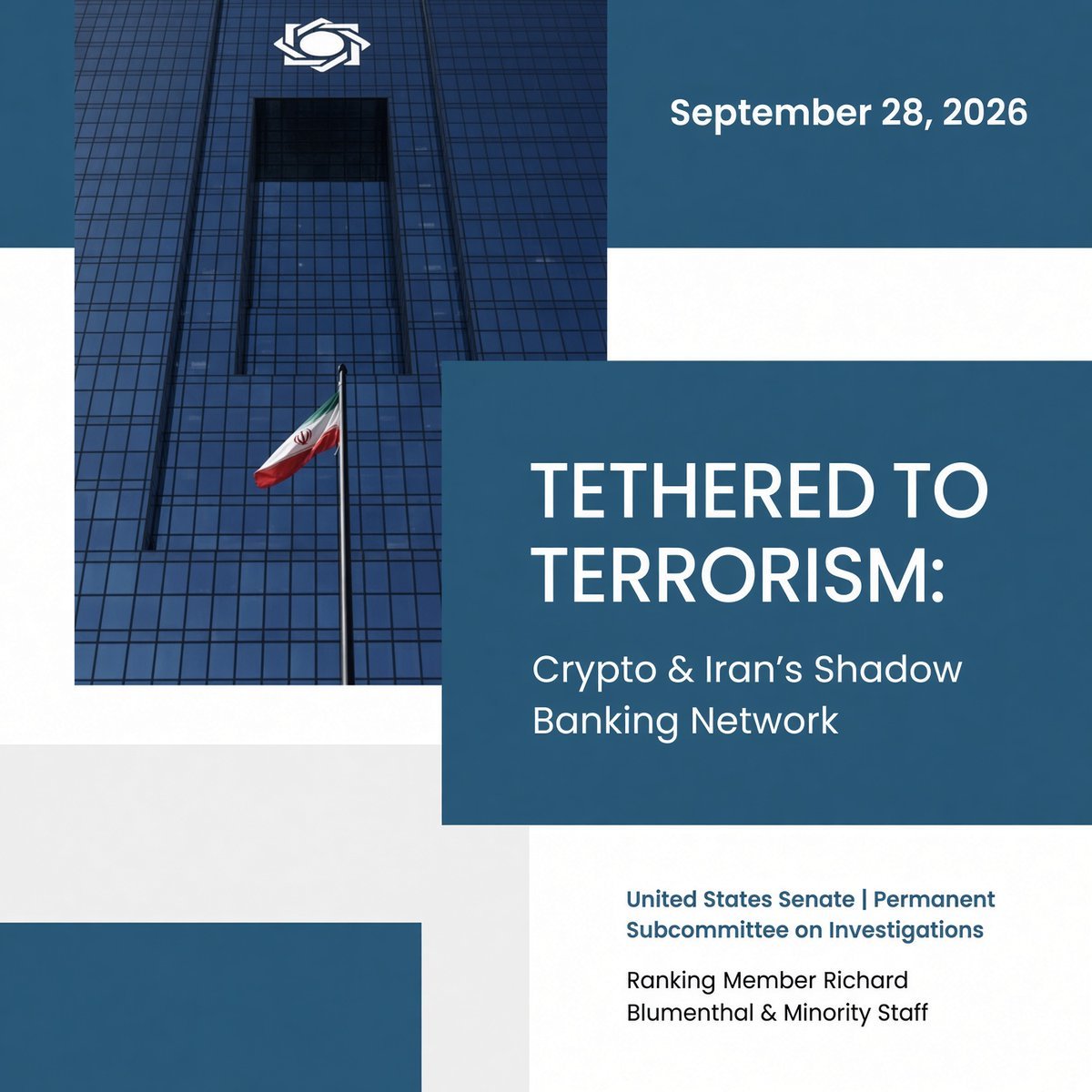
Iranian financial networks and regional proxy groups rely on Tether's USDT stablecoin more than any other digital asset to circumvent international sanctions, according to a report released by Democratic staff of the Senate Permanent Subcommittee on Investigations. Ranking member Richard Blumenthal called the stablecoin a superhighway for sanctions evasion and urged the Department of Justice and the Treasury Department to immediately open an investigation into Tether's anti-money laundering and sanctions compliance.[2][4][5]
Senate investigators analyzed transaction data across 846 wallets sanctioned or targeted for seizure by the U.S. Treasury's Office of Foreign Assets Control and Israel's counter-terror financing bureau over links to Iran, Hezbollah, Hamas, and the Houthis. The report found that 84% of these wallets transacted exclusively or almost exclusively in USDT, including 87% of the 757 Israeli-designated wallets and 57% of OFAC's 101 listed addresses. Investigators also criticized Tether's enforcement actions as uneven, alleging that delayed freezes permitted more than $34.6 million in USDT to leave 34 Hezbollah-linked wallets between June 2023 and March 2024.[2][1]
Blumenthal set an Oct. 9 deadline for Treasury Secretary Scott Bessent and Attorney General Todd Blanche to clarify whether earlier federal inquiries into Tether were altered, paused, or closed. Tether pushed back against the characterizations, releasing figures showing it supported freezing roughly $550 million in Iran-linked USDT this year. Tether CEO Paolo Ardoino stated that the stablecoin is not a haven for illicit organizations and reiterated the company's ongoing cooperation with law enforcement agencies.[2][3][5]
Key facts
- A Senate Permanent Subcommittee on Investigations staff report found that 84% of 846 examined sanctioned wallets linked to Iran transacted exclusively or nearly exclusively in USDT.
- Senator Richard Blumenthal referred the report's findings to the Treasury Department and Justice Department, calling for immediate investigations into Tether.
- The examined addresses included 757 wallets designated by Israel and 101 designated by the U.S. Office of Foreign Assets Control.
- The report found that more than $34.6 million in USDT exited 34 Hezbollah-linked wallets before Tether froze them in March 2024.
- Blumenthal asked federal agencies to report by Oct. 9 whether earlier investigations into Tether had been narrowed, paused, or closed.
- Tether stated that freezes it supported this year have locked up around $550 million in Iran-linked USDT.
Sources · 5 sources
- CB
Coin Bureau@coinbureauPost on X ·
🇺🇸🇮🇷BREAKING: US Senate investigation finds Tether’s USDT is the primary tool for Iran’s SHADOW BANKING system, prompting calls for an immediate federal probe. A report led by Senator Richard Blumenthal examined 846 wallets sanctioned over Iran ties and found 84% transacted exclusively or almost exclusively in USDT. Investigators accuse Tether of failing to quickly freeze sanctioned wallets. Blumenthal is calling on Treasury and the Justice Department to investigate potential sanctions violations. Tether says it is committed to fighting illicit finance and has supported$550 MILLION in Iran-linked asset freezes this year.
Open source - UN
UnchainedArticle ·
Sen. Blumenthal Urges Treasury and DOJ to Investigate Tether Over Iran’s Use of USDT Iran and its regional proxies rely on Tether’s USDT more than any other cryptocurrency to move money around sanctions, according to a report released Monday by Democratic staff of the Senate Permanent Subcommittee on Investigations . The staff, who work for ranking member Richard Blumenthal of Connecticut, analyzed the transactions of 846 wallets that the U.S. Treasury’s Office of Foreign Assets Control (OFAC) and Israel’s counter-terror financing bureau have sanctioned or targeted for seizure over links to Iran, Hamas, Hezbollah and the Houthis. The report says 84% of them “have transacted exclusively, or nearly exclusively, in USDT.” The staff describe their findings as preliminary. The share was 87% for the 757 wallets on Israel’s list and 57% for the 101 on OFAC’s, counting a wallet when more than 80% of its dollar volume was in USDT. Bitcoin came a distant second on both. Blumenthal asked Treasury Secretary Scott Bessent and Attorney General Todd Blanche to investigate Tether’s anti-money laundering and sanctions compliance, and to tell the subcommittee by Oct. 9 whether either department narrowed, paused or closed any earlier inquiry into the company. The letters cite reports that Manhattan federal prosecutors opened a Tether investigation in October 2024 and that Treasury weighed sanctioning the company. They also say Cantor Fitzgerald owns 5% of Tether and that the firm “until recently was run by Commerce Secretary Howard Lutnick” before his children took control. Get Unchained’s crypto news in your inbox with the free Unchained Daily newsletter . Report Cites Freeze Delays As the issuer, Tether can blacklist a USDT wallet so its funds can’t move. The report says Tether didn’t appear to freeze any wallets Israel designated from 2021 to May 2023, and the staff wrote in the report that its freezing since then has been “uneven and inconsistent.” In June 2023, Israel designated 39 wallets tied to Tawfiq Muhammad Sa’id Al-Law, whom the report calls a Hezbollah money launderer. Tether froze just five and did not freeze the other 34 until March 2024 , shortly before OFAC also sanctioned Al-Law, according to the report. More than $34.6 million in USDT left those wallets in between, the staff found . The report also faults Tether for not acting on its own against wallets not named in any sanctions or seizure notice, including Central Bank of Iran wallets that sanctioned Iranian financier Babak Zanjani posted on X in December 2025. Tether confirmed receiving the subcommittee’s June request for documents but has not responded, the report says. Tether Cites $550 Million in Freezes Tether published a release Monday morning saying freezes it supported this year have locked up about $550 million in Iran-linked USDT. It also says it has frozen more than 22 million USDT across more than 640 addresses in cases referred by Israel’s counter-terror financing bureau. The release did not mention the report. “Tether has consistently demonstrated that USD₮ is not a haven for sanctioned actors, terrorist organizations or criminal networks,” CEO Paolo Ardoino said in the release. The report comes a month after Treasury named digital assets a sanctionable sector of Iran’s economy. Related Listen: Why the Crypto Market Cap Could Reach $50 Trillion This Cycle The post Sen. Blumenthal Urges Treasury and DOJ to Investigate Tether Over Iran’s Use of USDT appeared first on Unchained .
Open source - TM
That Martini Guy ₿@MartiniGuyYTPost on X ·
U.S. Senate Democrats say USDT has become a “significant financial lifeline” for Iran Democrats allege it is helping the country move money around U.S. sanctions following an investigation in which: - 846 sanctioned Iran-linked crypto wallets were tracked - 84% had transacted in USDT, including networks linked to Iran’s government and proxy groups such as Hezbollah Tether has pushed back, saying it actively cooperates with U.S. authorities
Open source - DE
DecryptArticle ·
US Senator Blumenthal Calls Tether's USDT a 'Superhighway' for Iranian Sanctions Evasion The Connecticut Senator's subcommittee released its report on Monday and referred the findings to Treasury and the Justice Department.
Open source - TB
The Block@TheBlockCoPost on X ·
THE BLOCK: Tether and its $USDT stablecoin "have become central to Iran’s shadow banking system," the top Democrat on the Senate Permanent Subcommittee on Investigations, Richard Blumenthal, said in a report released on Monday. "The Trump Administration’s glaring lack of oversight of cryptocurrency issuers has undermined our own national security interests," Blumenthal said. "That is why I am calling on the Department of Treasury and Justice to immediately investigate Tether and hold it accountable for these potential sanctions violations." On Monday, Tether said it is committed to blocking illicit finance, and said it had frozen hundreds of millions of dollars over the past year in wallets connected to Iranian entities.
Open source