

OpenAI announces AI discoveries across math, computer science, and physics
OpenAI claims its artificial intelligence models have produced three major scientific findings, including a disproof of the longstanding Exponential Time Hypothesis.
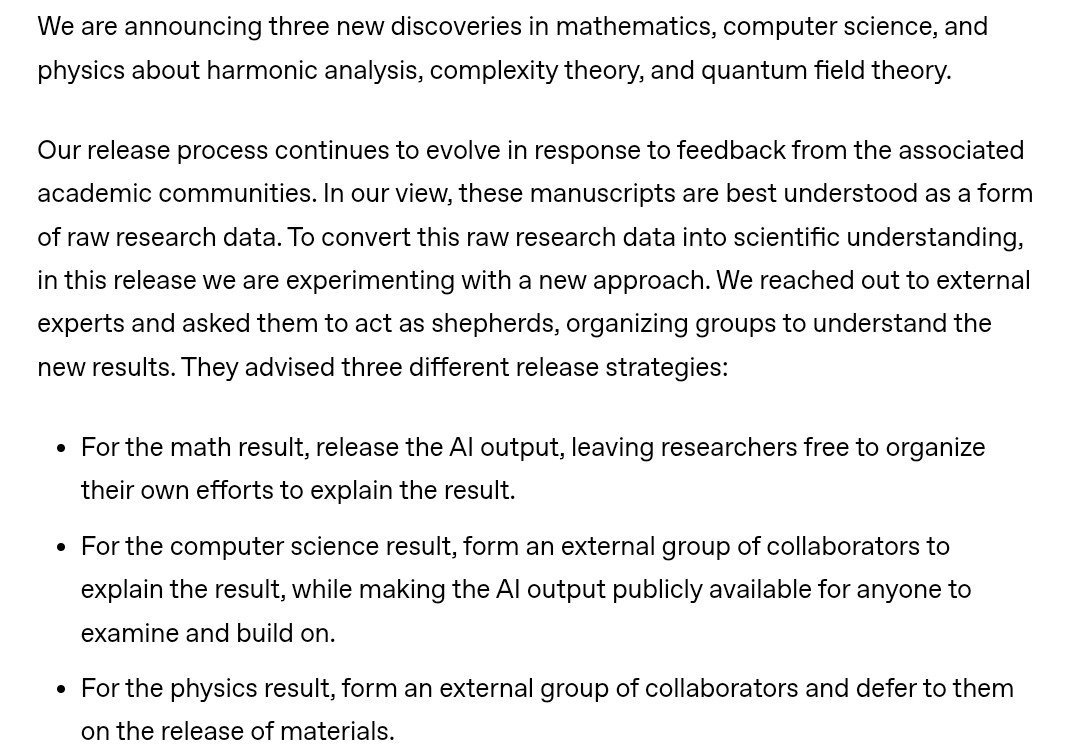
OpenAI announced three major AI-driven discoveries spanning mathematics, computer science, and physics, focusing on harmonic analysis, complexity theory, and quantum field theory. The company framed the releases as an evolving experiment in publishing scientific work, relying on external academic experts to help interpret and shepherd the findings.[2][4][5][1]
In computer science, OpenAI claims its models refuted the Exponential Time Hypothesis, a core complexity theory assumption postulating that solving problems such as 3-SAT requires exponential time. According to Coin Bureau, the AI developed an algorithm solving such problems faster than the hypothesis allows. The disproof was generated on Oct. 16 and verified the following day using the formal proof checker Lean. OpenAI published the paper and Lean verification files on GitHub, while hypothesis co-proposers Russell Impagliazzo and Ramamohan Paturi will lead an evaluation group alongside MIT's Ryan Williams. OpenAI noted that translating the theoretical result into faster real-world algorithms will require substantial further research.[3][7]
The company also unveiled results in mathematics and physics. In math, OpenAI said its models resolved the local smoothing and Kakeya conjectures in all dimensions, following a human proof of the three-dimensional version just last year. In physics, OpenAI reported a proof regarding the existence of quantum chromodynamics and completions of the Standard Model, addressing components tied to the Millennium Prize problems. While the math output was released publicly for researchers to examine, the physics findings remain unreleased pending review by an external group led by Nobel laureate David Gross.[3][5][6]
Key facts
- OpenAI announced three scientific discoveries covering harmonic analysis in mathematics, complexity theory in computer science, and quantum field theory in physics.
- OpenAI published a paper and GitHub repository asserting that the Exponential Time Hypothesis is false based on a faster algorithm for counting satisfying assignments.
- The Exponential Time Hypothesis disproof was discovered on Oct. 16 and checked by the Lean proof assistant on Oct. 17.
- Hypothesis co-proposers Russell Impagliazzo and Ramamohan Paturi are leading a verification effort with MIT's Ryan Williams.
- OpenAI claimed its models resolved the local smoothing and Kakeya conjectures across every dimension.
- A physics finding addressing the existence of quantum chromodynamics and Standard Model completions is being evaluated by a group led by Nobel laureate David Gross and has not yet been released.
Sources · 7 sources
- GI
Gizmodo@GizmodoPost on X ·
OpenAI Trumpets 3 More Math and Science Results, Along With a New Plan for Publishing Them https://t.co/NlG7ClyFME
Open source - TE
TechmemeArticle ·
OpenAI announces three breakthroughs in computer science, math, and physics, including that the Exponential Time Hypothesis, a longstanding conjecture, is false (OpenAI) OpenAI : OpenAI announces three breakthroughs in computer science, math, and physics, including that the Exponential Time Hypothesis, a longstanding conjecture, is false — We are announcing three new discoveries in mathematics, computer science, and physics about harmonic analysis, complexity theory, and quantum field theory.
Open source - CB
Coin Bureau@coinbureauPost on X ·
OpenAI says its AI has disproved ETH, and no, not Ethereum. ETH here is short for the Exponential Time Hypothesis, a decades-old computer science assumption. It says some hard computing problems will always take exponentially longer to solve as they grow. OpenAI says the hypothesis was widely believed to be true and has been used in hundreds of research papers. But its AI came up with an algorithm that solves these problems faster than the hypothesis allowed. The AI found the disproof on October 16, and Lean, a program that checks math proofs, verified the result a day later. OpenAI has published the proof and its Lean check on GitHub. Russell Impagliazzo and Ramamohan Paturi, two of the scientists who first proposed the hypothesis, will lead a group with MIT's Ryan Williams to verify the work. OpenAI says turning the result into faster real-world algorithms "will require significant further research." The company also announced two more AI discoveries. In math, OpenAI says its models resolved the Kakeya conjecture in every dimension. Mathematicians only proved the 3D version last year. In physics, OpenAI says its AI produced a proof covering part of one of math's $1 million Millennium Prize problems. A group led by Nobel Prize winner David Gross will study that work, which hasn't been released yet. Would you trust a proof written by AI before humans check it?
Open source - MT
MTS@MTSlivePost on X ·
SITUATION DETECTED: OpenAI has announced three new discoveries in mathematics, computer science, and physics about harmonic analysis, complexity theory, and quantum field theory.
Open source - AC
Andrew Curran@AndrewCurran_Post on X ·
OpenAI has announced to three new discoveries in mathematics, computer science, and physics: - Local smoothing and the Kakeya conjecture - The Exponential Time Hypothesis is false - Existence of quantum chromodynamics and completions of the Standard Model https://t.co/FIgVlNIEyY
Open source - CB
Crypto BriefingArticle ·
OpenAI says its models proved the local smoothing conjecture in every dimension AI's role in proving complex mathematical conjectures could revolutionize mathematical research, enhancing collaboration and verification. The post OpenAI says its models proved the local smoothing conjecture in every dimension appeared first on Crypto Briefing .
Open source - R�
RuntimeWire 🏴☠️@runtimewirePost on X ·
RuntimeWire LIVE: OpenAI says its AI disproved a core complexity hypothesis and posts the proof https://t.co/j21Las9DkE
Open source