

Ethereum activates Glamsterdam upgrade on Sepolia testnet with 200M gas limit
Ethereum's Glamsterdam upgrade has activated on the Sepolia testnet, testing a gas limit increase to 200 million following a last-minute software patch by validator client Prysm.
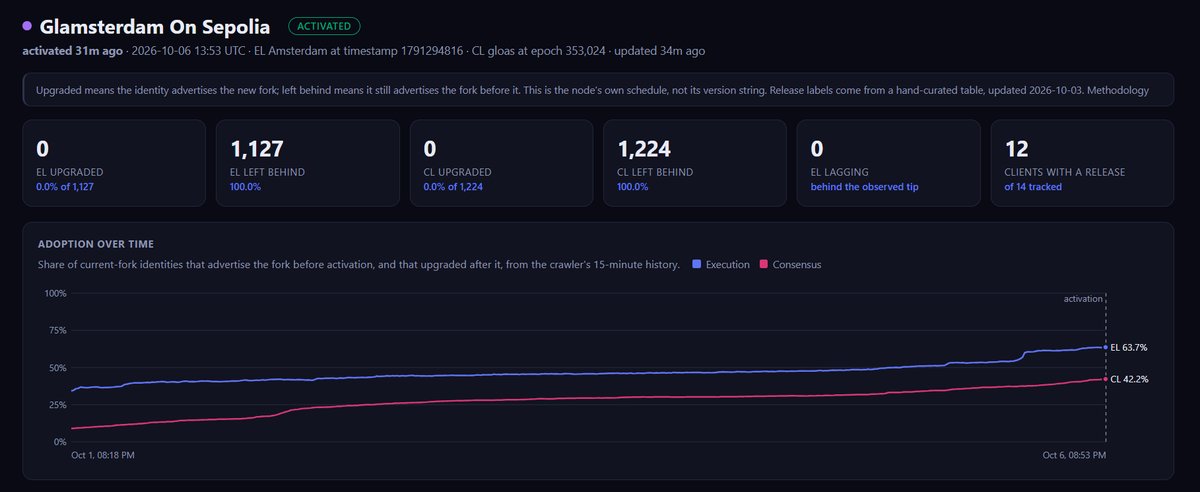
Ethereum's Glamsterdam upgrade activated on the Sepolia testnet on Oct. 6, 2026, launching a major public testing phase designed to evaluate whether network validators and clients can safely handle larger transaction blocks. The upgrade tests a gas limit increase from 60 million to 200 million gas, alongside architectural changes including parallel transaction execution and decoupled block-and-payload processing. Glamsterdam is intended to serve as a rehearsal ahead of testing on the Hoodi testnet and eventually Ethereum mainnet.[1][4][5][6][9]
Ahead of the fork, validator client maintainers coordinated software updates to support the increased block capacity. Offchain Labs, the team behind consensus client Prysm, released version 7.2.1 on Monday to default validators to the 200 million gas limit automatically once the upgrade activated. According to the Ethereum Foundation, another consensus client, Teku version 26.9.1, retained a 60 million gas default post-activation, requiring operators to configure the higher capacity setting manually.[1][2][3][7]
The testnet reached the 200 million gas target within 8 to 11 hours after the fork, according to reports by Bankless and Ethereum Foundation researcher nero_eth. Performance metrics shared by nero_eth showed execution times for a 40 million-gas block on the Geth client drop from approximately 115 milliseconds to 30 milliseconds under the upgrade's parallel execution setup.[4][8]
Key facts
- Ethereum's Glamsterdam upgrade went live on the Sepolia testnet at epoch 353,024 on Oct. 6, 2026.
- Offchain Labs released Prysm version 7.2.1 hours ahead of the fork to automatically raise validators' default gas limit from 60 million to 200 million.
- Teku version 26.9.1 retained a default 60 million gas limit after activation, requiring operators to configure the 200 million limit manually.
- Sepolia hit the 200 million gas target within 8 to 11 hours following the activation.
- Ethereum Foundation researcher nero_eth reported that execution time for a 40 million-gas block on Geth fell from roughly 115 milliseconds to 30 milliseconds.
- Glamsterdam will be deployed to the Hoodi testnet next before any mainnet activation dates are set.
Sources · 9 sources
- UN
UnchainedArticle ·
Ethereum Client Prysm Ships 200M Gas Limit Fix Hours Before Glamsterdam Test Offchain Labs , which maintains the Prysm Ethereum consensus client, released version 7.2.1 on Monday, hours before the Glamsterdam upgrade goes live on the Sepolia testnet. With the update, Prysm validators default to a 200 million gas limit once the fork activates, rather than the 60 million the prior release used unless operators set a higher number themselves. Glamsterdam is scheduled to activate on Sepolia at epoch 353,024, or 13:53:36 UTC on Oct. 6 , according to the Ethereum Foundation’s testnet announcement . Sepolia is a test network where developers try out protocol changes before they reach mainnet. Its shared configuration was updated on Sept. 24 to lift the gas limit to 200 million at the fork. Get Unchained’s crypto news in your inbox with the free Unchained Daily newsletter . A Late Config Change That schedule, set under EIP-8261 , arrived after Prysm had already cut v7.2.0, the version the foundation listed as Sepolia-ready. Validators on v7.2.0 would “default to a 60M gas limit in their Gloas proposer preferences,” its release notes warned, and anyone who wanted 200 million had to configure it manually. The team said a follow-up release would carry the schedule. Version 7.2.1 is that release. For validators running it, the higher limit “needs no action,” per the notes. Operators who still set a gas limit flag from older setups will override the 200 million schedule, though, and the client now warns them about it at startup. Gas is how Ethereum measures the computing work a block can hold. A higher limit makes room for more transactions per block but puts more load on the machines running nodes. At 200 million, Sepolia’s limit will be more than three times the old 60 million default. The release also switches on partial data columns by default, so nodes can trade individual cells of blob data instead of entire columns, and patches a bug in how Prysm builds the first post-fork block in some cases. Teku Still Defaults to 60M Prysm was one of two consensus clients the foundation flagged for the lower default. The foundation said in the same announcement that Teku 26.9.1 “defaults to a 60M gas limit after activation” and that Teku validators who want 200 million must set it with a command-line flag. As of Tuesday morning, 26.9.1 was still Teku’s newest release on GitHub. Glamsterdam bundles two sets of changes, Gloas on the consensus side and Amsterdam on the execution side. Most notable are enshrined proposer-builder separation (ePBS), which writes the handoff between validators and block builders into the protocol, and block-level access lists, which let nodes process transactions in parallel. Vitalik Buterin has argued that ePBS alone does not stop a small group of builders from gaining outsized power. “Hoodi and mainnet activation dates have not yet been decided,” the foundation said. Related Listen: The Chopping Block: Bitget’s 388 Million Dollar Hack, Kalshi’s Cooked Perps Volume, and Agentic Bank Runs The post Ethereum Client Prysm Ships 200M Gas Limit Fix Hours Before Glamsterdam Test appeared first on Unchained .
Open source - TB
The Block@TheBlockCoPost on X ·
THE BLOCK: Ethereum's Glamsterdam upgrade is set to activate on the Sepolia testnet later Tuesday, with its gas limit scheduled to rise from 60 million to 200 million. Prysm released a last-minute update to automatically apply the higher gas limit for validators. https://t.co/bs3ZP1Ws4N
Open source - LS
Laura Shin@laurashinPost on X ·
Ethereum's Glamsterdam upgrade hits Sepolia at 13:53 UTC on Oct. 6 with a 200 million gas limit. Prysm patched its default on Monday; the Ethereum Foundation says Teku 26.9.1 still "defaults to a 60M gas limit after activation." https://t.co/WcTIFeFOAS
Open source - CB
Crypto Banter@crypto_banterPost on X ·
🚨ETHEREUM JUST GOT MUCH FASTER ON TESTNET! @nero_eth at the Ethereum Foundation says Sepolia activated Glamsterdam yesterday. The gas limit jumped from 60 million to 200 million in about eight hours. A 40 million-gas block that took Geth about 115 milliseconds now takes about 30. The block and the payload are split, and clients can execute in parallel. The Hoodi testnet is next, then mainnet.
Open source - CB
Crypto Briefing@Crypto_BriefingPost on X ·
🔥NEW: Glamsterdam is officially live on Ethereum's Sepolia testnet https://t.co/jvGwdeg1MB
Open source - CT
Coin TelegraphArticle ·
Ethereum’s Glamsterdam upgrade launches on Sepolia testnet Sepolia marks one of the final major rehearsals before the final activation of Glamsterdam, aimed at bringing more efficiency and scalability to the Ethereum mainnet.
Open source - CO
CoinDesk@CoinDeskPost on X ·
JUST IN: A key $ETH validator client pushed a last-minute patch hours before Sepolia's Glamsterdam test, which will raise the block gas limit to 200 million. The fix clears the way for one of Ethereum's largest-ever capacity increases on a live test network. https://t.co/hkGStZrJaB
Open source - BA
BanklessArticle ·
Bigger Blocks Are Coming to Ethereum Sepolia's gas limit hit Glamsterdam's 200M target just 11 hours after the fork. Here's how Ethereum's next upgrade makes room for much bigger blocks.
Open source - BS
BSCN@BSCNewsPost on X ·
Ethereum Could Soon Get Much More Powerful... Ethereum’s Glamsterdam upgrade activated on Sepolia on Oct. 6 for a major public network test. The upgrade raises the testnet gas limit to 200 million, above the previous 60 million level. Developers will monitor whether validators and clients can safely handle larger blocks. Glamsterdam also tests changes to block production, parallel processing, and gas pricing. Ethereum is expected to use these results before moving Glamsterdam to Hoodi.
Open source