

Ethereum Foundation and Open Anonymity Project launch zkAPI on mainnet
The Ethereum Foundation and the Open Anonymity Project have deployed zkAPI on Ethereum mainnet, allowing users to privately pay for AI models and metered APIs with zero-knowledge proofs.
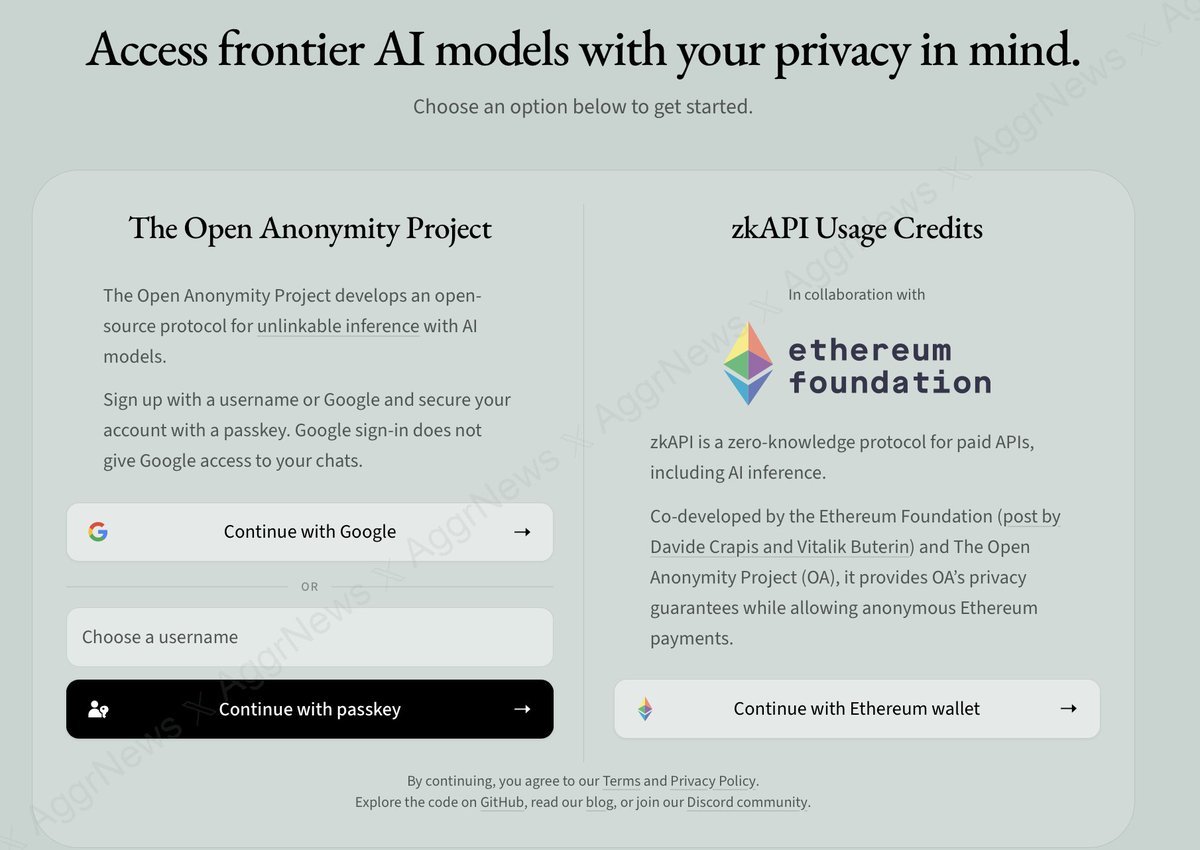
The Ethereum Foundation's dAI team and the Open Anonymity Project have launched zkAPI on Ethereum mainnet, according to a report by Unchained. The tool enables users to pay for artificial intelligence inference and other metered digital services without allowing API providers to link individual requests back to a payer's wallet or financial identity.[2][1]
To access services through zkAPI, users make a single deposit of cryptocurrency such as ETH or USDC into an Ethereum vault contract, and the balance is held as a private note on the user's local device. When paying for access, software on the user's machine produces a zero-knowledge proof showing that an unspent note covers the expense without revealing which specific note was used. A zkAPI server validates the proof and grants a short-lived API key with a spending cap. Once the key expires, the balance is charged for actual usage, meaning the server handling funds never views prompt contents and the API provider never learns the payer's identity.[2][5]
The code repository classifies the protocol as experimental. zkAPI implements a framework co-authored by foundation AI lead Davide Crapis and Ethereum co-founder Vitalik Buterin, which was published on the Ethereum Research forum in February. The foundation cautioned that zkAPI does not supply network anonymity, meaning providers can still inspect request content and metadata like IP addresses, though users retain the ability to withdraw remaining balances onchain if all zkAPI servers go offline.[2][1][4]
Key facts
- The Ethereum Foundation's dAI team and the Open Anonymity Project launched zkAPI on Ethereum mainnet.
- zkAPI allows users to prepay using ETH or USDC deposits into an onchain vault contract.
- Spending is authorized using zero-knowledge proofs to issue temporary, capped API keys without identifying the payer's balance.
- The underlying protocol design was co-authored by Vitalik Buterin and Davide Crapis on Ethereum Research in February.
- The Ethereum Foundation noted zkAPI does not hide IP addresses or prompt contents from AI providers.
- Users can withdraw unspent funds onchain even if all zkAPI servers go offline.
Sources · 5 sources
- TB
The Block@TheBlockCoPost on X ·
THE BLOCK: The Ethereum Foundation launched zkAPI on mainnet, based on a design co-authored by Vitalik Buterin. It lets users pay for AI and other APIs from prepaid $ETH or $USDC using zero-knowledge proofs, so providers can't link requests to who paid. https://t.co/rugWtnIJdy
Open source - UN
UnchainedArticle ·
Ethereum Foundation Launches Privacy Tool That Cuts the Link Between AI Prompts and Payers The Ethereum Foundation has launched zkAPI , a system for paying for AI models and other metered online services without that usage being traced back to the payer. The foundation’s dAI team announced the tool on Thursday, saying it was built with the Open Anonymity Project and is running on Ethereum mainnet . The project’s code repository describes the protocol as “experimental.” Reaching an AI model through an API today typically means holding a key tied to an account and a payment method, which lets the provider connect every prompt to one person over time. “Prompts are personal. People ask AI models about their health, their finances, their doubts,” the foundation wrote. Get Unchained’s crypto news in your inbox with the free Unchained Daily newsletter . How It Works Users make a single deposit of crypto, such as ETH or USDC, into a vault contract on Ethereum. That balance then sits as a private note on the user’s device. To spend, software on the user’s machine generates a zero-knowledge proof showing that some funded, unspent note covers the cost, without revealing which one. A zkAPI server checks the proof and issues a temporary API key with a dollar cap. Prompts then travel straight from the device to the AI provider with that key, and the private balance is charged for actual usage once the key expires. “The server that handles money never sees content, and the provider that sees content never learns the billing identity behind a key,” the post said. Each spend also publishes a one-time identifier that exposes any attempt to reuse a balance. Users can withdraw leftover funds onchain even if every zkAPI server goes offline, the foundation said. The client mimics the standard OpenAI and Ollama interfaces locally, so existing apps can plug in. Open Anonymity has also added zkAPI as a payment option in its OA chat app. What It Doesn’t Hide The foundation said zkAPI does not provide network anonymity. AI providers can still read what a request contains and see metadata such as a user’s IP address, and the post pointed users who want more protection to Tor. Repeated personal details or writing style in prompts can also let a provider re-link separate sessions. zkAPI implements a design that Davide Crapis, who leads the foundation’s AI team, and co-founder Vitalik Buterin posted to the Ethereum Research forum in February. The launch comes nearly a year after the foundation set up a Privacy Cluster to coordinate privacy work across the network. “It’s like a generalization of OA unlinkable inference that also abstracts payments away,” Ken Liu of the Open Anonymity Project wrote on X. Crapis said in a post that the team has “more things coming out to enhance user sovereignty and privacy in the age of AI.” Related Listen: Zcash, Ethereum, Aztec, Canton and More: Which Chain Will Win the Privacy Race? The post Ethereum Foundation Launches Privacy Tool That Cuts the Link Between AI Prompts and Payers appeared first on Unchained .
Open source - CO
Cointelegraph@CointelegraphPost on X ·
🚨 TODAY: Ethereum Foundation and the Open Anonymity Project introduce zkAPI, letting users pay for AI and other metered APIs privately using zero-knowledge proofs, now live on Ethereum mainnet. https://t.co/qKx3icZaJY
Open source - LS
Laura Shin@laurashinPost on X ·
zkAPI is live on Ethereum mainnet. Users fund a vault once, prove they can pay without revealing which deposit is theirs, and get a short-lived, capped API key. The Ethereum Foundation says it does not hide IP addresses or what's in a prompt. https://t.co/SRgWinEhh4
Open source - TB
The BlockArticle ·
Ethereum Foundation launches zkAPI to let users pay for AI models without revealing identity Users deposit funds into an Ethereum vault and authorize spending with zero-knowledge proofs, so the API provider can't link requests to a payer.
Open source