

Chainalysis reports China crypto activity reached $176 billion led by P2P stablecoin transfers
Crypto activity linked to China reached at least $176 billion in the year through June 2026, driven by a 43-fold surge in peer-to-peer stablecoin wallets and high transaction turnover.
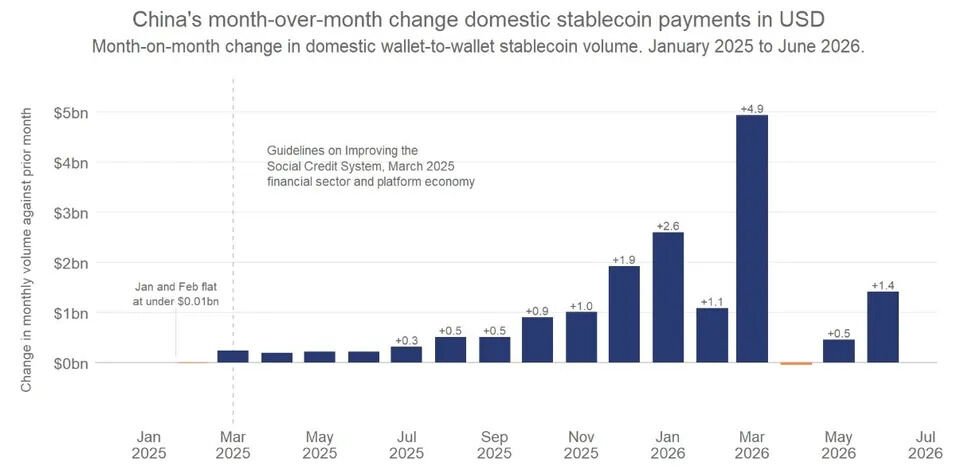
Cryptocurrency activity linked to China reached at least $176 billion during the 12 months through June 2026, driven largely by domestic peer-to-peer stablecoin payments despite longstanding digital asset restrictions, according to blockchain analytics firm Chainalysis. Direct P2P transfers accounted for 59.1% of the country's crypto activity—a proportion 3.5 times higher than in the previous period—diverging sharply from most major regional markets where centralized exchanges handle the majority of user volume.[4][5][6]
Between the first quarter of 2024 and the second quarter of 2026, unique wallets sending direct P2P stablecoin transactions in China grew 43-fold. Domestic payment activity accelerated beginning around March 2025 and expanded across 13 consecutive month-over-month periods, with monthly additions to volume rising from roughly $240 million to almost $5 billion a year later. The surge was concentrated in retail and small-business amounts: transfers under $100 rose 996%, transactions between $100 and $1,000 grew 1,057%, and payments between $1,000 and $10,000 jumped 1,321%.[1][2][3][4]
China-attributed wallets held an average of $3.1 billion in stablecoins during the 12-month period while transferring $104.1 billion across 18.1 million transactions. That resulted in an annual turnover rate of 33.2 times for self-custodied holdings, more than triple the 9.3 global benchmark. Chainalysis raised the possibility that China's March 2025 expansion of social-credit guidelines into the financial sector and internet platforms spurred users toward alternative rails, though it emphasized this as an unproven working hypothesis because on-chain data cannot reveal individual intent.[1][3][4][5]
Key facts
- Chainalysis estimates China-linked crypto activity totaled at least $176 billion in the 12 months through June 2026, ranking fourth in East Asia behind South Korea, Japan, and Hong Kong.
- Domestic peer-to-peer transfers accounted for 59.1% of China's crypto activity, a share 3.5 times higher than the previous period.
- Unique wallets executing P2P stablecoin transfers in China grew 43-fold between Q1 2024 and Q2 2026.
- China-attributed wallets held an average of $3.1 billion in stablecoins while moving $104.1 billion across 18.1 million transactions.
- Annual turnover of self-custodied stablecoin holdings in China reached 33.2 times, compared to a global benchmark of 9.3 times.
- Monthly new domestic stablecoin transaction volume increased from roughly $240 million in March 2025 to almost $5 billion a year later.
- Chainalysis treats a potential link to China's March 2025 social-credit system expansion as a working hypothesis, noting blockchain data cannot prove why users chose crypto payment rails.
Sources · 6 sources
- CN
crypto.news@cryptodotnewsPost on X ·
JUST IN: China’s P2P stablecoin activity surges despite crypto restrictions The number of wallets sending stablecoins directly to each other grew 43x from Q1 2024 to Q2 2026, with $104.1B moved across 18.1M transfers. https://t.co/qVbBrSxueA
Open source - CT
Coin TelegraphArticle ·
China P2P stablecoin wallets grew 43x despite crypto restrictions: Chainalysis Unique wallets sending P2P stablecoin transactions in China grew 43-fold between Q1 2024 and Q2 2026 as crypto activity increasingly shifted toward direct wallet-to-wallet transfers.
Open source - CO
Cointelegraph@CointelegraphPost on X ·
🇨🇳 UPDATE: China’s P2P stablecoin wallets surged 43-fold despite crypto restrictions, with $104.1 billion in annual transfers, Chainalysis reports. https://t.co/FsB1hAr3Mi
Open source - CR
CryptoSlateArticle ·
China’s crypto ban Is failing to stop a $176 billion P2P economy China’s underground crypto economy is increasingly shifting toward peer-to-peer stablecoin payments despite Beijing’s longstanding restrictions on digital assets. Chainalysis estimates China generated at least $176 billion of crypto activity during the 12 months through June 2026, with 59.1% occurring through domestic peer-to-peer transfers rather than exchanges and other centralized platforms. That share was 3.5 times higher than in the previous period, marking an unusual divergence from most major crypto markets, where exchanges remain the primary entry and exit point for users. Stablecoins dominate local activity in China The shift has been particularly pronounced in stablecoins. Chainalysis said domestic stablecoin payment activity began accelerating around March 2025 and continued expanding for 13 consecutive month-over-month periods, suggesting a gradual migration toward wallet-to-wallet settlement inside the country. The amount of new activity added each month rose from roughly $240 million in March 2025 to almost $5 billion about a year later. Growth was also concentrated across transaction sizes consistent with individuals and smaller businesses rather than solely large institutional transfers. Stablecoin volumes below $100 jumped 996% around the start of that shift, while transfers between $100 and $1,000 increased 1,057%. Activity between $1,000 and $10,000 climbed 1,321%, Chainalysis said. The blockchain analytics firm said the timing raises the possibility that tighter integration of China’s social-credit system with financial and internet infrastructure is encouraging some users to transact outside traditional payment channels. China expanded aspects of the system into finance and online activity in March 2025. Chainalysis said people whose access to conventional financial services has been restricted could potentially turn to crypto, while others may use stablecoins to settle transactions outside monitored banking or e-commerce platforms. Related Reading Crypto’s bear market wiped out over $2 trillion, yet on-chain activity held above $9 trillion The firm described that explanation as a working hypothesis rather than evidence of causation. Blockchain data can show when and how assets move but cannot establish why an individual chose one payment method over another. Stablecoins begin to resemble circulating money The way stablecoins move through China-attributed wallets also suggests users may be treating them as transactional liquidity. Chainalysis calculated annual turnover of self-custodied stablecoin holdings in China at 33.2 times, more than triple the global benchmark of 9.3 times and far above every major regional peer included in its analysis. Japan recorded turnover of 9.9 times, while Hong Kong stood at 6.1, South Korea at 5.1 and Taiwan at 3.5. China-attributed wallets held an average of about $3.1 billion of stablecoins during the period but transferred $104.1 billion across 18.1 million transactions. The figures indicate that the same pool of tokens was repeatedly returned to circulation rather than remaining dormant in wallets. High turnover is consistent with stablecoins functioning as working capital or settlement assets, Chainalysis said, a pattern that could emerge as tokens develop into a domestic payment rail. This P2P structure distinguishes China from neighboring markets, as most crypto economies depend heavily on regulated exchanges and other centralized services, while China’s restrictions have pushed more activity toward direct wallet transfers. That creates a potential challenge for Beijing as stablecoins become easier to move without relying on domestic financial intermediaries. Restrictions on exchanges can limit formal market access, but self-custodied dollar tokens can still circulate through decentralized networks and private transfers. For stablecoin issuers and crypto service providers, China represents a large potential source of demand that remains difficult to serve directly because of the country’s regulatory restrictions. Growth may therefore continue through offshore platforms, OTC networks and self-custody rather than conventional consumer-facing crypto businesses. The next question is whether the acceleration persists as Chinese authorities expand oversight of digital payments and financial activity. If smaller stablecoin transfers continue increasing alongside high wallet turnover, regulators may face a growing pool of dollar-linked value circulating beyond the exchange infrastructure that earlier crypto restrictions were designed to constrain. The post China’s crypto ban Is failing to stop a $176 billion P2P economy appeared first on CryptoSlate .
Open source - CR
CryptoSlate@CryptoSlatePost on X ·
Crypto activity linked to China reached at least $176B in the 12 months through June 2026, @chainalysis estimates. Domestic peer-to-peer transfers made up 59.1%. The wallet attribution is estimated, and transfers do not show who moved funds or why. https://t.co/00uJVX3wa4
Open source - WB
Wu Blockchain@WuBlockchainPost on X ·
Chainalysis: South Korea Leads East Asia Crypto Economy With $449.1B in Activity Chainalysis reported that South Korea led East Asia’s crypto economy with approximately $449.1 billion in activity between July 2025 and June 2026, followed by Japan at $228.3 billion, Hong Kong at $192.2 billion, mainland China at $176.3 billion, and Taiwan at $140.4 billion. South Korea’s growth was driven primarily by retail trading, with AI-related tokens emerging as the market’s most popular thematic category. In Hong Kong, institutional platforms accounted for 16% of inflows to crypto services, significantly higher than in other markets across the region.
Open source