

Apollo economist Torsten Slok warns AI delivers zero financial payoff outside tech
Apollo Global Management Chief Economist Torsten Slok warned that artificial intelligence has yielded zero financial payoff for corporate America outside the technology sector, leaving broader productivity and margins stagnant.
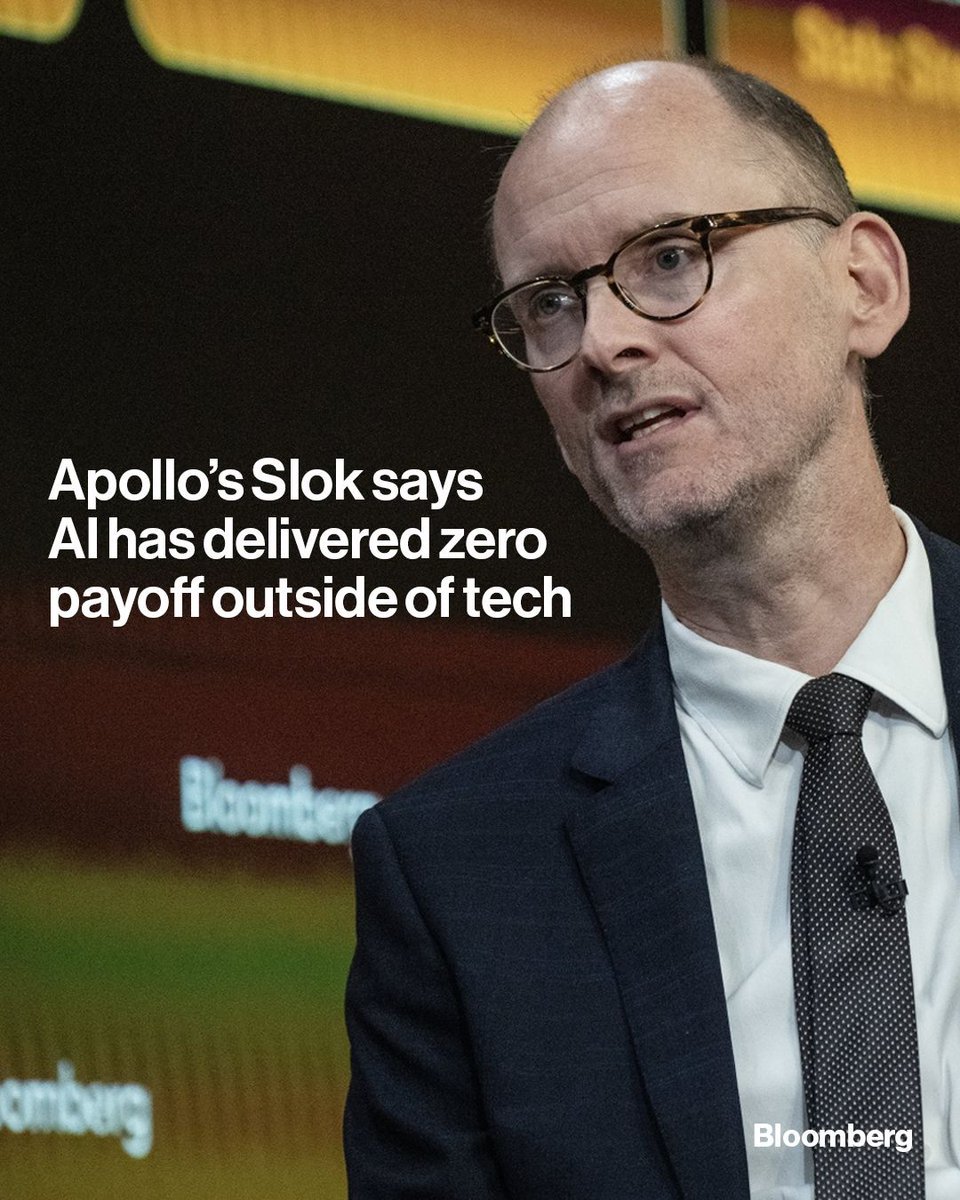
Despite massive corporate capital expenditure and intense hype around artificial intelligence, the technology has delivered zero financial payoff to corporate America outside of tech, according to Apollo Global Management Chief Economist Torsten Slok. Slok warned that mainstream businesses are seeing no measurable productivity gains from the technology, emphasizing that the ultimate economic impact of AI will be decided across the wider S&P 493 rather than among Big Tech leaders alone.[1][2][3][5][6]
Apollo's analysis highlights a sharp divergence between mega-cap tech and the rest of the market. Revenue per employee among the Magnificent Seven climbed from roughly $550,000 in 2022 to nearly $800,000 this year. In contrast, revenue per worker for the remaining 493 firms in the S&P 500 has remained flat near $550,000 since 2019, while profit margins across those companies have shown no improvement from AI adoption.[1][3][6]
Slok noted that non-tech firms are pulling back after discovering that AI usage acts primarily as a margin-hurting cost center, leaving companies unwilling to pay for the latest frontier models while token consumption remains largely concentrated in venture-backed firms. The lack of broader return coincides with mounting infrastructure worries, as research firm Gartner estimates that $3.5 trillion in AI infrastructure spending faces impairment risk by 2030, driven by an estimated $4.9 trillion revenue shortfall for data center investments.[1][4][5][6]
Key facts
- Apollo Global Management Chief Economist Torsten Slok stated that AI has delivered zero financial payoff to corporate America outside of tech.
- Revenue per employee and profit margins have remained flat for the S&P 493 since 2019 near $550,000, with no signs of AI lifting measured productivity growth.
- Revenue per employee for the Magnificent Seven rose from approximately $550,000 in 2022 to nearly $800,000 this year.
- Slok reported that mainstream corporate America is treating token spending as a margin-hurting cost center and is unwilling to pay for newer AI models.
- Gartner estimates that $3.5 trillion in AI infrastructure spending faces impairment risk by 2030, citing a $4.9 trillion revenue gap between required returns and projected data center revenues.
Sources · 6 sources
- *B
*Walter Bloomberg@DeItaonePost on X ·
APOLLO: AI HAS DELIVERED “ZERO PAYOFF” OUTSIDE BIG TECH Apollo Chief Economist Torsten Slok warns that massive AI spending has yet to deliver measurable productivity gains across corporate America. Revenue per worker and profit margins are rising for the Magnificent Seven but remain flat for the S&P 493. Meanwhile, Gartner estimates $3.5 trillion in AI infrastructure spending could face impairment risk by 2030. The key takeaway: AI investment is booming, but returns outside Big Tech remain elusive.
Open source - BL
Bloomberg@businessPost on X ·
Despite the significant investments ploughed into artificial intelligence it has provided “zero payoff” to corporate America outside of technology, according to Apollo's Chief Economist Torsten Slok. Read more: https://t.co/YEYTeFbzoD 📷: Victor J. Blue/Bloomberg https://t.co/s2Ts60VdOj
Open source - TA
Techstrong.ai@TechstrongaiPost on X ·
A new analysis from Apollo Global Management finds that despite massive corporate investments in AI, most U.S. companies have yet to see measurable gains in revenue, profit margins or productivity, with revenue per employee at the Magnificent Seven climbing from roughly $550,000 in 2022 to nearly $800,000 this year while the other 493 S&P 500 firms have remained flat near $550,000 since 2019. As Apollo chief economist Torsten Slok put it, the AI story will be decided in the S&P 493, not the Magnificent Seven, and so far there is no evidence that revenue growth or margins are improving outside the tech sector. Read the full analysis on where AI returns are actually showing up: https://t.co/8pPHuFfZXc #AI #EnterpriseAI #Apollo #Productivity #TechNews
Open source - TE
Techmeme@TechmemePost on X ·
Outside of tech there has been no financial payoff to US companies for using AI, now viewed as a margin-hurting cost center, as VC-backed firms burn more tokens (Torsten Slok / Apollo Global Management) (Visit Techmeme dot com for the link and full context!)
Open source - TE
TechmemeArticle ·
Outside of tech there has been no financial payoff to US companies for using AI, now viewed as a margin-hurting cost center, as VC-backed firms burn more tokens (Torsten Slok/Apollo Global Management) Torsten Slok / Apollo Global Management : Outside of tech there has been no financial payoff to US companies for using AI, now viewed as a margin-hurting cost center, as VC-backed firms burn more tokens — Despite massive investments and widespread hype around artificial intelligence, the technology has delivered zero financial payoff to corporate America outside of tech.
Open source - GM
Gary Marcus@GaryMarcusPost on X ·
the negative case against AI gets stronger every day; even Altman admits the problems are very serious with no obvious solution. the positive case, meanwhile, looks weaker every day. a quote from Apollo’s Torsten Slok: “Despite massive investments and widespread hype around artificial intelligence, the technology has delivered zero financial payoff to corporate America outside of tech. Revenue per worker is… flat for the S&P 493…. Profit margins are… flat for the S&P 493…. No signs of AI boosting [measured] productivity growth…. Mainstream corporate America is pulling back and starting to view token spending… as a cost center…. Mainstream corporate America does not need the latest model and is unwilling to pay for it. As long as agentic AI and token spending are confined to a small part of the economy, the macroeconomic effects of AI will be very limited.” https://t.co/DIFgO2XiA2
Open source