

Anthropic reports staff expect AI to perform 75% of work hours by 2030
Internal research from Anthropic reveals that its employees anticipate AI handling 75% of their work hours by 2030, alongside declining entry-level technical hiring and surging software agent usage.
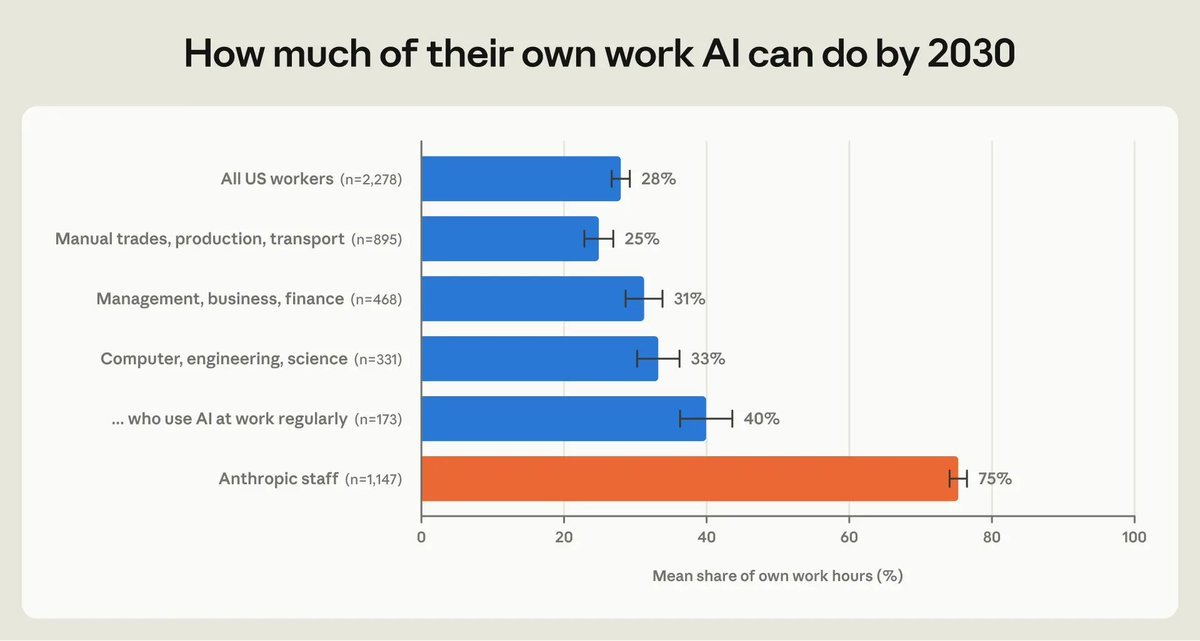
Anthropic has published internal survey data showing that its employees expect artificial intelligence to be capable of performing an average of 75% of their work hours by 2030, compared to an average of 28% expected by surveyed U.S. workers. Inside the AI developer, staff medians indicate that automated systems already handle 51% of the work required to build a frontier model, a share projected to climb to 80% by late 2027 and 95% by the end of 2030.[3][5][6]
The research highlights sharp contrasts in technological expectations: 91% of Anthropic staff expect AI to make a scientific discovery worthy of a Nobel Prize by 2030, compared to 39% of U.S. adults, with over half of Anthropic respondents anticipating that milestone as soon as 2027. While up to 40% of surveyed U.S. adults believed AI would never fully manage certain complex tasks, no more than 2% of Anthropic employees viewed any listed technical capability as permanently unattainable.[2][5][6]
The company also detailed how high-density AI adoption has restructured its own internal operations. Hours logged by autonomous software agents exceeded human interactive sessions in early 2026 and reached a six-to-one ratio over human working hours by August. Over a 12-month period, the share of junior technical staff among new hires dropped from 27% to 9% as hiring managers prioritized advanced domain judgment and orchestration over execution skills.[1][4][6]
Although Anthropic reported productivity gains across engineering, sales, and legal teams, human attention emerged as an operational bottleneck, redirecting employees toward managing orchestration systems and verification pipelines. Macroeconomic projections also diverged significantly: median staff answers implied 17.1% U.S. GDP growth in 2030, compared to 5.4% implied by the median American adult.[1][5][6]
Key facts
- Anthropic staff expect AI to be capable of performing an average of 75% of their current work hours by 2030, compared to 28% predicted by surveyed U.S. workers.
- Anthropic employees estimate that AI already performs 51% of frontier model building work, rising to 80% by late 2027 and 95% by 2030.
- Ninety-one percent of Anthropic staffers expect AI to achieve a Nobel Prize-level discovery by 2030, compared to 39% of U.S. adults.
- Automated software agent hours surpassed employee working hours in early 2026 and outnumbered human hours six to one by August.
- The proportion of junior technical staff among new hires at Anthropic declined from 27% to 9% over a 12-month period.
- Survey responses from Anthropic staff implied 17.1% U.S. GDP growth in 2030, compared to 5.4% implied by median U.S. adults.
Sources · 4 sources
- WE
webulite@webulitePost on X ·
A report released by Anthropic details internal research examining how artificial intelligence usage has reshaped workforce demographics, hiring practices, and daily operations within the company. The study reveals that as AI agents became deeply integrated into company operations, the proportion of junior technical staff among new hires fell dramatically from twenty-seven percent to nine percent over a twelve-month period. Furthermore, job postings for entry-level technical roles experienced a steep drop. Company teams relying heavily on automated tools found that primary technical tasks like writing code and identifying software bugs were increasingly absorbed by AI models, leading hiring managers to prioritize candidates with advanced domain judgment and orchestration capabilities over junior execution skills. The internal findings highlight a rapid surge in autonomous work performed by AI agents. Hours logged by software agents crossed parity with human employee interactive sessions in early 2026, and by August, automated agent hours outnumbered human working hours by a ratio of six to one. This shift led to a significant productivity boom across various operational functions. Software engineers generated substantially higher quantities of code commits, sales representatives closed more customer deals, and legal teams processed contracts at an accelerated rate. At the same time, the overall proportion of technical staff within the firm decreased slightly as non-technical departments expanded faster to support overall business growth. As AI agent output multiplied, human attention emerged as a primary operational bottleneck. The study noted that reading and reviewing all generated text produced by active agents would require nearly half of a standard work week for many employees. In response, workers shifted their focus toward meta-work, which involves creating monitoring dashboards, setting up verification pipelines, and building orchestration systems to direct and evaluate AI output effectively. Employees increasingly view their primary role as managing and supervising teams of autonomous agents rather than carrying out manual execution. The report suggests that Anthropic's internal experience offers an early look at how high-density AI adoption restructures workforce needs and day-to-day work patterns. While total headcount continued growing, the fundamental balance of work changed from direct task execution to system management, oversight, and strategic direction. Company researchers noted that these internal shifts underscore a broader transformation in technical career entry points and operational workflows as agentic systems mature.
Open source - TE
Techmeme@TechmemePost on X ·
Survey of Anthropic staffers and US adults: 39% of US adults vs. 91% of staffers expect AI will be able to make a Nobel-level discovery by 2030, and more (Anthropic) (Visit Techmeme dot com for the link and full context!)
Open source - LA
Lisan al Gaib@scaling01Post on X ·
On average, Anthropic employees expect AI to be capable of performing 75% of their current work hours by 2030 https://t.co/W4dym9g15J
Open source - TE
Techmeme@TechmemePost on X ·
Anthropic report on how AI is changing employment at the startup: decline of entry-level technical hiring, productivity boom across departments, and more (Anthropic) (Visit Techmeme dot com for the link and full context!)
Open source - WE
webulite@webulitePost on X ·
A major study published by Anthropic reveals a profound divergence in expectations between artificial intelligence researchers and the general public regarding the future trajectory of AI capabilities and its economic impact. The survey compared responses from over ten thousand American adults with those of more than thirteen hundred Anthropic employees. While both groups demonstrated broad consensus regarding what AI tools can accomplish today, a massive gap emerged when forecasting technological advancements over the rest of the decade. The headline finding illustrates that ninety-one percent of Anthropic staffers expect an artificial intelligence model to make a scientific discovery worthy of a Nobel Prize by the year 2030. In contrast, only thirty-nine percent of American adults anticipate AI reaching that milestone within the same timeframe. This divergence extends across various technical milestones, with the public expressing far higher skepticism. Up to forty percent of surveyed adults believed AI would never be capable of fully managing certain complex tasks, whereas no more than two percent of Anthropic staff viewed any listed technical capability as permanently out of reach for automated systems. The disparity in capability forecasts directly translates into contrasting views on workplace automation and individual productivity. Anthropic employees estimated that AI models will be capable of performing seventy-five percent of their daily work tasks by 2030, compared to American workers who estimated that AI could automate just twenty-eight percent of their current job duties. Furthermore, over half of Anthropic staff predicted that AI would handle at least eighty percent of their daily workload by the end of the decade, a level of automation expected by only five percent of the general workforce. Employees who currently use AI heavily reported significantly larger time savings on complex tasks than typical workplace users. Despite their diverging timelines on technological advancement, both groups share remarkably similar economic mental models regarding the link between automation and labor market disruption. Among both corporate staff and general public respondents, individuals who predicted higher levels of workplace task automation systematically forecasted higher national unemployment rates. Both groups also anticipated prolonged job transition periods for displaced workers attempting to switch occupations. However, Anthropic staff projected far higher overall macroeconomic growth, with median employee responses implying annual gross domestic product growth exceeding seventeen percent by 2030, driven by rapid gains in automated task efficiency. The report concludes that everyday exposure and familiarity with frontier models serve as the primary drivers behind these differing outlooks. As artificial intelligence integration expands across various industry sectors, public expectations are likely to shift closer to those held by specialized AI developers.
Open source - AG
AGTP@AGTPinsightsPost on X ·
Anthropic just published internal polls showing staff expect AI to do 75% of their work hours by 2030. Here's what you need to know. Anthropic surveyed its own employees on where AI is headed. On average, they expect AI to be able to perform 75% of their current work hours by 2030. Over half believe AI will be able to make Nobel Prize-worthy discoveries by 2027. Staff also think AI already does about half the work of building a new frontier model. The median answer today is 51%. The median expects 80% by the end of 2027 and 95% by the end of 2030. Separately, Head of Global Affairs Michael Sellitto told the IMF that Claude could lead 80-90% of frontier model training by next year, up from 3% in April. On the economy, the median staff member's answers imply GDP growth of 17.1% in 2030. The median US adult's answers imply 5.4%. Both groups expect fast progress, but Anthropic staff expect it faster and broader. Those who expect AI to do more of their own work anticipate similar unemployment effects, in both staff and the public. Researchers also found that people's view of AI in their own field shapes their predictions about AI overall. Inside the company, adoption is already well ahead. Anthropic says it runs roughly a year and a half ahead of the economy on AI adoption. Interactive AI agent hours outnumbered employee hours 6 to 1 by August. Agents worked more hours than employees by March 2026. Anthropic is hiring for a smaller share of junior technical roles, and emphasizing autonomy and judgment over technical expertise and implementation. Entry-level hires in tech roles reportedly fell from 27% to 9%. Productivity rose too, with more code written, more sales per rep and more legal contracts processed. Key numbers: - 75% of current work hours doable by AI by 2030, per staff average - 51% of frontier model building done by AI today, per staff median - 80% by end of 2027, 95% by end of 2030 - 17.1% GDP growth in 2030 for staff vs 5.4% for the median US adult - 6 to 1 AI agent hours to employee hours by August - 27% to 9% entry-level share of technical hires, reportedly The research was published by Anthropic on October 16, as a possible leading indicator for the wider economy.
Open source