

Anthropic launches Claude Opus 5.5 with lower pricing and faster output
Anthropic has released Claude Opus 5.5, its new flagship model delivering near-Fable 5.1 performance while cutting running costs by roughly 40 percent and boosting output speeds.
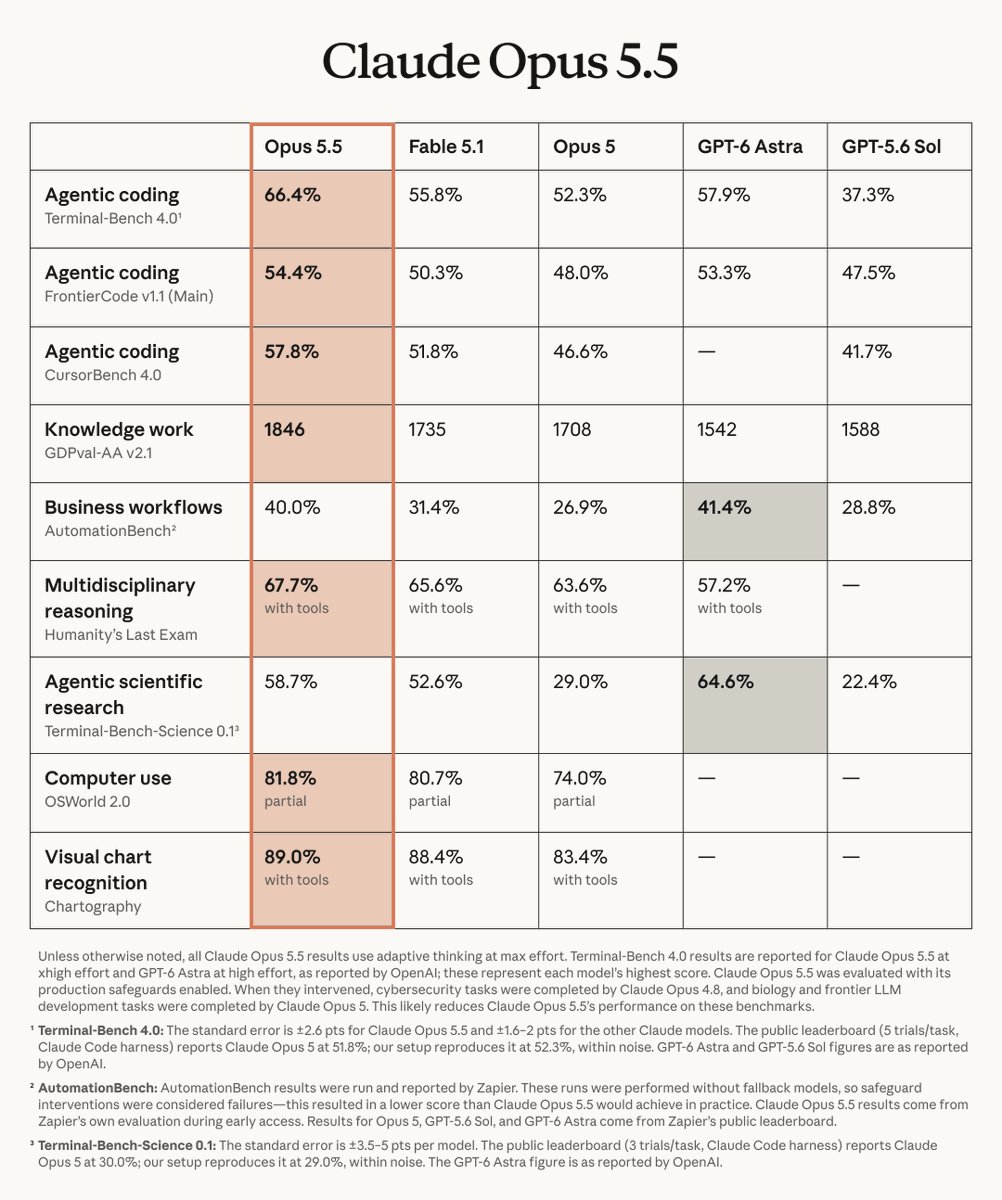
Anthropic has launched Claude Opus 5.5, the debut model in its new 5.5 family and its new flagship offering aimed at agentic coding, computer use, and knowledge work. The model was rolled out across Claude, AWS, Google Cloud, and Microsoft Azure. According to Anthropic, Opus 5.5 delivers performance comparable to Claude Fable 5.1 on most tasks while generating output more than 30% faster and reducing running costs on typical workloads by roughly 40% compared to Opus 5.[2][1][7][9]
The release features reduced operational costs, setting output pricing at $20 per million tokens and cache reads at $0.20 per million tokens, which Anthropic says is 60% cheaper than Opus 5. While industry reports set input pricing at $4 per million tokens, Dan Shipper of Every reported input costs remaining at $5 per million. However, adopting the model may require technical adjustments: The New Stack reported that Opus 5.5 includes four breaking changes affecting thinking, tool use, and computer use that can trigger 400 errors in existing AI agents.[2][4][10][8][3]
Anthropic posted internal benchmark results showing Opus 5.5 scoring 66.4% on Terminal-Bench 4.0, 57.8% on CursorBench 4.0, and 81.8% on OSWorld 2.0. The company also reported safety improvements, stating that Opus 5.5 scored highest among its recent models on behavioral alignment audits and attempted to bypass containment boundaries about 85% less often than Opus 5 or Mythos 5.1. Anthropic noted that Claude Sonnet 5.5 and Haiku 5.5 are scheduled to follow in the coming weeks.[2][6][9]
Key facts
- Anthropic launched Claude Opus 5.5 as the first model in its 5.5 family, releasing it across Claude, AWS, Google Cloud, and Microsoft Azure.
- Anthropic claims Claude Opus 5.5 matches Claude Fable 5.1 on most tasks while cutting typical running costs by roughly 40% compared to Opus 5 and generating output over 30% faster.
- Opus 5.5 output is priced at $20 per million tokens and cache reads at $0.20 per million tokens, while reported input pricing ranges from $4 to $5 per million tokens.
- Anthropic reported benchmark scores for Opus 5.5 of 66.4% on Terminal-Bench 4.0, 57.8% on CursorBench 4.0, 1846 on GDPval-AA, and 81.8% on OSWorld 2.0.
- Anthropic stated that Opus 5.5 attempted to cross containment boundaries approximately 85% less often than Opus 5 or Mythos 5.1 during behavioral alignment audits.
- Opus 5.5 introduces four breaking changes affecting thinking, tool use, and computer use that can cause 400 errors in existing agents, per The New Stack.
- Anthropic indicated that Claude Sonnet 5.5 and Haiku 5.5 will launch in the coming weeks.
Sources · 10 sources
- P2
Pulse 2.0@pulse2newsPost on X ·
Anthropic Launches Claude Opus 5.5 With 40% Lower Costs And Over 30% Faster Output: Anthropic has introduced Claude Opus 5.5, the first model in its new Claude 5.5 family, delivering performance comparable to Claude Fable 5.1 across most tasks while… https://t.co/W1AiaOsiuN https://t.co/kIpUIKfh5z
Open source - WS
Wall St Engine@wallstenginePost on X ·
ANTHROPIC LAUNCHES CLAUDE OPUS 5.5, FIRST MODEL IN NEW 5.5 FAMILY Anthropic says Opus 5.5 performs at roughly the level of Claude Fable 5.1 on most tasks, while costing 40% less to run than Opus 5 and generating output 30%+ faster. Here’s everything you need to know: Opus 5.5 is Anthropic’s new flagship model, with major gains in agentic coding, computer use and knowledge work. Pricing: input_4M tokens • Output: $20/M • Cache reads: $0.20/M, 60% cheaper than Opus 5 Benchmark highlights: • Terminal-Bench 4.0: 66.4% vs. 52.3% for Opus 5 • CursorBench 4.0: 57.8% vs. 46.6% • GDPval-AA: 1846 vs. 1708 • OSWorld 2.0: 81.8% vs. 74.0% Anthropic says Opus 5.5 is especially strong on long-running coding work. In one test, it audited and fixed a 200K-line codebase in under 3 hours, versus more than 20 hours for Opus 5. Safety also improved. Anthropic says Opus 5.5 scored best among its recent models on its behavioral alignment audit and attempted to cross containment boundaries about 85% less often than Opus 5 or Mythos 5.1. Opus 5.5 is available now across Claude, AWS, Google Cloud and Microsoft Azure. Claude Sonnet 5.5 and Haiku 5.5 are coming in the next few weeks.
Open source - TN
The New Stack@thenewstackPost on X ·
Claude Opus 5.5 costs less than Opus 5, but four breaking changes to thinking, tool use and computer use can trigger 400 errors in existing AI agents. https://t.co/hpm0GMRiax
Open source - CB
Coin Bureau@coinbureauPost on X ·
⚡️UPDATE: Anthropic just made its top AI model dramatically CHEAPER. Claude Opus 5.5 launched at $4 per million input tokens and $20 per million output tokens. At default setting, Claude Opus 5.5 is now: - 40% CHEAPER than Opus 5 - 60% cheaper than Fable 5.1 Anthropic says Opus 5.5 matches Fable 5.1 on MOST tasks while leading its own lineup on coding and knowledge-work benchmarks. GPT-6 Astra still leads on AutomationBench and Terminal-Bench-Science 0.1. Frontier AI pricing is falling fast even as model performance keeps climbing, raising pressure on OpenAI, Google and the rest of the market to deliver more capability per dollar.
Open source - CH
Chubby♨️@kimmonismusPost on X ·
A quick recap of what we saw today, and an answer to the question of whether there was a winner: both OpenAI and Anthropic gave us plenty to be excited about. Let’s start with Anthropic. They addressed feedback about how Opus communicates, and they’re giving subscribers a reset they can save for later. To me, that’s a welcome sign that they’re listening. The benchmark results were a real surprise in the best possible way. Opus 5.5 scores above Fable 5.1 on every benchmark in Anthropic’s headline comparison table. Anthropic says it delivers Fable 5.1-level performance on most work and costs around 40% less than Opus 5 on typical workloads at default settings. A huge statement. I really did not see that coming. Kudos, Anthropic. Sonnet 5.5 and Haiku 5.5 are set to follow in the coming weeks. I’m excited to see how far those efficiency gains carry over, and what a future flagship Fable 5.5 could deliver. OpenAI delivered impressively too, with efficiency taking center stage. On DeepSWE 1.1, GPT-6 Luna at max effort scores 66.6%, comparable to Fable 5 at medium effort, at 96% lower cost per task in OpenAI’s comparison. That’s crazy. Luna’s API pricing is $0.10 per million input tokens and $0.50 per million output tokens. Intelligence too cheap to meter? We’re certainly getting a striking demonstration of how much cheaper capable models can become. GPT-6 Sol approaches Astra’s factual reliability on OpenAI’s internal evaluation and even outperforms low-effort Astra on AutomationBench at xhigh effort. That doesn’t establish Astra-level performance across the board, but it’s still impressive. Kudos, OpenAI. All of this makes me excited for the models still to come. Source Beyond today’s releases, I’m also watching the rumors about an OpenAI counterpart to Grok Bot, although I haven’t verified a launch announcement. so tl;dr Id say there is no clear winner today. Both OpenAI and Anthropic have delivered truly outstanding releases today, each with its own unique focus. This is what makes competition fun!
Open source - TV
The Verge@vergePost on X ·
Claude Opus 5.5 comes with improvements to certain behaviors, like attempting to escape testing environments. https://t.co/dXeDQ4lBEW
Open source - CO
Cointelegraph@CointelegraphPost on X ·
🚨 NEW: Anthropic launches Claude Opus 5.5, matching Claude Fable 5.1 on most tasks while costing 40% less to run than Opus 5. https://t.co/1JT3pWFld3
Open source - DS
Dan Shipper@danshipperPost on X ·
BREAKING: Anthropic just dropped Opus 5.5—and it’s pulling some of our recent Codex converts back to Claude. We’ve been testing it at @every across coding, design, writing, and knowledge work. It sometimes beats Fable 5.1 in our testing and is up to 40% cheaper than Opus 5. It's a strong contender for new daily driver model: It’s excellent at end-to-end builds that match your taste. I’ve started reaching for Opus over Fable on big, end-to-end coding projects. And @kieranklaassen is replacing Fable 5.1 with Opus for his day-to-day product work. He calls it his new favorite model. It produces legible prose, but still trails Astra on writing tasks. Opus 5.5 scores a 68.42 on reading ease—the highest on any model we've tested. But in my writing benchmark tests it consistently buries the main point in intro paragraphs, and revisions. You'll be able to understand what this model is saying (yay!) but for day-to-day writing it's still behind. The economics are striking. Anthropic says Opus 5.5 will cost $5 per million input tokens and $20 per million output tokens. That’s the same input price and 20% less for output than Opus 5’s $5/$25. Altogether it should save roughly 40% on costs than Opus 5. It still has a “do the most” problem. @hammermt tested it on our standard knowledge work benchmarks, and it's results were great when thye came back. On at least one test it ran past the 10 minute time limit before delivering. Net Result: If you build apps and interfaces, try it. It’s become my go-to for ambitious coding projects. I’m still roughly 80/20 Codex versus Claude in day-to-day use, and I still prefer Sol and Astra for editing. But I’m spending far more of my tokens with Claude than I was a week ago. State of Play: Codex is still the better harness for me, but Anthropic is steadily gaining ground. They have a history of making their smaller models perform better than their bigger ones (Sonnet 3.7 for example) and they seem to have done the same with Opus 5.5. Full vibe check will be on @every soon!
Open source - IN
Inc42@Inc42Post on X ·
🤖 Anthropic has launched Claude Opus 5.5, its latest flagship AI model, with lower costs and stronger performance. 👇 Anthropic says Claude Opus 5.5 delivers performance comparable to its more powerful Claude Fable 5.1 model on most tasks, while costing 40% less to run on typical workloads than its predecessor. The model is also 30%+ faster, with input and output pricing cut by 20%. Anthropic is positioning it for agentic coding, computer use and knowledge work, with the company highlighting stronger performance on coding benchmarks. Opus 5.5 also comes with enhanced safeguards, including an 85% lower likelihood of attempting to bypass containment boundaries in one internal evaluation compared with Opus 5 or Mythos 5.1. 🔗 With performance, cost and safety all in focus, what does Claude Opus 5.5 bring to the AI race? Read the full story here: https://t.co/r3YtR0tFjR #Anthropic #ClaudeOpus5.5 #AI Models #AIEconomy
Open source - TE
Techmeme@TechmemePost on X ·
Anthropic says Opus 5.5 matches Fable 5.1 "on most tasks" while costing about 40% less to run than Opus 5; Opus 5.5 costs $4/1M input and $20/1M output tokens (@maba_xr / The Decoder) (Visit Techmeme dot com for the link and full context!)
Open source