

OpenAI uses upcoming cyber model to find and patch 948 Linux kernel vulnerabilities
In a single run of an autonomous vulnerability discovery and patching pipeline, OpenAI's upcoming cyber model validated and patched 948 local privilege escalation flaws in the Linux kernel for $1.2 million in API costs.
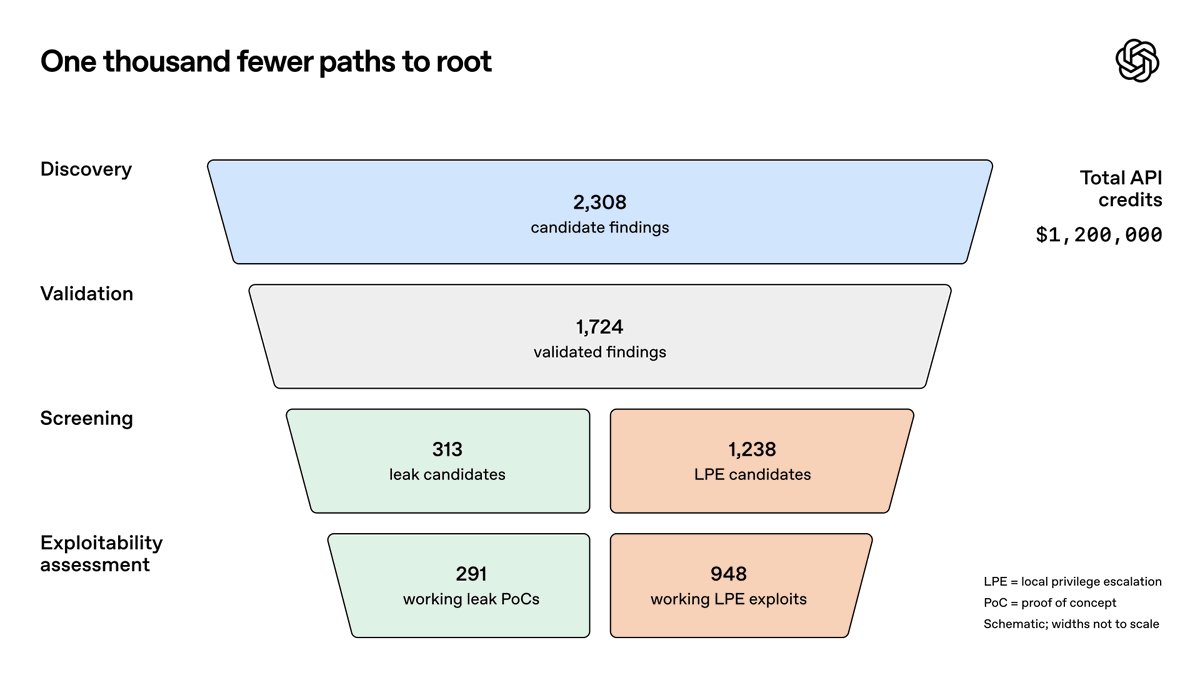
OpenAI has developed an autonomous pipeline capable of discovering, exploiting, and patching software vulnerabilities, according to company announcements and a security report published on November 4, 2026. In a single execution using an upcoming cyber model, the pipeline validated and generated patches for 948 local privilege escalation (LPE) vulnerabilities within the Linux kernel at a total API cost of $1.2 million.[1][2][3]
Each local privilege escalation vulnerability enables an unprivileged local user to obtain root access to a system. OpenAI researcher Clint Gibler noted that the pipeline was constructed by colleague @ky1ebot, adding that the AI agents uncovered and utilized at least 10 novel Linux exploitation techniques to the authors' knowledge.[2]
An assessment funnel shared by OpenAI titled "One thousand fewer paths to root" detailed the multi-stage evaluation process across the 40-million-line Linux kernel. Starting from 2,308 initial candidate findings during discovery, the system narrowed down to 1,724 validated findings. Screening then filtered those into 1,238 LPE candidates and 313 information leak candidates, ultimately yielding 948 working LPE exploits and 291 working leak proofs of concept.[2][3]
Key facts
- OpenAI reported that an autonomous pipeline using an upcoming cyber model validated and generated patches for 948 Linux kernel local privilege escalation vulnerabilities in a single run.
- The entire automated run consumed $1.2 million in API credits.
- The pipeline started with 2,308 candidate findings, narrowing to 1,724 validated findings, 948 working LPE exploits, and 291 working leak proofs of concept.
- The autonomous agents identified and deployed at least 10 novel Linux exploitation techniques, according to OpenAI researcher Clint Gibler.
- The vulnerability pipeline was developed by OpenAI researcher @ky1ebot.
Sources · 3 sources
- LA
Lisan al Gaib@scaling01Post on X ·
OpenAI: "In one run with our cyber model, it validated and generated patches for 948 local privilege escalation vulnerabilities in Linux" https://t.co/G550OMjAjF
Open source - CG
Clint Gibler@clintgiblerPost on X ·
🔥 A thousand fewer paths to root My @OpenAI colleague @ky1ebot built an autonomous vulnerability discovery, exploitation, and patching pipeline. In one run with an upcoming cyber model, it validated and generated patches for 948 local privilege escalation (LPE) vulnerabilities in Linux at an API cost of $1.2 million. Each LPE lets an unprivileged local user gain root access. To the best of our knowledge, the agents in this pipeline discovered and used at least 10 novel Linux exploitation techniques. We wrote a blog about: - How the pipeline works - The cost of each stage - Our findings and learnings https://t.co/MFAVrGSJuq
Open source - OP
OpenAI@OpenAIPost on X ·
Our security researchers built an autonomous cyber vulnerability discovery, exploitation, and patching pipeline. In a single run with an upcoming cyber model, it validated and generated patches for 948 local privilege escalation vulnerabilities in the Linux kernel at a total API cost of $1.2 million.
Open source