

Claude traces NIST elliptic curve seeds to timestamps, easing backdoor suspicions
Anthropic reported that its Claude AI traced the seeds of NIST's ECDSA elliptic curves to a basic random number generator seeded with timestamps, resolving a 26-year-old cryptographic mystery in under 30 minutes.
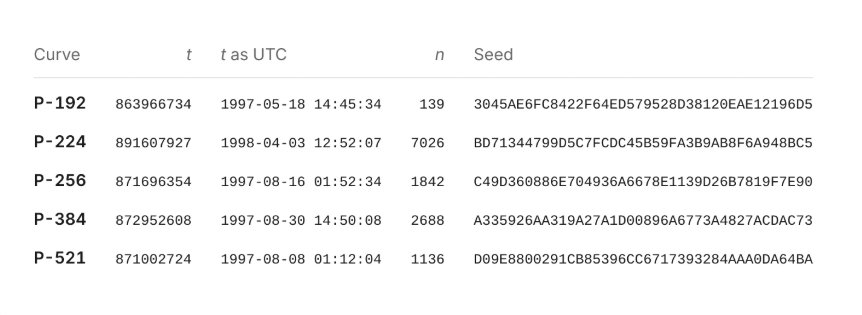
Anthropic reported that its Claude AI traced the seeds used in the National Institute of Standards and Technology's ECDSA elliptic curves to a pseudorandom number generator seeded with simple timestamps. The discovery resolved a 26-year-old cryptographic puzzle in under 30 minutes, according to Coin Bureau and Cointelegraph.[1][2][5][6]
In a writeup titled "It's just timestamps" published by Frontier Red Team, researchers outlined how the NSA supplied the seeds behind the curves in the late 1990s without public justification or explanation. When NIST adopted ECDSA under the FIPS 186-2 Digital Signature Standard in 2000, each curve published a seed parameter whose hash determined curve coefficient b. Claude's analysis showed that seeds for standard curves—including P-192, P-224, P-256, P-384, and P-521—were generated from timestamp values recorded between May 1997 and April 1998.[4][6][3]
The discovery challenges decades of speculation regarding a potential NSA backdoor in the widely used signature standard. Anthropic emphasized that the finding is not a weakness in the curves and makes fears of a backdoor much less plausible, adding that most researchers had already trusted the curves. The work claimed a $36,864 bounty, which will be donated to the Internet Security Research Group.[1][2][4][6]
Key facts
- Claude traced the seeds of NIST's ECDSA elliptic curves to a basic random number generator seeded with timestamps in under 30 minutes.
- The NSA provided the curve seeds in the late 1990s without origin explanations prior to NIST adopting ECDSA in 2000 under FIPS 186-2.
- Seeds for curves P-192, P-224, P-256, P-384, and P-521 were linked to specific timestamp runs dating between May 1997 and April 1998.
- Anthropic stated the origin mechanism does not expose a weakness in the curves and makes suspicions of an NSA backdoor much less plausible.
- A $36,864 bounty earned from the discovery will be donated to the Internet Security Research Group.
Sources · 6 sources
- TE
Techmeme@TechmemePost on X ·
Anthropic says Claude traced NIST's ECDSA curve seeds to a pseudorandom number generator, challenging decades-old suspicions of an NSA backdoor in the algorithm (Anthropic) (Visit Techmeme dot com for the link and full context!)
Open source - TE
TechmemeArticle ·
Anthropic says Claude traced NIST's ECDSA curve seeds to a pseudorandom number generator, challenging decades-old suspicions of an NSA backdoor in the algorithm (Anthropic) Anthropic : Anthropic says Claude traced NIST's ECDSA curve seeds to a pseudorandom number generator, challenging decades-old suspicions of an NSA backdoor in the algorithm — “It's just timestamps”: the decades-old mystery of the origins of one of the most popular cryptographic standards has been explained.
Open source - CB
Crypto BriefingArticle ·
Claude traces NIST P-256 seed to a 1997 random number generator run The discovery underscores the potential of AI in unraveling cryptographic mysteries, prompting a reevaluation of legacy systems' transparency. The post Claude traces NIST P-256 seed to a 1997 random number generator run appeared first on Crypto Briefing .
Open source - LA
Lisan al Gaib@scaling01Post on X ·
Claude figured out how the curve parameters for ECDSA were chosen ECDSA is an algorithm for creating and verifying digital signatures using elliptic curves. You might know its older more well known sibling DSA. In the late 1990s, the NSA supplied the seeds behind these curves used for ECDSA with no explanation of where they came from turns out they're just output from a basic random number generator, seeded with a timestamp https://t.co/SFTJc5LFHE
Open source - CO
Cointelegraph@CointelegraphPost on X ·
🤖 NEW: Claude solved the decades-old mystery of NIST elliptic curve seeds in under 30 minutes, tracing them to timestamps. https://t.co/YEz3ULe27Q
Open source - CB
Coin Bureau@coinbureauPost on X ·
🚨JUST IN: Anthropic’s Claude solves the NSA’s 26 year cryptography mystery in under 30 minutes. Claude found the NSA’s “random” seeds for cryptography curves like P-256 were generated from simple 1997 and 1998 timestamps. Nobody had explained them since NIST published the curves in 2000. The discovery claims a $36,864 bounty, which will be donated to the Internet Security Research Group. Anthropic says it is not a weakness in the curves, and it makes backdoor fears “much less plausible.”
Open source