

Blockchain Association urges Treasury to narrow GENIUS Act stablecoin rule
The Blockchain Association filed comments on the U.S. Treasury's proposed GENIUS Act rule, calling for narrower liability standards, clearer exemptions for decentralized finance, and simplified vetting for foreign stablecoins.
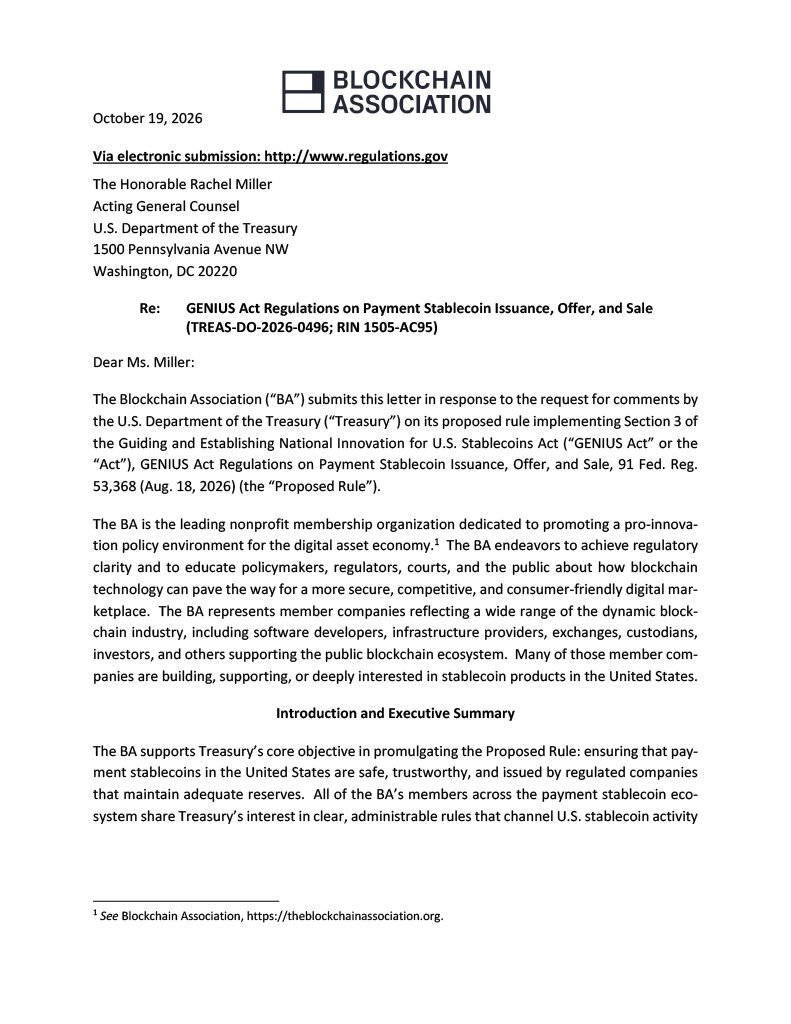
The Blockchain Association has submitted a 26-page comment letter urging the U.S. Department of the Treasury to narrow its proposed rule implementing Section 3 of the GENIUS Act, which governs who can issue payment stablecoins and when digital asset service providers can offer them in the U.S. The industry group filed its letter on Oct. 19, 2026, the final day of the public comment period, addressed to Acting General Counsel Rachel Miller.[3][4]
While supporting Treasury's core goal of ensuring stablecoins are safe, trustworthy, and backed by adequate reserves, the association cautioned against regulatory overreach. It asked Treasury to set a higher bar before finding that a company took part in an unlawful issuance, arguing that liability should require actual knowledge of the underlying facts rather than constructive belief. The letter stressed that routine secondary trading and market making should not constitute knowing participation without affirmative, substantial assistance coordinated with the issuer.[1][3][4]
The group also pushed Treasury to respect congressional carve-outs for public blockchain infrastructure, arguing that validators, liquidity pools, self-custody software, and proprietary traders should not be classified as digital asset service providers. Additionally, the association urged Treasury to drop a proposed geographic standard based on whether a firm 'reasonably believes' a counterparty is abroad, noting that decentralized finance protocols often interact only with wallet addresses.[2][4]
To reduce compliance burdens, the association asked regulators to let service providers rely on official government lists of approved and barred foreign issuers rather than mandating open-ended due diligence. It also pointed out that Treasury's proposal lacks an explicit effective date, requesting that implementation not take effect before related rules are finalized or accelerate the July 18, 2028 compliance deadline provided by Congress.[4]
Key facts
- The Blockchain Association filed a 26-page comment letter on Oct. 19, 2026, addressing the U.S. Treasury's proposed rule under Section 3 of the GENIUS Act.
- The association argued that liability for participating in an unlawful stablecoin issuance should require actual knowledge and substantial assistance, rather than encompassing ordinary secondary trading.
- The group asked Treasury to exclude self-custody software, validators, liquidity pools, and proprietary traders from being classified as digital asset service providers.
- The filing urged Treasury to replace its 'reasonably believes' counterparty location test with a standard based on actual knowledge obtained in the ordinary course of business.
- The association recommended permitting firms to rely on regulators' public lists of approved foreign issuers instead of performing open-ended due diligence.
- Treasury's proposal was published on Aug. 18, 2026, following an initial announcement on Aug. 17 by Treasury Secretary Scott Bessent.
Sources · 4 sources
- BS
BSCN@BSCNewsPost on X ·
Treasury Faces Pressure to Clarify GENIUS Act Rules The Blockchain Association wants Treasury to narrow its GENIUS Act rules. In a 26-page letter, it argued criminal liability should require actual knowledge and substantial assistance in unlawful issuance. Ordinary secondary market trading should not count as knowing participation, the group said. The Blockchain Association says self-custody software and validators should remain outside certain requirements.
Open source - LS
Laura Shin@laurashinPost on X ·
Independent market makers, validators and self-custody wallets should stay outside Treasury's GENIUS Act rule on stablecoin sales, the Blockchain Association said, asking the department to replace its proposed "reasonably believes" location test. https://t.co/H1pkkgBv5i
Open source - TB
The Block@TheBlockCoPost on X ·
THE BLOCK: The Blockchain Association has filed comments on Treasury's proposed rule implementing Section 3 of the GENIUS Act, which governs who can issue and sell payment stablecoins in the U.S. The group backed Treasury's core approach but called for clearer lines on the definition of digital asset service providers, "knowing participation" standards, and foreign issuer requirements.
Open source - UN
UnchainedArticle ·
Blockchain Association Asks Treasury to Narrow GENIUS Act Rule on Who Can Sell Stablecoins The Blockchain Association is asking the U.S. Treasury to set a higher bar before a crypto company can be found to have taken part in an unlawful stablecoin issuance under the GENIUS Act , and to leave traders and decentralized finance (DeFi) infrastructure outside the rule’s reach. The industry group filed a 26-page comment letter dated Oct. 19 , the last day Treasury accepted feedback on its proposed rule implementing Section 3 of the stablecoin law. That section governs who may issue payment stablecoins in the U.S. and when digital asset service providers (DASPs) may offer or sell them to people here. In a post on X , the group said its letter “seeks clearer lines so the final rule matches what Congress wrote.” Get Unchained’s crypto news in your inbox with the free Unchained Daily newsletter . Knowledge, Not Belief Treasury’s proposal lists three non-exclusive examples of “knowing” participation in an unlawful issuance, one of which covers market making and distributing newly issued coins. The association asked Treasury to confirm that the standard “requires actual knowledge of the underlying facts that make an issuance unlawful” and that firms may rely on what an issuer tells them. Routine market making and secondary trading should not count, the letter said, unless a firm provides “affirmative, substantial assistance in coordination with the issuer who issues a stablecoin.” It also asked Treasury to make sure the provision “does not, in practice, accelerate the July 18, 2028, compliance date” Congress gave DASPs. On geography, the group wants Treasury to scrap a test that turns on whether a firm “reasonably believes” a counterparty is outside the U.S. In its place, it proposed “a standard based on actual knowledge and information reasonably obtained in the ordinary course of a transaction,” arguing that a firm working in DeFi “may interact only with a wallet address” and have no way to see who is behind it. Who Counts as a Service Provider The association said the DASP label should apply to service providers alone, and that Treasury should honor the carve-outs Congress wrote for self-custody software, validators and liquidity pools. The letter said those exclusions “reflect a deliberate congressional judgment” that such public blockchain infrastructure is not a service provider. A firm that trades with its own money, on decentralized exchanges or elsewhere, should not become a DASP for that reason alone, it added. The group also wrote in the letter that Treasury “should not require DASPs to conduct open-ended due diligence on foreign payment stablecoin issuers” and asked that firms be allowed to rely on regulators’ public lists of approved and barred issuers instead. No Date Set Yet Treasury announced the proposal on Aug. 17 , with Treasury Secretary Scott Bessent saying the department “welcomes input from stakeholders as we work to provide the regulatory certainty businesses need.” The letter noted that the proposal “does not specify an effective date or compliance date for Part 1523” and asked that the rule take effect no earlier than the latest related GENIUS Act rule, several of which are still proposals, including one the Federal Reserve proposed in September. The law starts applying on Jan. 18, 2027 , or 120 days after regulators finalize their rules, whichever is earlier. Related Listen: Why Banks Failed to Kill Stablecoin Rewards in the Clarity Act The post Blockchain Association Asks Treasury to Narrow GENIUS Act Rule on Who Can Sell Stablecoins appeared first on Unchained .
Open source