

Pudgy Penguins backer Igloo to shut down Abstract Layer 2 on Dec. 15
Igloo Inc. is winding down its Ethereum Layer-2 network Abstract after losing tens of millions of dollars and opting against a token launch, requiring users to bridge out funds by December 15, 2026.
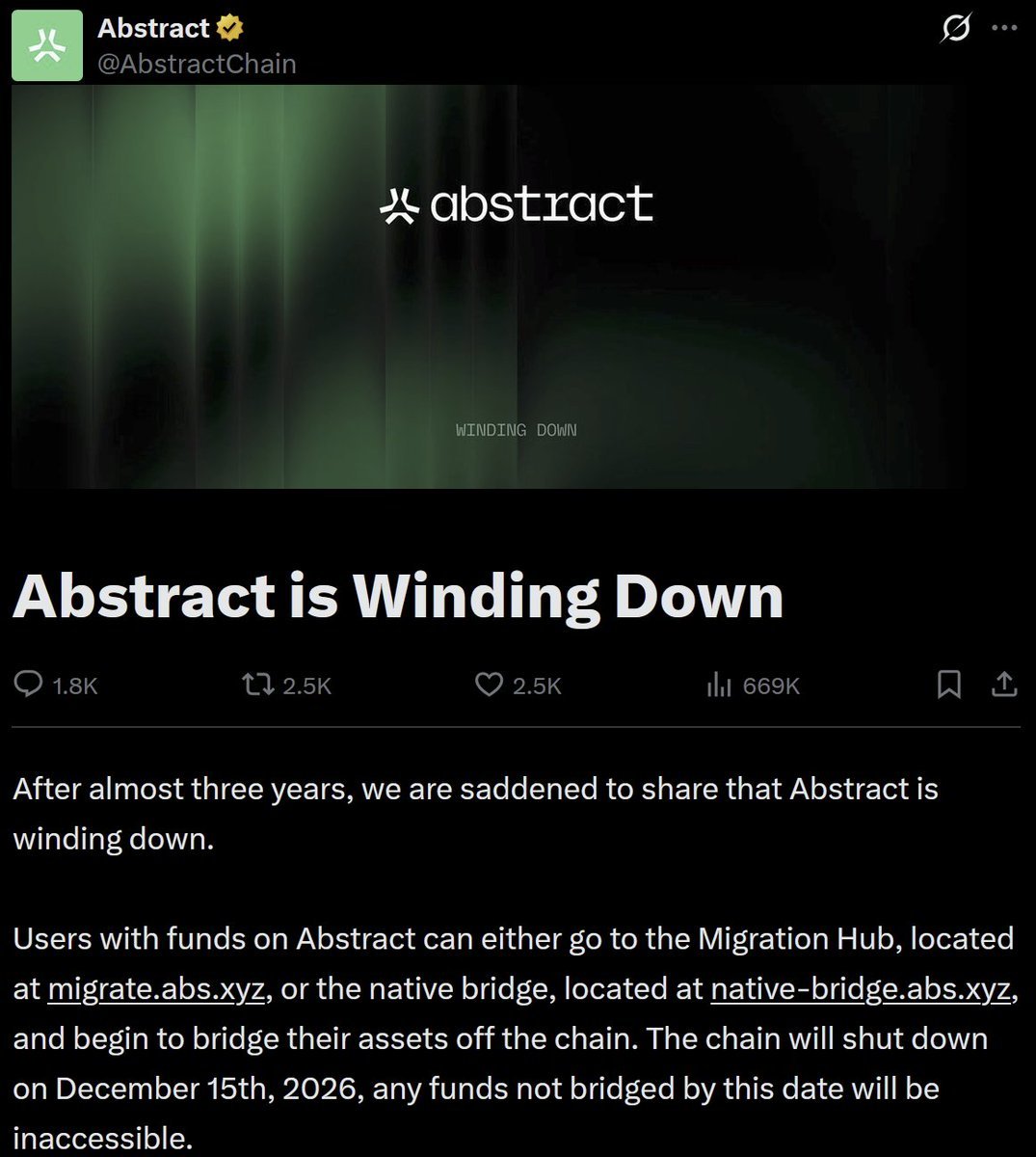
Abstract, the consumer-focused Ethereum Layer-2 network backed by Pudgy Penguins parent Igloo Inc., announced it will shut down on December 15, 2026. The project instructed users to move their assets off the network through its Migration Hub at migrate.abs.xyz or its native bridge, warning that any funds left on the chain after the deadline will become inaccessible.[2][3][8][12]
The team stated that a standalone network focused solely on consumer crypto proved operationally unsustainable amid stagnant growth, thin liquidity, a restricted decentralized finance ecosystem, and limited institutional adoption. Igloo CEO Luca Netz disclosed that the company had quietly financed Abstract for 18 months, incurring tens of millions of dollars in losses over two years. Netz said Igloo chose not to launch a token or conduct an initial coin offering to sustain the project, noting the company could no longer justify diverting resources from Pudgy Penguins, its NFTs, and the PENGU token.[3][5][7][8][12]
The closure arrives despite Abstract registering more than 400,000 users, hosting 144 applications, and establishing brand tie-ins with Disney and Red Bull Racing. However, community members noted that users who spent nearly two years farming experience points in anticipation of an airdrop will receive nothing. The decision also marks the second Ethereum Layer-2 shutdown in under a week, coming four days after rival rollup Blast announced its own wind-down due to unsustainable operating costs.[1][4][6][9][11][12]
Key facts
- Abstract Chain will shut down on December 15, 2026, and unbridged assets left on the network after that date will become inaccessible.
- Igloo CEO Luca Netz revealed that the company quietly funded Abstract for 18 months and lost tens of millions of dollars over two years.
- Igloo opted against holding an ICO or launching a token for Abstract, choosing instead to refocus entirely on Pudgy Penguins, Pudgy NFTs, and PENGU.
- Abstract cited thin liquidity, stagnant growth, a restricted DeFi ecosystem, and limited institutional adoption for its wind-down.
- The wind-down came four days after Blast announced its own shutdown, making Abstract the second Ethereum Layer 2 to shutter within a week.
- Users can withdraw funds via the Migration Hub at migrate.abs.xyz or the native bridge, which carries an estimated three-hour processing delay.
Sources · 11 sources
- W�
wyck 📴@wyckoffwebPost on X ·
Abstract is shutting down with $9.6M TVL and $2,646 daily fees. Blast shut down four days ago with $32M TVL and $110 daily fees. MegaETH, zkSync, Scroll, Manta and Mode might be next. MegaETH got 18.4M TVL and $2,589 daily fees zkSync: $15.7M TVL, $361 daily fees Mode: $2M TVL, $28 daily fees Manta: $3.1M TVL, $8 daily fees Scroll: $8.7M TVL, $118 daily fees Two L2s have shut down in four days. If this turns into a trend, these are definitely the chains I'd be watching next.
Open source - CB
Crypto Briefing@Crypto_BriefingPost on X ·
⚠️ NEW: Abstract is winding down its blockchain after nearly three years, citing an unsustainable consumer crypto model as growth stalled and competition intensified. The chain will shut down on Dec. 15, 2026, giving users until then to bridge their assets off the network. https://t.co/YaLzXzh0CU
Open source - TB
The Block@TheBlockCoPost on X ·
NEW: Abstract, a consumer-focused Ethereum layer-2 network, said it will wind down operations and shut down the chain on Dec. 15, citing stagnant growth, thin liquidity, a restricted DeFi ecosystem and limited institutional adoption. The project said users must bridge their assets off Abstract before the shutdown date or risk losing access to their funds.
Open source - W�
wyck 📴@wyckoffwebPost on X ·
I don't know if what Abstract did is good or bad. They could've still have done an ICO, launched a token, crime-pump it and made millions like we've seen other projects do before shutting down. Instead, they chose not to launch something they knew wasn't sustainable. That's probably the right thing to do. But people also spent almost two years farming XP, spending real money expecting an airdrop. Now all that XP is worth nothing. So I'm genuinely not sure which decision would've been worse.
Open source - CT
Coin TelegraphArticle ·
Pudgy Penguins-backed Abstract to shut down after ‘tens of millions’ in losses Igloo CEO Luca Netz said the company funded Abstract for 18 months but still failed to find product-market fit despite attracting major brands and a community of millions.
Open source - CO
CoindeskArticle ·
Pudgy Penguins’ Abstract becomes second Ethereum layer 2 to shut in a week The consumer-focused blockchain will close Dec. 15 after Igloo spent tens of millions supporting it, days after Blast said its own network was no longer worth operating.
Open source - LS
Laura Shin@laurashinPost on X ·
Igloo CEO Luca Netz said the company quietly funded Abstract for the last 18 months and chose not to launch a token. It "could no longer justify taking from the Pudgy Penguins business," he wrote. https://t.co/2tm60k6lJA
Open source - WB
Wu Blockchain@WuBlockchainPost on X ·
Abstract to Shut Down on Dec. 15; Igloo Says It Lost Tens of Millions Over Two Years Abstract will shut down on December 15, 2026, citing high operating costs, limited liquidity, a restricted DeFi ecosystem and weaker market demand. Parent company Igloo said it lost tens of millions of dollars over the past two years keeping Abstract operating while searching for product-market fit and profitability. In July 2024, Igloo raised over $11 million in a Founders Fund-led round to establish Cube Labs and support Abstract’s development. Igloo will now refocus resources on Pudgy Penguins, Pudgy NFTs and PENGU.
Open source - CR
CryptoSlateArticle ·
Why Abstract is killing its Ethereum L2 instead of launching a token to save it Abstract will shut down on Dec. 15 despite onboarding more than 400,000 users, hosting 144 apps, and landing brands including Disney and Red Bull Racing. The consumer-focused Ethereum layer-2 (L2) cited stagnant growth, thin liquidity, restricted DeFi activity, and limited institutional crossover. Igloo CEO Luca Netz said the company had lost “ tens of millions of dollars ” supporting the network and chose to forgo a token launch as a lifeline. Abstract says funds left on the chain at the deadline will become inaccessible. Users arrived, and liquidity stayed home DefiLlama's snapshot shows that Abstract’s 41,078 daily active addresses produced $9.7 million in DeFi total value locked (TVL), $6.4 million in stablecoins, $398,134 in daily DEX volume and $2,876 in daily chain revenue, roughly $1 million annualized. In comparison, Coinbase-backed Base logged 325,671 daily active addresses, $6.4 billion in DeFi TVL, $5.2 billion in stablecoins and over $1 billion in daily DEX volume. This means that Base's active-address count runs about 7.9 times Abstract's, while its DeFi TVL runs about 662 times higher and its DEX volume about 2,722 times higher. Each daily active address on Base carries roughly $19,756 of DeFi TVL against about $237 on Abstract. Metric Abstract Base Base / Abstract Daily active addresses 41,078 325,671 7.9x DeFi TVL $9.7M $6.4B 662x Stablecoins $6.4M $5.2B 800x+ Daily DEX volume $398,134 $1B+ 2,700x+ Daily chain revenue $2,876 — — DeFi TVL per active address ~$237 ~$19,756 83x Abstract's list of what it lacked reads like the same table in words: liquidity, DeFi depth, institutional crossover, and scale. Ethereum Layer 2 shutdowns became budget decisions Blast announced its shutdown days earlier , saying maintenance costs exceeded revenue and that economic sustainability looked out of reach. Users have until Oct. 26 to move assets back to Ethereum mainnet. Silicon stopped accepting new bridge deposits on Sept. 3 and gave users until Dec. 31 to withdraw. Blast and Abstract both cite economics. Sophon reached the same arithmetic in June and chose migration. It sunset its L2, moved its consumer apps to Base, and cut annual burn by about $3 million, from roughly $3.4 million a year spent on chain infrastructure, rollup services, data, and tooling. Network Outcome Trigger / rationale User deadline or impact Strategic takeaway Abstract Shutdown Stagnant growth, thin liquidity, restricted DeFi, limited institutional crossover Dec. 15 deadline; funds left become inaccessible Users alone did not sustain the chain Blast Shutdown Maintenance costs exceeded revenue Oct. 26 deadline to move assets back to Ethereum Revenue failed to justify operations Silicon Shutdown process Network wind-down after bridge deposits stopped Dec. 31 withdrawal deadline Wind-downs create stranded-asset risk Sophon Migration to Base Chain costs too high; annual burn cut by ~$3M Apps moved rather than chain kept alive Migration can replace shutdown At Abstract's current revenue run rate, a chain carrying Sophon's cost stack would need about 3.2 times the revenue to break even, before counting team, incentive, and business-building costs. L2Beat tracks $34.3 billion of value secured across rollups, and Base's $16.3 billion plus Arbitrum One's $11.4 billion add up to about 80.6% of it. Related Reading Blast shuts down $20M layer-2 network, forcing Oct. 26 exit deadline DefiLlama's figures for other chains show a long tail operating far below those leaders. Scroll has about $8.7 million in DeFi TVL and $57 in daily chain revenue. Metis has $2.6 million in TVL and $59,318 in daily DEX volume, and Mode has nearly $2 million in TVL and $1,741 in DEX volume. Taiko has $243,822 in TVL and about $205 in DEX volume, and Zora has $47,528 in TVL and $1.86 in DEX volume. These readings show how many networks carry the fixed cost of independent infrastructure on a fraction of the liquidity and fee base available on the leaders. What the closures mean for crypto Ethereum's scaling roadmap has delivered, with a recent academic paper finding that upgrades through March 2026 doubled throughput on mainnet and L2s. Mainnet median fees fell from above $2 to below $0.02, and L2 median fees dropped more than 95%, from $0.05 to $0.0015. Cheap execution is becoming abundant, so the defensible layer sits in liquidity, distribution, compliance, app revenue, and institutional access. Abstract shows that a chain can onboard hundreds of thousands of wallets while building shallow markets. If standalone chains find reasons to exist beyond generic cheap EVM execution , such as gaming rails, brand distribution layers, identity networks, or compliance-focused venues, the long tail narrows to chains that earn their keep. Their teams would measure success by fee revenue and enterprise value, and the Abstract and Blast closures become evidence for which designs deserve to continue. If more teams run the same burn-versus-revenue comparison and land where Blast, Abstract and Sophon did, chains with thin liquidity and sub-$10 million DeFi footprints face a choice. Path What it means Best fit Risk Keep subsidizing Team continues funding the chain despite weak revenue Strategically important ecosystems with long-term backing Burn continues without clear payback Migrate Apps move to Base, Arbitrum, or another larger venue Consumer apps that need liquidity and distribution more than sovereignty Loss of chain identity Specialize Chain narrows around gaming, identity, brands, compliance, or app-specific use Networks with a clear non-generic reason to exist Niche may still be too small Shut down Users are told to bridge out before a deadline Chains with low revenue, thin liquidity, and no credible path to scale Stranded assets, phishing, reputational damage They can subsidize the chain, migrate to Base or Arbitrum, or shut down. Each wind-down sets a deadline for users to bridge out, which turns a corporate economics decision into a user-protection problem around stranded assets and phishing. Ethereum needs rollups, and Abstract's 400,000 users failed to sustain the idea that every crypto product benefits from owning one. The post Why Abstract is killing its Ethereum L2 instead of launching a token to save it appeared first on CryptoSlate .
Open source - SO
SolanaFloor@SolanaFloorPost on X ·
🚨BREAKING: Ethereum Layer 2 @AbstractChain is winding down, the second L2 to announce a shutdown in a week after Blast. Founder @LucaNetz says the entire focus going forward will be on Pudgy Penguins, Pudgy NFTs and $PENGU. https://t.co/0AUBR94V3p
Open source - KO
kook@KookCapitalLLCPost on X ·
abstract shuts down dec 15 and there is no token luca says igloo lost 8 figures funding it and still refused to launch one..... almost two years of xp farming for nothing 3 minutes later all focus goes to solana:2zMMhcVQEXDtdE6vsFS7S7D5oUodfJHE8vd1gnBouauv the farmers were never the customer lmao
Open source - UN
UnchainedArticle ·
Pudgy Penguins Owner Is Shutting Down Its Abstract Chain, Where $47 Million Still Sits Abstract , the Ethereum layer 2 that Pudgy Penguins parent Igloo Inc. built to bring everyday users onchain, will shut down on Dec. 15 , its team announced on X on Tuesday. Abstract said anyone who hasn’t bridged out by then will lose access to their funds. That puts a deadline on roughly $48 million in assets, the value the chain held shortly before the announcement, according to L2BEAT data. Igloo set out to build a blockchain for consumer crypto after it acquired Frame in the summer of 2024, CEO Luca Netz wrote on X. He wrote that Igloo hoped to take the mass-market playbook behind Pudgy Penguins and apply it to a chain. Abstract’s own figures put the chain at more than 400,000 users, brought in through tie-ins with Red Bull Racing and Disney, and more than 325 million transactions. Get Unchained’s crypto news in your inbox with the free Unchained Daily newsletter . Why Abstract Is Closing Abstract said its growth began to stagnate as the chain struggled with a narrow DeFi offering and thin liquidity, drew few institutions and had less to spend than competitors. After a year of trying to make the chain scale, it faced a choice: “continue exhausting resources on a chain that is operationally unsustainable and not scaling, or elect to shut it down.” Netz said Igloo had been funding Abstract for the last 18 months, which most people did not know. He wrote that the company lost “tens of millions of dollars” over two years. He said the company could have launched a token or run an ICO, but chose not to. Without a scalable path forward, he wrote, Igloo “could no longer justify taking from the Pudgy Penguins business.” Its full focus now shifts to Pudgy Penguins, its NFTs and the PENGU token. How to Get Funds Out Abstract pointed users to its Migration Hub. The chain’s native bridge also works, though Abstract told users to expect a three-hour delay . The hub also lists the Stargate, Relay and Jumper bridges. Its engineering and ecosystem team will work with projects on Abstract to relocate them, the team said, and it warned users about impersonators and fake migration sites. Blast , another Ethereum layer 2, said on Oct. 2 that it would shut down because running the chain cost more than it earned. Abstract’s announcement came four days later. Related Listen: Zcash, Ethereum, Aztec, Canton and More: Which Chain Will Win the Privacy Race? The post Pudgy Penguins Owner Is Shutting Down Its Abstract Chain, Where $47 Million Still Sits appeared first on Unchained .
Open source