

Vitalik Buterin argues ETH should prioritize store-of-value role over fee burning
Ethereum co-founder Vitalik Buterin stated that ETH should be valued primarily as a store of value rather than a fee-burning asset, warning that optimizing for burned fees risks compromising network decentralization.
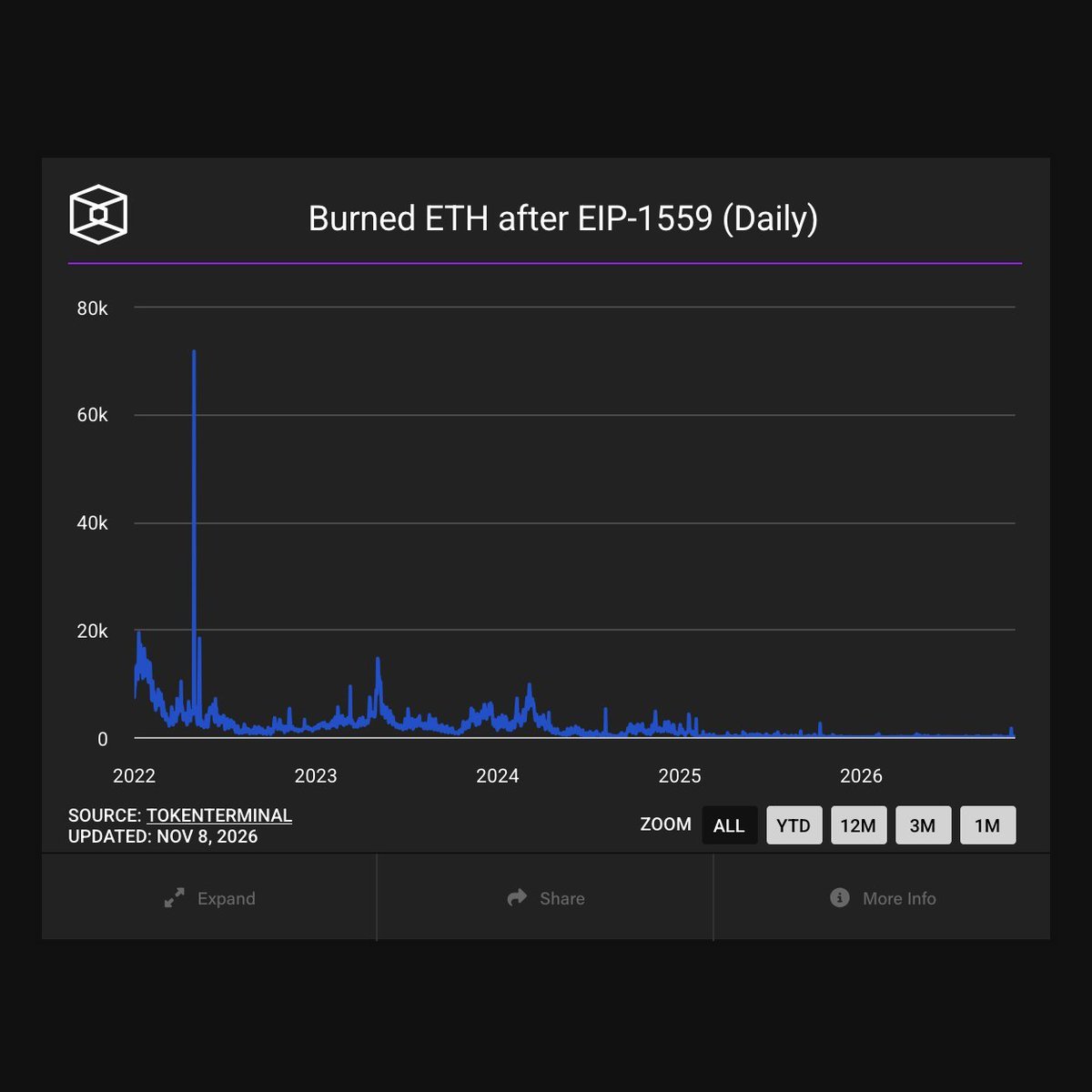
Ethereum co-founder Vitalik Buterin argued on X that focusing on ETH as a store of value makes far more sense than treating it as a fee-burning token. While Buterin maintained that EIP-1559 and its transaction fee burning mechanism should be kept, he noted that the community should not feel sad if fee burning remains below 10% of breakeven indefinitely, as the asset's underlying value comes from outside the burn model.[4][5]
Buterin explained that fee burns never provided a dependable valuation floor because historical spikes were propelled by internal crypto speculation, including an NFT sale that consumed $180 million in transaction fees in one day. To justify a valuation of around $270 billion through burns alone, Buterin estimated that Ethereum would need to operate like a major corporation such as L'Oréal, requiring roughly 700,000 ETH in yearly protocol funding, cutting validator revenues by two-thirds, and demanding interventionist governance that could push gas prices too high for users needing security and privacy.[2][5]
Instead, Buterin pointed to decentralization and what he called CROPS—censorship and capture resistance, open source, privacy, and security—as Ethereum's primary strengths. These characteristics yield stability, a trait Buterin believes will become increasingly prized during an era of disruption from artificial intelligence. The remarks follow data reported by The Block showing Ethereum has burned roughly 19,200 ETH this year, a sharp decline from 1.48 million ETH burned in 2022, and come weeks after developers withdrew a contested proposal to burn validator rewards following industry pushback.[1][2][3][4][5]
Key facts
- Vitalik Buterin stated that treating ETH as a store of value makes much more sense than treating it as a fee-burning token.
- Buterin said EIP-1559 should be retained, but holders should not feel sad if fee burning stays below 10% of breakeven indefinitely.
- Buterin argued that justifying a roughly $270 billion market cap on burned fees alone would require around 700,000 ETH in annual protocol spending and reduce validator revenue by two-thirds.
- Past fee-burn spikes were largely driven by internal crypto activity, such as a digital monkey sale that burned $180 million in fees in a single day.
- Ethereum has burned about 19,200 ETH so far this year, down from 1.48 million ETH in 2022, according to data from The Block.
- Buterin emphasized decentralization and CROPS (censorship and capture resistance, open source, privacy, and security) as the foundation for stability, which he expects to be highly valued amid AI disruption.
Sources · 5 sources
- TB
The BlockArticle ·
Vitalik Buterin says ETH should be valued as a store of value, not a fee-burning token A recent controversial proposal to burn a rising share of validator rewards as more ETH is staked was withdrawn last month after facing pushback.
Open source - TB
The Block@TheBlockCoPost on X ·
THE BLOCK: Vitalik Buterin says ETH should be valued as a store of value, not a fee-burning token. He said the burn "was never a true floor" and that optimizing for fees would require heavy protocol spending and interventionist governance. Buterin said Ethereum should keep its fee burn, but holders "should not feel sad" if it stays below 10% of breakeven indefinitely. Ethereum has burned about 19,200 ETH so far this year, down from 1.48 million in 2022, per The Block’s data. The thread comes five weeks after the authors of a proposal to burn a rising share of staking rewards withdrew it following industry pushback.
Open source - BS
BSCN@BSCNewsPost on X ·
Vitalik Buterin Sees a Store Of Value Future For Ethereum Vitalik Buterin (@VitalikButerin) believes Ethereum (@ethereum) should focus on $ETH's role as a store of value, not fee burning. He says EIP-1559 should remain, even if burns offset less than 10% of new issuance. The idea of ETH as ultrasound money gained traction during the 2021 bull market. Buterin now argues fee burning never provided the reliable valuation floor supporters expected. Much of the earlier activity came from speculative crypto use cases, not lasting external demand. For Buterin, decentralization, security and stability matter more. The Ethereum co-founder believes these qualities could become more valuable as AI disruption accelerates.
Open source - DN
DEGEN NEWS@DegenerateNewsPost on X ·
NEW: @VitalikButerin SAYS "$ETH AS STORE OF VALUE" MAKES "MUCH MORE SENSE" THAN "$ETH AS FEE-BURNING TOKEN" ADDS "WE SHOULD NOT FEEL SAD IF FEE BURN IS < 10% OF BREAKEVEN INDEFINITELY; THE VALUE OF ETH COMES FROM ELSEWHERE" https://t.co/cTDVcmeNxz
Open source - UN
UnchainedArticle ·
Vitalik Buterin Says Maximizing ETH’s Fee Burn Would Cost Ethereum Its Decentralization Ethereum co-founder Vitalik Buterin wants ETH holders to judge the token by how well it holds value, not by how much of it the network burns, arguing that ETH’s case as a store of value (SoV) rests on Ethereum’s decentralization. In a four-part thread on X on Sunday, Buterin said EIP-1559 , the fee mechanism that destroys part of what users pay for transactions, “is fine and good, we should keep them.” But he added that the community “should not feel sad if fee burn is What ETH is for has been a live argument among Ethereum developers and investors for some time. “This is not an engineering problem. This is a political economy problem,” Gitcoin founder Kevin Owocki said on Unchained in August, during an episode on a proposal to change ETH issuance. He described rival camps “in a debate about what is Eth.” Get Unchained’s crypto news in your inbox with the free Unchained Daily newsletter . A Floor That Wasn’t Buterin walked through the valuation math behind the burn thesis: divide the fees a token burns each year by a discount rate, so $1 billion burned at 4% implies a $25 billion floor. He said that floor never really held for Ethereum, because most of the ETH burned from 2021 to 2023 came from activity inside crypto, from lending to a “digital monkey sale” that he said burned $180 million in fees in one day. Had ETH fallen tenfold, that spending would have shrunk with it. “The floor argument only works if the backing of the revenue stream is external,” he wrote, adding that the growing market for tokenized real-world assets now gives Ethereum a better claim to that backing. Corporate-Scale Costs To justify a market cap of about $270 billion with burned fees alone, Buterin argued , Ethereum would have to operate like a major global company on the order of L’Oreal, which he placed 55th. Citing an AI estimate that L’Oreal spends about 0.58% of its market cap a year on research, Buterin wrote in the same post that Ethereum would need “in-protocol funding to the tune of ~700k ETH per year,” cutting validator revenue by two-thirds. Buterin wrote that the network would also need “highly interventionist governance.” Optimizing for the burn would also mean higher gas prices, he said, which could price out users who most need privacy and security. Survival as the Test The first test for a store of value, Buterin wrote , is “to survive.” He pointed to conservative security choices, partial ossification of the protocol, and work on multisigs and private holdings. He also cited EIP-8288, a draft proposal he co-authored that he tied to holding ETH both privately and safely, and said FOCIL aims to stop block builders from blocking transactions. He said a node running on his laptop “synced in “The best private reason to hold ETH is its SoV properties, which are a direct consequence of that decentralization and CROPS,” Buterin wrote, using his shorthand for censorship and capture resistance, open source, privacy and security. Related Listen: Vitalik Finally Says ETH Matters. Zak Cole: ‘Should Have Said That 5 Years Ago’ The post Vitalik Buterin Says Maximizing ETH’s Fee Burn Would Cost Ethereum Its Decentralization appeared first on Unchained .
Open source