

Vitalik Buterin opens Devcon 8 with push for verifiable hardware and data privacy
Ethereum co-founder Vitalik Buterin opened Devcon 8 by calling for inspectable hardware, stronger privacy safeguards, and a broader vision for Ethereum that reaches beyond finance into verifiable personal technology.
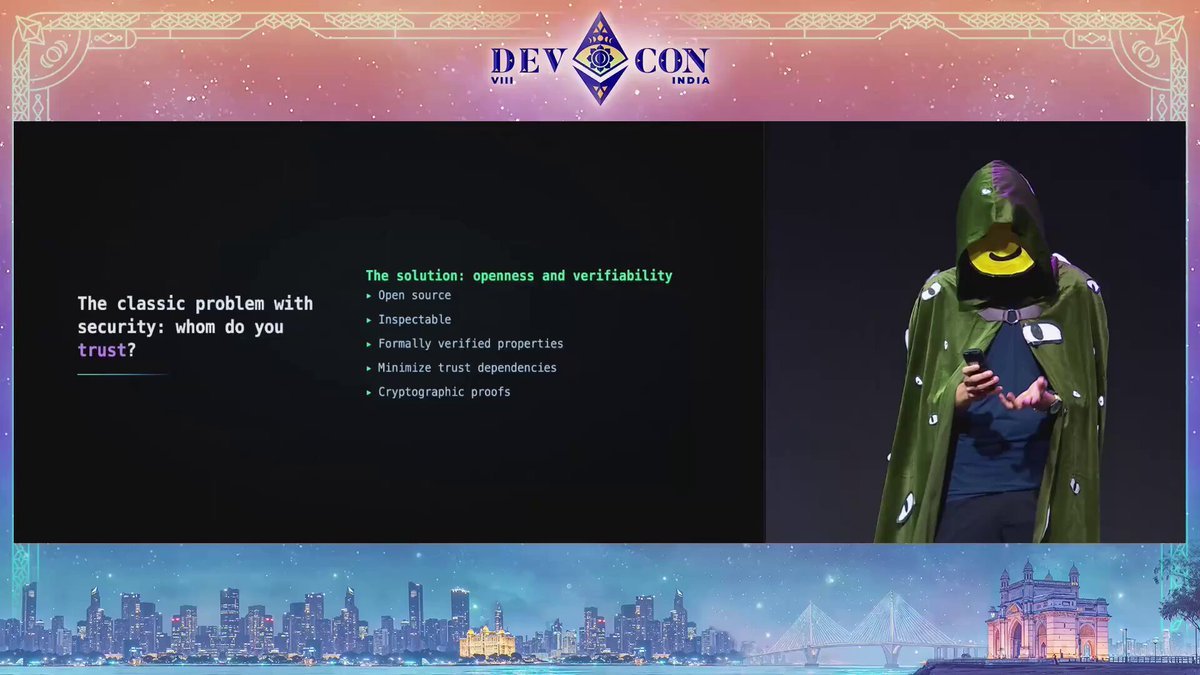
Opening Devcon 8 in India, Ethereum co-founder Vitalik Buterin called on the technology industry to build inspectable hardware and enforce stricter data protections, declaring, "Not your silicon, not your life." He urged developers to "treat data as toxic waste by default" and argued that security must address whom individuals trust with their devices, communications, health records, and artificial intelligence, according to reports by Coin Bureau and Crypto Briefing.[1][2]
Buterin presented openness and verifiability as the primary solution to trust dependencies, advocating for open-source software, inspectable hardware designs, formal verification, and cryptographic proofs to remove reliance on corporations or social influencers. He framed Ethereum's overarching mission as extending past financial applications toward decentralized, verifiable tools that users can independently inspect and safely operate.[2]
According to Cointelegraph, Buterin also raised questions about the security of existing hardware wallets and pointed out that AI presents a dual reality: generating new privacy and security risks while simultaneously assisting in finding code vulnerabilities. He cautioned against making investment decisions based on bot-heavy social media feeds and urged companies to minimize personal data collection while adopting zero-knowledge proofs and decentralized systems to protect user information.[3]
Key facts
- Vitalik Buterin opened Devcon 8 in India with a keynote focusing on hardware trust and privacy protections.
- Buterin stated during the conference that users must be able to trust their hardware, using the phrase "Not your silicon, not your life."
- Buterin argued that data should be treated as "toxic waste by default" and urged companies to refrain from collecting unnecessary personal information.
- To reduce blind trust in companies and influencers, Buterin advocated for open source, inspectable hardware, formal verification, and cryptographic proofs.
- Buterin questioned the security of hardware wallets and warned against following crypto investment advice on social media due to bot manipulation.
- Buterin noted that AI creates new privacy and security threats while also serving as a tool to detect software vulnerabilities.
Sources · 3 sources
- CB
Crypto BriefingArticle ·
Vitalik Buterin calls for trustworthy hardware at Devcon 8 Buterin's call for verifiable hardware at Devcon 8 highlights a shift towards enhancing trust and privacy in tech, impacting future blockchain security. The post Vitalik Buterin calls for trustworthy hardware at Devcon 8 appeared first on Crypto Briefing .
Open source - CB
Coin Bureau@coinbureauPost on X ·
🚨TODAY: Vitalik Buterin calls for trustworthy hardware and stronger privacy protections at Devcon 8: “Not your silicon, not your life.” “We really need to treat data as toxic waste by default.” Opening the conference, Buterin framed security around one question: whom do we trust with our devices, health data, communications and AI? “We need to be able to trust our hardware.” He called for open-source code, inspectable hardware, formal verification and cryptographic proofs to reduce reliance on blind trust in companies or influencers. He explains how Ethereum’s mission extends beyond finance to technology people can independently verify and safely use.
Open source - CO
Cointelegraph@CointelegraphPost on X ·
⚡️ LATEST: Ethereum co-founder Vitalik Buterin warned at Devcon 8 that AI is creating new threats to security and privacy while also helping detect vulnerabilities. He questioned the security of hardware wallets and warned against making crypto investments based on social media posts filled with bots and manipulation. Buterin called for decentralized, verifiable technologies and zero-knowledge proofs to protect personal data, arguing that companies should avoid collecting unnecessary information.
Open source