

US spot bitcoin ETFs shed $643 million after Binance hack
US spot bitcoin exchange-traded funds recorded over $643 million in net outflows on Friday following a reported $6.3 billion hack at Binance, marking their largest single-day withdrawal since June.
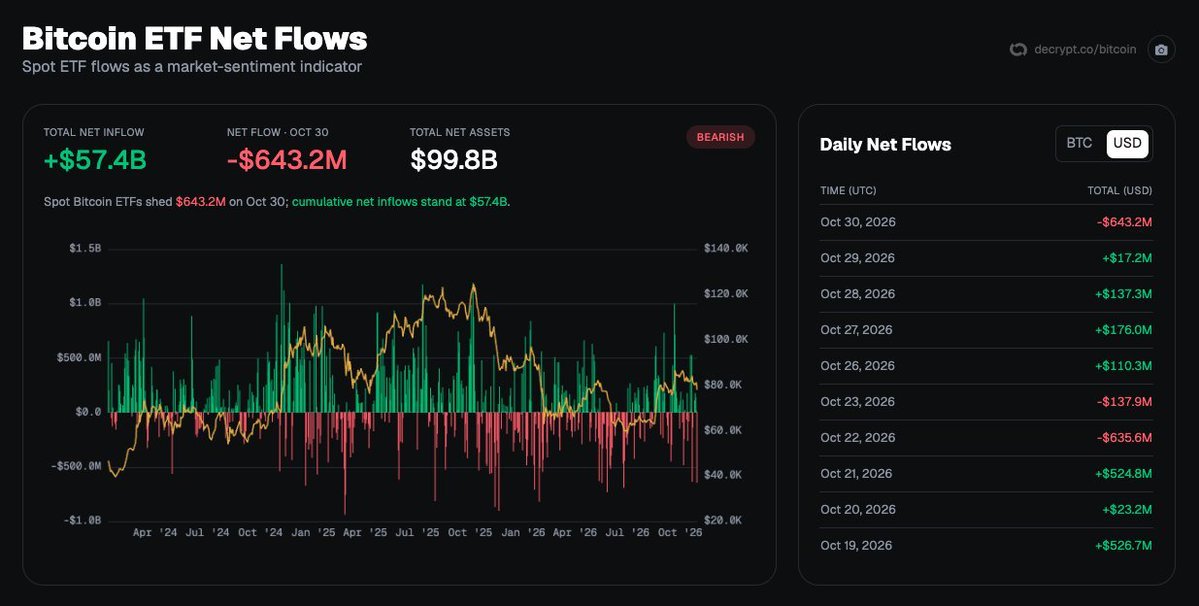
US spot bitcoin ETFs suffered $643.3 million in net outflows on Friday, Oct. 30, marking the funds' largest single-day withdrawal since June 25, according to reports from The Block and CoinDesk. The heavy redemptions came on the first trading session after a reported $6.3 billion hot-wallet security breach hit crypto exchange Binance.[1][2][9][10]
The outflows wiped out positive momentum earlier in the week, when bitcoin funds took in more than $436 million between Monday and Thursday, according to CoinMarketCap. Redemptions were led by BlackRock's IBIT, which lost $233.7 million, and Fidelity's FBTC, which saw approximately $201 million in withdrawals, Analytics Insight reported. The single-day exit erased more than 63% of net inflows accumulated over 2026 and flipped the net flow for October into negative territory, according to investor posts.[4][5][6][8][10]
The retreat extended into other digital asset vehicles. Spot ether ETFs logged $155.9 million in net outflows on Friday, their largest one-day exit since Oct. 7, The Block reported. CoinMarketCap data noted that ether funds experienced net outflows on every day of the week, with wider market spot sell orders exceeding buys by $399.9 million.[2][4][6]
Separately, the US-listed VanEck BNB ETF led October inflows among alternative crypto spot funds tracked by SoSoValue with $99 million, ahead of NEAR and XRP products, CryptoSlate reported. However, around $97 million of those BNB allocations arrived on Oct. 2, weeks before the Binance breach, and the fund's custody remains independent of the exchange.[3][7]
Key facts
- US spot bitcoin ETFs logged $643.3 million in net outflows on Friday, Oct. 30, their largest single-day loss since June 25.
- The ETF outflows followed an Oct. 29 hot-wallet security incident at Binance reported as a $6.3 billion theft.
- BlackRock's IBIT lost $233.7 million and Fidelity's FBTC saw about $201 million in net withdrawals on Oct. 30.
- Spot ether ETFs posted $155.9 million in net outflows on Friday, marking their biggest single-day withdrawal since Oct. 7.
- Friday's outflows reversed four straight days of net gains for bitcoin ETFs, which had brought in more than $436 million from Monday through Thursday.
- VanEck's BNB ETF registered $99 million in net inflows for October, with approximately $97 million deposited on Oct. 2 prior to the Binance hack.
Sources · 10 sources
- CO
CoindeskArticle ·
Bitcoin ETFs lost $643 million in outflows Friday, and 2026 is barely green now The first trading day after the Binance hack saw the biggest ETF outflow since June 25.
Open source - TB
The Block@TheBlockCoPost on X ·
THE BLOCK: Spot bitcoin ETFs recorded $643.3 million in net outflows on Friday following the Binance hack, marking their largest single-day outflow since Jun 25. Spot ether ETFs also saw $155.9 million in net outflows, their largest since Oct. 7. bitcoin:native ethereum:native https://t.co/KFeXUZTDlv
Open source - CR
CryptoSlateArticle ·
BNB’s $99 million ETF inflows came almost entirely before Binance’s hack BNB exchange-traded funds (ETFs) led October inflows among US-listed spot crypto ETFs tracked by SoSoValue, with the largest allocation arriving weeks before Binance suffered a record $6.3 billion cryptocurrency hack. The US-listed VanEck BNB ETF attracted $99 million during the month, ahead of $35 million for NEAR and $19 million for XRP, according to SoSoValue… Read the full story on CryptoSlate Understand the crypto stories that matter and what to watch next. Get The Catalyst in your inbox
Open source - CO
CoinMarketCap@CoinMarketCapPost on X ·
⚡ Crypto ETFs Lost $671M. Selling Extended Beyond Funds. 🔹 BTC ETFs took in $436.6M from Monday to Thursday, but Friday's $643.2M outflow wiped out all four days of gains. 🔹 ETH ETFs saw outflows every single day, losing $396.6M for the week. Unlike BTC, there was no early-week recovery. 🔹 Selling went beyond ETFs. Spot sell orders exceeded buys by $399.9M, while BTC long-term holder supply fell by 33,370 BTC.
Open source - T�
TylerD 🧙♂️@Tyler_Did_ItPost on X ·
The BTC ETFs saw $634M in net outflows on Friday That flipped the month of October from +$127M to -$516M net. This week's flows will be telling... https://t.co/IfyAl3n1L0
Open source - MA
ManLy@ManLyNFTPost on X ·
Bitcoin ETFs bought for four straight days last week. Then Friday erased the entire move. Funds took in $441M from Monday through Thursday and lost $643M in the final session, leaving the week at -$202M. That kind of reversal tells you more than the weekly total. Institutions are still willing to buy the range. They are not willing to defend that decision for very long. The onchain picture is less dramatic. Bitcoin’s 30-day realized volatility has fallen to roughly 25%, a level seen on only about 5% of days since 2015. Realized losses have also become smaller with each dip since August. So demand is thin, but this still doesn’t look like panic distribution. BTC is stuck between buyers moving their bids down toward $78K–$79K and old supply repeatedly rejecting price around $84K–$85K. ETH showed an even cleaner split. Its ETFs sold every day last week, losing $431M. At the same time, roughly 1.12M ETH is waiting to enter staking and only 576 ETH is waiting to exit. That doesn’t make ETH automatically bullish. It shows that liquid financial exposure and native yield demand are being priced by two very different groups. The stronger businesses were mostly being built outside the chart. Tether generated $1.5B in quarterly operating profit and nearly doubled its reserve buffer to $8B, despite USDT supply staying broadly flat. Aviva launched a tokenized share class for its £22B sterling liquidity fund and committed £50M to the product. Coinbase’s prediction markets passed $200M in annualized revenue, while the average USDC held across its products reached a record $22B. On Hyperliquid, stocks, indices and commodity perps now generate more daily volume than Bitcoin perps. Those developments point in the same direction. Crypto companies are no longer competing only for crypto trading volume. They are competing for cash balances, fund distribution, event markets and leveraged exposure to traditional assets. The market itself remains indecisive. The market structure built around it is becoming much less dependent on whether BTC breaks $85K next week.
Open source - CR
CryptoSlate@CryptoSlatePost on X ·
About $97M of the @vaneck_us BNB ETF’s $99M October inflows arrived on Oct. 2, per @SoSoValueCrypto. That was weeks before Binance’s Oct. 29 hot-wallet hack. The fund’s custody is separate from the exchange. By @hardeyjumoh https://t.co/0R4mfUhriB
Open source - CG
Crypto GEMs 📈🚀@cryptogems555Post on X ·
Wall Street just erased 64% of Bitcoin ETFs' 2026 inflows... in ONE day 📉 Friday: -$643M, biggest exit since June IBIT -$234M | FBTC -$201M BTC still holding $78K. This week decides it: 🗳️ Tue: US midterms 📊 Fri: jobs report Buy the fear or wait? 👇 https://t.co/WOCgviH7KR
Open source - TB
The BlockArticle ·
Spot bitcoin ETFs see largest daily outflows in four months following record Binance hack US spot bitcoin ETFs shed $643 million on Friday, marking their largest single-day outflow since June 25, following Thursday's Binance's hack.
Open source - AI
Analytics Insight@analyticsinmePost on X ·
𝐁𝐢𝐭𝐜𝐨𝐢𝐧 𝐄𝐓𝐅𝐬 𝐋𝐨𝐬𝐞 𝐔𝐒𝐃 𝟔𝟒𝟑 𝐌𝐢𝐥𝐥𝐢𝐨𝐧 𝐚𝐬 𝐁𝐢𝐧𝐚𝐧𝐜𝐞 𝐇𝐚𝐜𝐤 𝐒𝐡𝐚𝐤𝐞𝐬 𝐈𝐧𝐯𝐞𝐬𝐭𝐨𝐫 𝐂𝐨𝐧𝐟𝐢𝐝𝐞𝐧𝐜𝐞 US spot Bitcoin ETFs recorded USD 643.3 million in net outflows on October 30, their largest single-day withdrawals since June 25, following Binance's reported USD 6.3 billion security breach. BlackRock's IBIT lost USD 233.7 million, while Fidelity's FBTC recorded approximately USD 201 million in withdrawals. According to SoSoValue, total Bitcoin ETF assets declined to USD 98.14 billion, with Friday's outflows erasing 63.6% of the year's previous net inflows. #Bitcoin #BitcoinETF #BitcoinETFOutflows #BinanceHack #InstitutionalInvestors #AI #AINews #AnalyticsInsight #AnalyticsInsightMagazine Read More 👇 https://t.co/dQrbdyC9nY
Open source