

Solana activates 200-millisecond block slots on mainnet
Solana has completed its SIMD-0525 upgrade on Mainnet Beta, reducing target slot times from 400 milliseconds to 200 milliseconds and shortening network epochs to roughly one day.
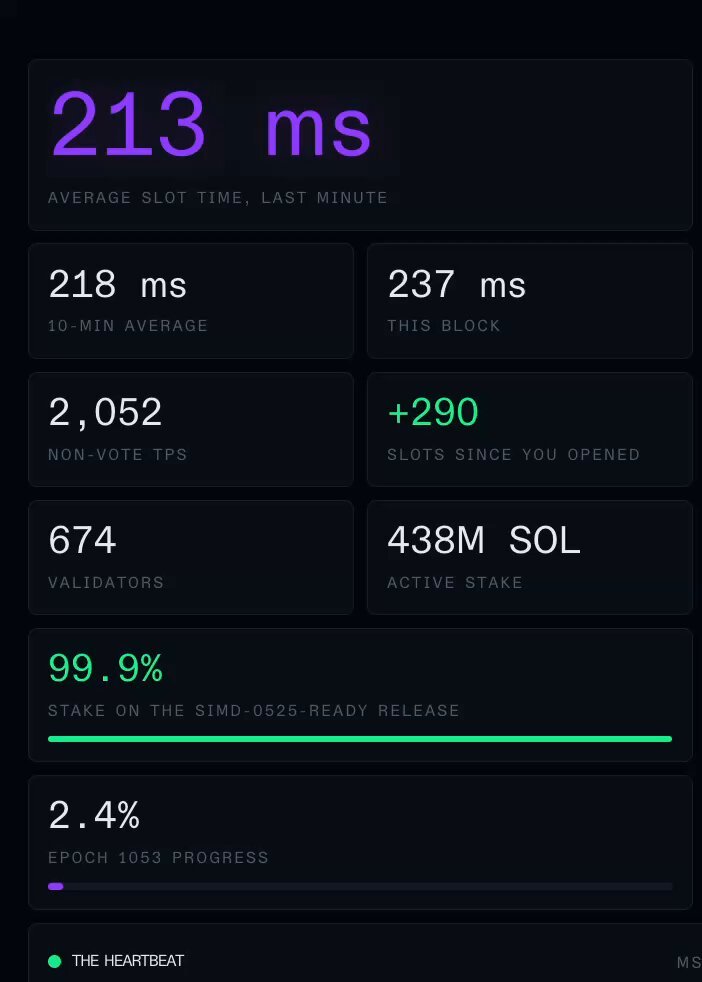
Solana has activated 200-millisecond slot times on Mainnet Beta, concluding a phased rollout that halved its original 400-millisecond slot target. The upgrade, implemented via proposal SIMD-0525, activated at epoch 1052 and slot 454,464,000, enabling the network to produce up to five block-production opportunities per second and shortening the duration of network epochs from roughly two days to approximately 24 hours.[2][4][1]
Agave validator client developer Anza confirmed the completion of SIMD-0525, which concluded a four-stage process that began in August with stepwise reductions to 350ms, 300ms, and 250ms. Under the new configuration, each validator's nominal block-production window drops from 1.6 seconds to 800 milliseconds across four slots. While overall execution capacity per second remains unchanged because developers proportionally reduced each slot's computational budget, transaction blockhash validity has shortened from 60 seconds to about 30 seconds. Following activation, early sampling of public mainnet RPC nodes by CryptoSlate revealed an average slot time of approximately 222 milliseconds across 1,413 slots, while a live dashboard shared by SolanaFloor showed a 10-minute average of 218 milliseconds.[1][4][6]
According to CoinDesk, the faster cadence imposes higher operating costs and tighter block-propagation windows on validators. Looking ahead, Solana Foundation Vice President of Technology Jacob Creech identified the planned Alpenglow consensus overhaul as the network's next major upgrade. Alpenglow aims to lower finality times to around 150 milliseconds from the roughly 12.8 seconds required by TowerBFT; it has been deployed on testnet and devnet, with no mainnet activation date yet announced.[5][4]
Key facts
- Proposal SIMD-0525 activated on Solana Mainnet Beta at epoch 1052 and slot 454,464,000, lowering target slot times to 200 milliseconds.
- The change completed a four-stage rollout that began in August with reductions to 350ms, 300ms, and 250ms, halving the genesis target of 400ms.
- Network epoch durations were reduced from approximately 48 hours to about 24 hours.
- A validator's four-slot block-production window decreased from 1.6 seconds to 800 milliseconds.
- Per-second execution capacity remains unchanged because per-slot compute budgets were reduced proportionally, while transaction blockhash expiration dropped to about 30 seconds from 60 seconds.
- Early post-activation RPC sampling by CryptoSlate showed an average slot time of roughly 222 milliseconds across 1,413 slots.
- Solana's next major planned consensus upgrade, Alpenglow, targets approximately 150-millisecond finality and is currently deployed on testnet and devnet.
Sources · 5 sources
- DN
DEGEN NEWS@DegenerateNewsPost on X ·
NEW: SOLANA’S BLOCKS NOW ARRIVE TWICE AS OFTEN AFTER ITS SLOT TIME DROPPED FROM 400MS TO 200MS https://t.co/qALlPcVgIk
Open source - SO
SolanaFloor@SolanaFloorPost on X ·
🚨JUST IN: The final step in @Solana’s four-stage slot time reduction has been activated at epoch 1052. Slots shorten to 200ms at epoch 1053, completing a 50% reduction from the original 400ms. https://t.co/4gAWgD02u7
Open source - SS
SolanaNews.sol@solananewPost on X ·
🚨BREAKING: SOLANA ACTIVATES 200MS SLOTS ON MAINNET-BETA — COMPLETING SIMD-0525 SLOT REDUCTION FROM 400MS, WITH BLOCKS NOW LANDING TWICE AS OFTEN AND EPOCHS SHORTENED FROM ABOUT TWO DAYS TO ONE!!!🚨 https://t.co/ggpFoZpZTg
Open source - CR
CryptoSlateArticle ·
Solana doubles block production speed to 200ms as network prepares for Alpenglow upgrade Solana has doubled its targeted block-production frequency after activating 200-millisecond slots on mainnet, completing a months-long effort to accelerate the blockchain. The Oct. 9 upgrade reduces Solana's original 400-millisecond slot target by half, allowing the network to create five block-production opportunities per second instead of 2.5. It also shortens the time required to complete a network epoch to approximately 24 hours from 48 hours. Anza, the developer behind Solana's Agave validator client, confirmed the activation , declaring that the SIMD-0525 upgrade had been completed. “Blocks land twice as often as they did at genesis. An epoch now takes about a day instead of two,” Anza stated. Jacob Creech, the Solana Foundation's vice president of technology, also celebrated the milestone, saying the network continues to improve with successive software releases. “Solana continues to improve release after release, proving to be the best place to build,” Creech said, before identifying Alpenglow as the network's next major upgrade. Early performance data indicated that the change was already producing faster slots, although the network had yet to consistently reach its new target. CryptoSlate's sampling of Solana's public mainnet RPC showed an average of approximately 222 milliseconds across 1,413 slots following activation, compared with roughly 268 milliseconds under the previous 250ms target. The latest change completes a four-stage rollout that began in August, when Solana first reduced its slot target to 350 milliseconds. Subsequent reductions to 300ms and 250ms prepared validators for Friday's final adjustment. Related Reading Why Solana’s new 250ms speed boost could actually trigger network instability Faster slots put Solana's next upgrade in focus The shorter intervals could improve transaction responsiveness for applications operating on Solana, particularly decentralized trading platforms and market makers that depend on rapid updates to prices and orders. Under the SIMD-0525 proposal , each validator's nominal four-slot block-production window has fallen to 800 milliseconds from the original 1.6 seconds, reducing how long individual validators can control transaction inclusion. However, the upgrade does not automatically double Solana's transaction-processing capacity. Developers proportionally reduced the computational budget available within each slot, keeping the network's approximate execution capacity per second unchanged. The faster cadence also introduces operational adjustments. According to the Solana Foundation , transaction blockhashes now have an expiration window of approximately 30 seconds, compared with 60 seconds under the original configuration. That gives applications using offline signing or delayed transaction submission less time before transactions require refreshing. Infrastructure providers must also accommodate more frequent blocks, while validators face tighter deadlines for producing and propagating them. Those demands make sustained performance and skipped-slot rates important measures of the upgrade's success. Meanwhile, community attention now shifts to Alpenglow , Solana's planned consensus overhaul targeting transaction finality of approximately 150 milliseconds, compared with roughly 12.8 seconds under the existing TowerBFT system. Alpenglow has undergone deployment on Solana's testnet and devnet, but a mainnet activation date has not been announced. The post Solana doubles block production speed to 200ms as network prepares for Alpenglow upgrade appeared first on CryptoSlate .
Open source - CO
CoindeskArticle ·
Solana is about to halve its block times as final 200-millisecond upgrade nears The network is completing a seven-week push to produce blocks twice as frequently, though validators face higher costs and tighter operating windows.
Open source - SO
SolanaFloor@SolanaFloorPost on X ·
NEW: Watch live as @Solana’s slot time drops to 200ms, completing the final step in its four-stage reduction from 400ms. https://t.co/6fxYM7jWz4
Open source