

SEC updates crypto taxonomy FAQ to clarify decentralization and token buybacks
The U.S. Securities and Exchange Commission has updated its crypto token taxonomy FAQ, clarifying that community voting does not automatically indicate central control and establishing guidelines around token buybacks.
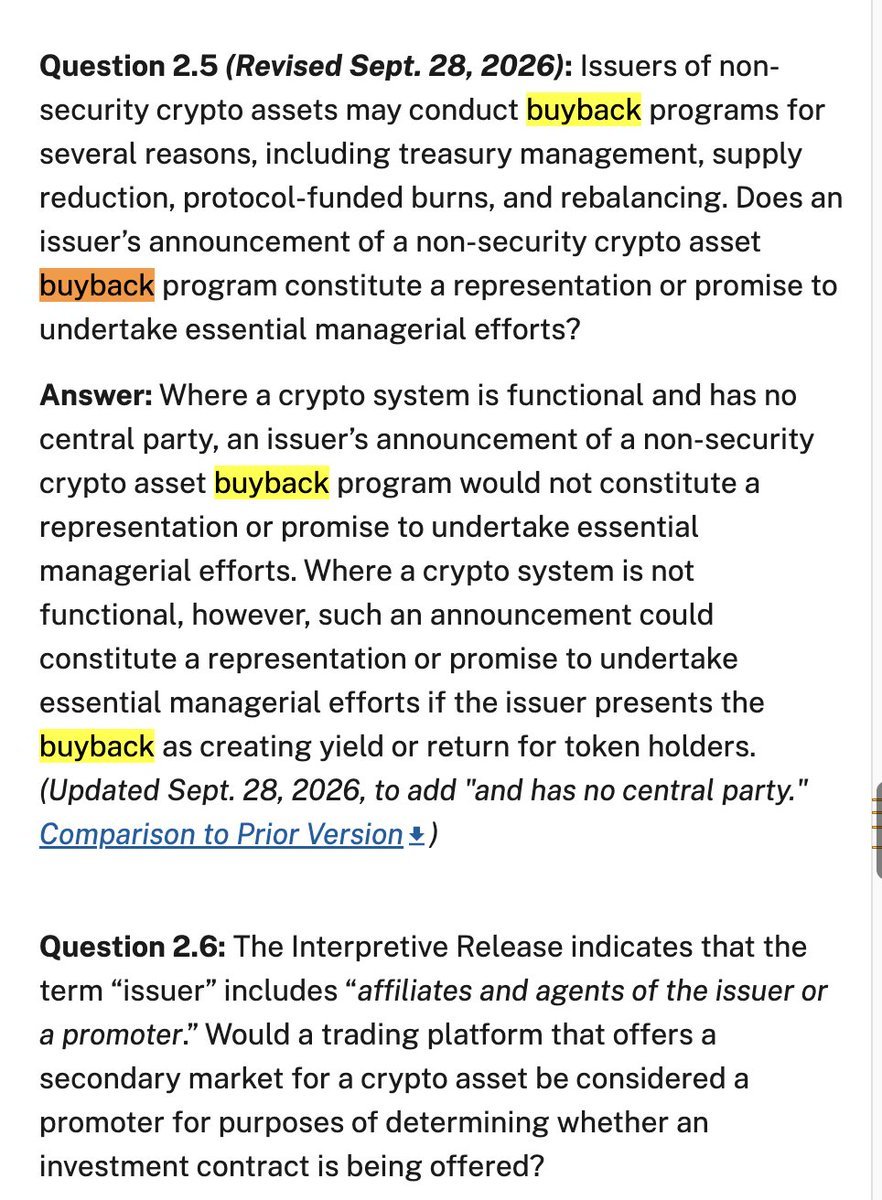
The U.S. Securities and Exchange Commission has released an updated set of frequently asked questions clarifying how federal securities laws apply to crypto assets, expanding upon a token taxonomy originally issued in March, according to reporting by The Block and other crypto outlets.[2][4][5][6]
Under the new guidance, community voting and token-holder governance alone do not classify a crypto project as centrally controlled. Instead, the agency treats network functionality and decentralization as distinct tests, noting that central control hinges on unilateral powers such as modifying protocol code, altering voting rules, restricting network access, or selecting validators. Unaffiliated participants involved in broad-based governance—including structures housed within foundations or decentralized unincorporated nonprofit associations—generally do not constitute a central party.[1][3][7][8][9]
The guidance also details how token buybacks and post-launch development factor into securities analysis. According to the FAQ text, an issuer announcing a buyback program for a non-security crypto asset on a functional system with no central party does not constitute a representation of essential managerial efforts. However, if the system is not functional, a buyback presented as providing yield or return could qualify. In addition, routine network maintenance, software upgrades, and network growth efforts following launch do not count as essential managerial efforts, while mergers or migrations do not extinguish an existing investment contract if managerial obligations merely transfer to another entity.[9]
Key facts
- The SEC released updated crypto FAQ guidance expanding on the token taxonomy it published in March.
- Token holder voting alone does not mean a crypto network is centrally controlled.
- Central control is determined by unilateral authority, such as modifying code, selecting validators, changing voting rules, or restricting user access.
- Unaffiliated participants in network governance, including through foundations or DUNAs, generally do not count as a central party.
- Buyback announcements for non-security tokens on functional networks without a central party do not constitute promises of essential managerial efforts.
- Routine maintenance, protocol upgrades, and ecosystem growth support after a system becomes functional are not deemed essential managerial efforts.
- Mergers or migrations do not automatically terminate an existing investment contract if managerial obligations are simply assumed by another entity.
Sources · 9 sources
- CR
Crypto Rover@cryptoroverPost on X ·
BREAKING: 🇺🇸 SEC releases new guidance, clarifying that crypto projects can allow community voting without automatically being considered centrally controlled. CLARITY IS COMING! 🚀 https://t.co/oWzwEmUHox
Open source - SI
Solid Intel 📡@solidintel_xPost on X ·
INTEL: SEC releases new crypto token taxonomy FAQ | Per SEC
Open source - CB
Crypto Banter@crypto_banterPost on X ·
🚨SEC RELEASES NEW CRYPTO FAQ CLARIFYING DECENTRALIZATION! The @SECGov updated its crypto assets FAQ today with questions on decentralized governance, permissioned vs permissionless systems, and the difference between “functional” and “decentralized.” It notes broad-based governance (including via entities like DUNAs) generally does not create a “central party.”
Open source - CO
Cointelegraph@CointelegraphPost on X ·
🇺🇸 BIG: The SEC has updated its crypto token taxonomy FAQ. https://t.co/Kn0AlLzEUZ
Open source - BM
Bitcoin Magazine@BitcoinMagazinePost on X ·
JUST IN: 🇺🇸 SEC releases new guidance clarifying securities laws on crypto assets 👀 https://t.co/z4gh3chHnv
Open source - TB
The Block@TheBlockCoPost on X ·
THE BLOCK: The SEC released its latest set of "frequently asked questions" in a move to clarify how federal securities laws apply to crypto following the release of its taxonomy in March. On Monday, the agency specifically clarified its stance when it comes to certain aspects of decentralization.
Open source - TW
The Wolf Of All Streets@scottmelkerPost on X ·
SEC STAFF SAYS UNAFFILIATED PARTICIPANTS IN A CRYPTO NETWORK'S GOVERNANCE GENERALLY DON'T COUNT AS A "CENTRAL PARTY" UNDER ITS TOKEN TAXONOMY THE NEW FAQ GUIDANCE SAYS THE SAME APPLIES WHEN GOVERNANCE SITS INSIDE A FOUNDATION https://t.co/9v1wfsHcjv
Open source - BL
BlockNews@blocknewsdotcomPost on X ·
🚨 LATEST: The SEC releases NEW crypto guidance that could be a major win for DeFi! 🔥 • Token holder voting alone does NOT mean centralization. • Central control depends on powers like restricting access, changing voting rules, selecting validators, or modifying code. • Network functionality and decentralization are SEPARATE tests. A major step toward clearer crypto regulations
Open source - SO
SolanaFloor@SolanaFloorPost on X ·
NEW: @SEC staff has released updated crypto FAQs clarifying how token buybacks, governance and network upgrades factor into securities analysis. • Buyback announcements for non-security tokens on functional networks without central control do not constitute promises of essential managerial efforts. • Mergers or migrations do not automatically end an existing investment contract. If another party takes over the original team’s promised managerial work, the token does not shed that contract simply because responsibility changes hands. • Unilateral authority over users, validators, governance or protocol code can indicate central control. • Maintenance, upgrades and network-growth support after a system becomes functional would not constitute essential managerial efforts.
Open source