

XRP Ledger patches decade-old payment bug that allowed token minting
Developers released an emergency patch for an integer overflow vulnerability in the XRP Ledger that could have let an attacker create spendable XRP far beyond the network's 100 billion token supply cap.
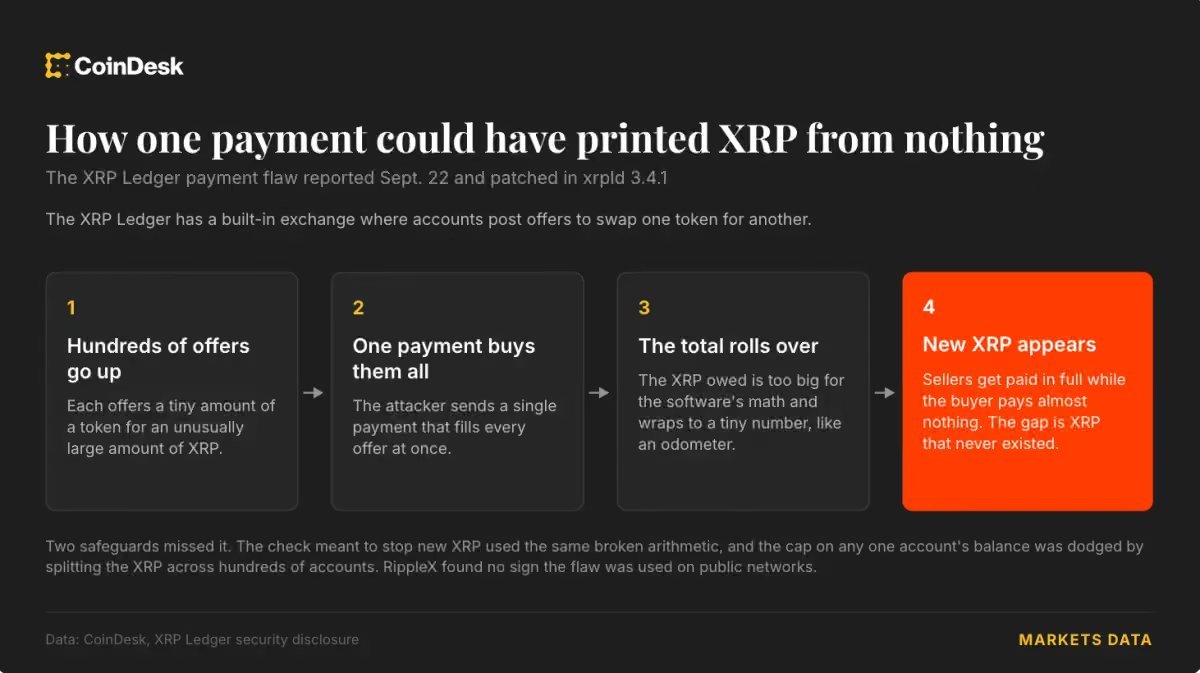
XRP Ledger developers and RippleX deployed an emergency fix to eliminate a critical integer overflow vulnerability in the network's payment engine that had remained undetected since 2015. Disclosed publicly on Oct. 9, the bug would have allowed an attacker to execute a single payment transaction that created spendable XRP out of thin air, bypassing both network supply invariants and account balance limits. The team reported finding no evidence that the vulnerability was ever exploited on any public network.[8][6][1]
The vulnerability was submitted on Sept. 22 through the XRPL bug bounty program by security firm Veria Labs founder Cayden Liao and an AI agent. The exploit mechanism relied on setting up hundreds of deliberately mispriced order offers and routing a single payment through them. Because the payment engine tallied owed funds using unchecked 64-bit addition, the total wrapped around to a negligible amount. The engine paid each offer recipient in full while debiting the buyer only the wrapped sum. According to Liao, the proof-of-concept could have minted approximately 18 trillion XRP, or roughly 184 times the fixed 100 billion token supply.[8][6][2][3]
RippleX engineers reproduced the issue on a standalone server and escalated it to critical before coordinating an immediate patch via xrpld 3.4.1 on Sept. 25. Developers deliberately bypassed the usual two-week validator amendment voting process to prevent the flaw from being reverse-engineered while open to attacks, marking the first time in over a decade that a transaction-processing change skipped the amendment vote. More than 80% of default trusted validators upgraded on release day, before source code was published.[8][6][4]
Veria received a $250,000 bounty for the finding, the maximum payout under the program. The reward drew public criticism from on-chain investigator ZachXBT, who termed the payment cheap relative to the potential damage and warned that modest bounties could incentivize bad actors to exploit major flaws rather than disclose them.[6][3][7][5]
Key facts
- The XRP Ledger vulnerability was an integer overflow in the payment engine dating back to 2015 that allowed newly minted XRP to be created without sender funding.
- Veria Labs founder Cayden Liao stated the proof-of-concept could generate roughly 18 trillion XRP in a single payment, about 184 times XRP's fixed supply cap.
- The flaw was reported on Sept. 22 and patched on Sept. 25 in xrpld version 3.4.1.
- Developers bypassed the network's standard two-week validator amendment vote, releasing the update initially as binaries without public source code to avoid exploitation during deployment.
- RippleX and the XRP Ledger Foundation reported no evidence of the vulnerability being exploited on any public network, confirming approximately 99.986 billion XRP exist.
- Veria received a maximum $250,000 bounty for the discovery, which blockchain investigator ZachXBT criticized as too low given the scale of the flaw.
Sources · 7 sources
- CO
CoinGape@CoinGapeMediaPost on X ·
🟡 UPDATE: @RippleXDev confirms no evidence of exploitation following the emergency XRPL 3.4.1 patch addressing the vulnerability. 🔗Know More in the comments. https://t.co/XBAWXlryDQ
Open source - WB
Wu Blockchain@WuBlockchainPost on X ·
XRPL Fixes Decade-Old Bug That Could Have Minted Trillions of XRP RippleX and the XRP Ledger Foundation disclosed that a critical payment-engine overflow bug could have allowed an attacker to create spendable XRP beyond the network’s fixed supply using a specially crafted transaction. The issue, present in code dating back to 2015, was reported through the XRPL bug bounty program and fixed in xrpld 3.4.1 on September 25, with more than 80% of default validators upgraded that day. Security researcher @Cayden_Liao said his team’s proof of concept could mint about 18 trillion XRP in a single transaction, roughly 184 times XRP’s intended 100 billion supply, and earned the program’s maximum $250,000 bounty. XRPL said it found no evidence the flaw was ever exploited on a public network.
Open source - PR
ProtosArticle ·
XRPL branded ‘cheap’ for paying infinite XRP exploiter just $250K Crypto sleuth ZachXBT says the XRP Ledger Foundation (XRPL) can potentially look forward to losing upwards of $100 million next time it’s hacked after the company paid a whitehat hacker just $250,000 for uncovering and reporting an infinte supply XRP bug. ZachXBT claimed XRPL “cheaply” paid the hacker, noting the crypto firm has “billions” in its treasury. He suggested that XRPL’s stingy reward could lead to cybercriminals in the future choosing to exploit similar major vulnerabilities rather than reporting them in good faith. This, he says, could cost XRPL “nine figures.” “This is why people do not take XRPL or Ripple seriously as an org,” he added. By contrast, in 2022, an Ethereum hacker who could’ve printed an infinite supply of ETH was paid a $2 million bug bounty for disclosing the potential exploit. Infinite XRP hack charged buyers less than intended XRPL released a report last week that disclosed the flaw allowing the creation of new XRP tokens out of thin air. This exploit was discovered by whitehat hackers Cayden Liao and Veria AI, and submitted to XRPL’s bug bounty program on September 22. The pair found that an “integer overflow in the payment engine” could be manipulated with various XRP orders to underpay funds. XRPL said, “The engine paid each offer owner their full amount individually but charged the buyer only the wrapped-around total. The difference was new XRP that should never have existed.” Hacker could’ve printed unlimited ‘Ether’ but chose $2M bug bounty instead Read more: The year’s second-largest XRP hack is spilling over to Bitcoin and Ethereum XRPL submitted a fix by September 25, claiming there’s “no evidence that this issue was exploited on any public network.” It added that the bug has been around since 2015. There are 100 billion XRP in circulation from XRP’s 2012 launch, which now has a market cap of $86.5 billion. XRP was built to prevent any more XRP from being created. Tether and Circle bug bounties also ‘inadequate’ DeFi risk management firm Llamarisk has previously criticised bug bounties offered by Tether and Circle in 2025, finding that they failed to exceed $10,000. They claimed these numbers were “inadequate,” and that a minimum of $50,000 is required to attract decent security researchers. LlamaRisk claims, “For protocols with total value locked (TVL) above $250 million, a maximum payout exceeding $1 million represents a sufficiently capitalized program.” XRP’s TVL is currently $41.8 million. Got a tip? Send us an email securely via Protos Leaks . For more informed news and investigations, follow us on X , Bluesky , and Google News , or subscribe to our YouTube channel. The post XRPL branded ‘cheap’ for paying infinite XRP exploiter just $250K appeared first on Protos .
Open source - BS
BSCN@BSCNewsPost on X ·
XRP Ledger Bypasses Normal Vote to Fix Unlimited XRP Bug XRP Ledger developers defended an emergency patch released on September 25. The vulnerability would have allowed hackers to mint infinite amount of spendable ripple:native. Per reports, waiting two weeks for the regular validator vote could have left the network vulnerable to attacks. According to the Foundation, this decision was made by developers, RippleX (@RippleXDev) and validators in collaboration. They reported no evidence of exploitation on public networks.
Open source - BL
BlockNews@blocknewsdotcomPost on X ·
🚨 LATEST: ZachXBT criticizes the $250,000 reward offered for reporting a critical XRP vulnerability, warning that low bug bounty payouts could discourage whitehat researchers from responsibly disclosing security flaws. $XRP https://t.co/FYJ6c4mpjr
Open source - CR
CryptoSlateArticle ·
AI discovers XRP Ledger flaw that could mint 18 trillion tokens and put $94 billion market at risk An AI agent uncovered a decade-old bug in the XRP Ledger (XRPL) that could create trillions of XRP, prompting an emergency fix. The vulnerability could have let an attacker generate about 18 trillion XRP through a single payment transaction, roughly 180 times the cryptocurrency's original 100 billion token supply, according to security firm Veria Labs. Veria founder Cayden Liao said the flaw potentially threatened XRP's $94 billion market capitalization by undermining the cryptocurrency's fixed supply. The vulnerability was reported on Sept. 22 and patched three days later. RippleX later confirmed that no unauthorized XRP was created, no funds were lost, and investigators found no evidence of exploitation on public networks. The incident was publicly disclosed on Oct. 9. AI uncovers two interconnected flaws that survived a decade of audits The discovery emerged from Veria's AI-powered security system, which analyzed rippled , the software underpinning XRPL, and identified two weaknesses that could be combined to bypass its monetary safeguards. The first involved an integer overflow in the payment engine, where deliberately constructed trading offers could cause the system to miscalculate the amount a buyer owed. Under the exploit, sellers would receive their full XRP payments while the buyer would be charged only a fraction of the actual amount. The difference would effectively create XRP that had never existed. A second vulnerability affected the network's supply-protection mechanism. Because it relied on the same flawed arithmetic, it could fail to recognize that new XRP had been created. The attacker would need to prepare hundreds of accounts and trading offers before submitting the payment. According to the official vulnerability report, the attack required only a few hundred XRP in largely refundable reserves and ordinary transaction fees. The underlying payment-engine code dates to 2015, while the affected supply safeguard was introduced in 2017. That longevity is particularly significant given the network's security history. Liao said the XRPL codebase had undergone more than a dozen audits and security contests since 2024, including one competition with a $550,000 prize pool. Its bug bounty programs had also distributed more than $1 million. Despite those efforts, the combined vulnerability remained undetected until Veria's AI system identified it, assembled a working exploit, and demonstrated the problem on a local network. RippleX engineers independently reproduced the exploit and confirmed that the newly generated XRP could be spent in subsequent transactions. Veria received a $250,000 bounty, the program's maximum. Liao described it as the largest known reward for a vulnerability discovered entirely by an AI agent. Emergency fix bypasses decade-old governance procedures The severity of the discovery forced XRPL developers into an unusual decision: deploy a protocol-changing fix without waiting for the network's established amendment process. Ordinarily, changes to transaction-processing rules require support from more than 80% of trusted validators for two consecutive weeks before activation. However, developers determined that following this procedure would leave the vulnerability exposed while the network voted on its repair. Because XRPL software is open source, publishing the fix could also reveal the exploit to potential attackers before the protection became effective. Instead, RippleX, the XRP Ledger Foundation and validators coordinated an emergency upgrade that activated the protection immediately on servers running version 3.4.1. The patch was initially distributed as binaries, temporarily withholding its source code to limit the risk of attackers reverse-engineering the vulnerability during deployment. According to the disclosure, this marked the first deliberate bypass of the amendment activation process for a transaction-processing change in more than a decade. The approach carried its own danger. Servers running different versions could disagree on whether an exploit transaction was valid, potentially disrupting consensus or halting the network. Developers nevertheless concluded that a temporary network interruption was preferable to letting counterfeit XRP enter circulation. More than 80% of validators on the default trusted-validator list had upgraded by Sept. 25, substantially reducing that risk. XRPL Foundation contributor Vet said the coordinated response preserved network integrity and established version 3.4.1 as the new minimum software requirement following the activation of separate Batch-related amendments on Oct. 9. RippleX turns to AI and formal verification after security scare The incident has prompted RippleX to reassess how it protects critical infrastructure, particularly older software that has survived years of conventional security reviews. J. Ayo Akinyele, RippleX's head of engineering, acknowledged that the vulnerability demonstrated the need to revisit longstanding assumptions about the network's design. He outlined plans to expand AI-assisted vulnerability discovery, strengthen adversarial testing and increase scrutiny of legacy components, including the payment engine, consensus mechanisms and peer-to-peer networking. The organization also plans to accelerate formal verification, a mathematical technique that proves whether software meets specific security properties. That work will build on existing verification efforts involving XRPL's Lending Protocol and Single Asset Vault, alongside collaboration with CommonPrefix and the XRP Ledger Foundation. Akinyele said AI is fundamentally accelerating vulnerability discovery, putting pressure on developers to find weaknesses before malicious actors deploy similar tools. Vet echoed that concern, warning that increasingly capable AI systems could make previously obscure vulnerabilities easier to exploit. The October 9 disclosure also introduced a specific procedural change: security findings previously classified as resolved must now be retested against release candidates before being formally closed. The post AI discovers XRP Ledger flaw that could mint 18 trillion tokens and put $94 billion market at risk appeared first on CryptoSlate .
Open source - BS
BSCN@BSCNewsPost on X ·
ZachXBT Slams Ripple Over $250K XRP Bug Bounty Blockchain investigator ZachXBT (@zachxbt) criticized Ripple (@Ripple) for paying $250,000 to a researcher who uncovered a critical XRP Ledger vulnerability. The bug could have allowed an attacker to create 18 trillion ripple:native in one transaction. That amount was 184 times XRP’s fixed 100 billion token supply. Veria Labs co-founder Caydel Liao (@Cayden_Liao) received the maximum reward under Ripple’s bounty program.
Open source - UN
UnchainedArticle ·
XRP Ledger Fixes Bug That Could Have Broken the Token’s Fixed Supply XRP Ledger developers published a vulnerability disclosure report on Friday, Oct. 9, describing an integer overflow in the ledger’s payment engine . Exploited, it would have handed an attacker newly minted, spendable XRP “far beyond the total supply” in one transaction. The flaw was fixed in xrpld 3.4.1 , released on Sept. 25 . “We have found no evidence that this issue was exploited on any public network,” the report said. Researcher Cayden Liao and Veria AI flagged the issue through the XRPL bug bounty program on Sept. 22. The submission rated it Major; RippleX engineers raised it to critical after reproducing the mint on a standalone server and confirming the new XRP could be spent in a follow-up payment. The report said the bug had likely existed since the current payment engine was written in 2015 . In a post on X , Liao wrote that the bug “let anyone mint infinite XRP, with $94B at risk.” The report itself gives no XRP or dollar amount. Get Unchained’s crypto news in your inbox with the free Unchained Daily newsletter . How the Exploit Worked An attacker would open a few hundred accounts, have each post a deliberately mispriced offer demanding an enormous amount of XRP for a sliver of some token, then route one payment through every offer at once. The engine totaled what the payer owed with unchecked 64-bit addition, so the sum rolled over to a tiny figure. Each offer owner received the full amount, while the payer was debited only the rolled-over number. Neither of two existing safety checks caught it. The invariant meant to stop XRP creation relied on the same unchecked math, and the per-account limit only trips when one account holds more than the entire supply. The setup required only a few hundred XRP in reserves, which can be reclaimed, plus fees, according to the report. No Amendment Vote The fix took effect on each server as soon as it upgraded, skipping the usual process in which a rule change must keep more than 80% validator support for two weeks. The report called it the first change to transaction processing deliberately shipped that way since amendments were introduced more than a decade ago, arguing that because xrpld is open source, a voted fix would have exposed the bug for weeks while it remained exploitable. More than 80% of default UNL validators ran 3.4.1 on release day, when its source code had not yet been published. The report says the source code has now been published. “This case does not change how the XRP Ledger makes protocol changes,” the report said, adding that bypassing amendments “only makes sense for the most severe bugs, where the exploit is even worse than a network halt.” The XRP Ledger Foundation said on X on Sunday that no XRP had been created. “About 99.986 billion XRP exist today,” it wrote. “AI makes bugs like this faster to find, for the bad guys and the good guys.” The report also disclosed a second, lower-impact bug in the Batch feature, which was not yet live on Mainnet at the time; its fix, the fixBatchV1_2 amendment, activated Oct. 9. Developers said every security finding marked as fixed will now be re-tested against each release candidate before it is closed. Related Listen: How OpenAI’s Math Dump Has Crypto Rethinking Its Cryptography: Uneasy Money The post XRP Ledger Fixes Bug That Could Have Broken the Token’s Fixed Supply appeared first on Unchained .
Open source