

NEAR governance approves plan to cut maximum yearly issuance to 1.6%
NEAR Protocol token holders voting in the House of Stake have approved a proposal to reduce the network's maximum annual token issuance from 2.5% to 1.6% over a 24-month period.
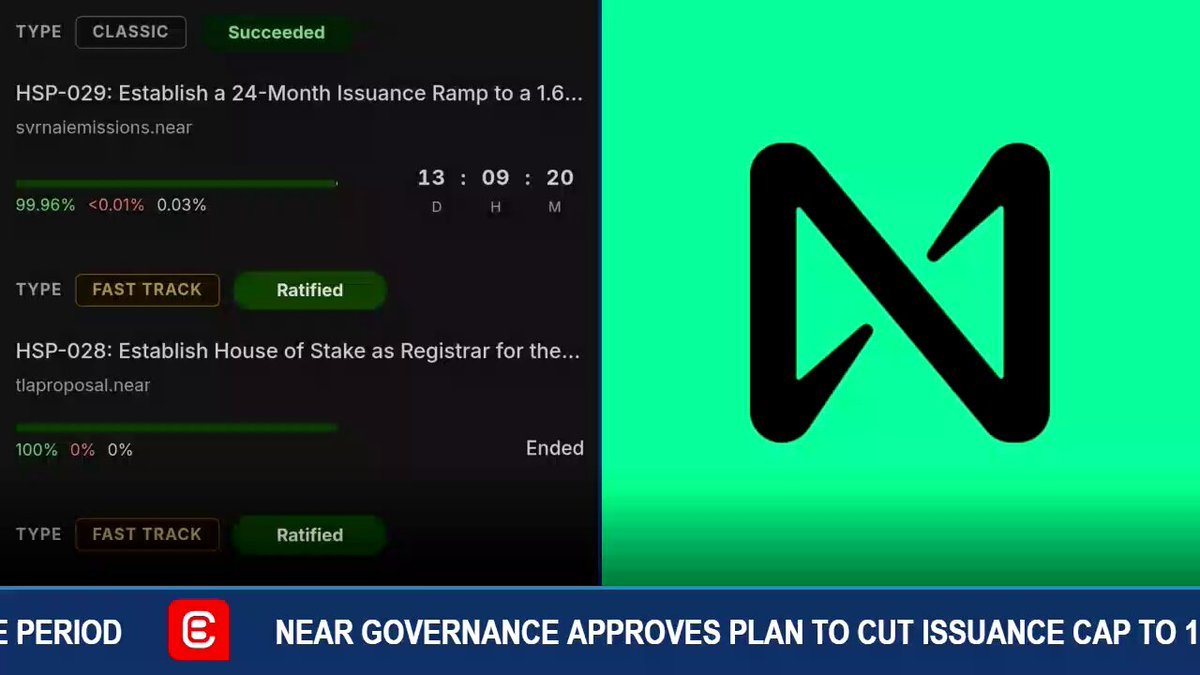
NEAR Protocol's onchain governance body, the House of Stake, has voted to approve proposal HSP-029, a measure to lower the network's yearly issuance cap from 2.5% to 1.6%. The reduction is designed to curb token dilution and sell pressure by phasing in gradually over 24 months. However, the vote does not alter issuance immediately; the change must clear a review by the House of Stake Security Council, undergo a roughly 90-day grace period, and be adopted by validators via a protocol upgrade.[1][2][3][6][7]
Authored by Sal Ternullo, CEO of Nasdaq-listed SVRN, the proposal outlines a tapering schedule where the issuance ceiling drops by roughly 3.75 basis points a month, recalculated every epoch. SVRN holds approximately 55 million NEAR—accounting for over 8% of all staked tokens—and disclosed its intent to back the plan despite acknowledging lower future staking returns. Newly minted tokens will maintain the existing distribution model, directing 90% to stakers and 10% to the NEAR treasury.[2][7]
According to modeling in the proposal, the slower minting schedule will keep roughly 11.8 million NEAR out of circulation over two years, representing about $45 million at market prices cited in coverage, and 66.1 million fewer tokens over six years. The cut is projected to lower gross staking yield from around 5.27% to 3.37% at current participation levels. The modeling also estimated that 24 validator pools would fail to cover their operating costs at the lower rate under September pricing. Despite the intended anti-dilutive impact, the NEAR token dropped 7% following the proposal's passage, according to Cointelegraph.[2][4][6]
Key facts
- NEAR Protocol's House of Stake voted to approve proposal HSP-029, lowering the network's maximum annual issuance from 2.5% to 1.6%.
- The issuance reduction will phase in over 24 months, dropping by roughly 3.75 basis points each month recalculated every epoch.
- Before taking effect, the proposal requires review by the Security Council, a roughly 90-day grace period, and a protocol upgrade adopted by validators.
- The change will retain the network's 90/10 split between staking rewards and the NEAR treasury.
- The proposal's projections indicate 11.8 million fewer NEAR will be issued over two years and 66.1 million fewer over six years.
- Gross staking yield is expected to decrease from approximately 5.27% to about 3.37% once the target rate is reached.
- HSP-029 was drafted by SVRN CEO Sal Ternullo, whose firm holds about 55 million NEAR, representing more than 8% of all staked tokens.
- The proposal estimates that 24 validator pools would stop covering operational costs under the new issuance rate based on token prices measured in September.
Sources · 7 sources
- TB
The Block@TheBlockCoPost on X ·
THE BLOCK: NEAR Protocol's governance body has voted to lower the maximum annual issuance of near:native from 2.5% to 1.6% over 24 months. This is to reduce unnecessary dilution and sell pressure on the token. Full effect still requires a security council review, a ~90-day grace period, and validators adopting the protocol upgrade.
Open source - UN
UnchainedArticle ·
NEAR Blockchain Holders Vote to Trim Max Issuance to 1.6%, Pending Validator Adoption NEAR Protocol ‘s onchain governance body, the House of Stake , has voted to lower the network’s yearly issuance ceiling from 2.5% to 1.6% , phasing the reduction in over 24 months , NEAR announced on X on Nov. 2. The vote does not change issuance on its own. Several steps remain, per NEAR. The House of Stake’s Security Council has to look over the result before ratification. A roughly 90-day grace period follows, and the change becomes binding only once validators adopt it through a protocol upgrade. The proposal , HSP-029, says it “cannot take effect on a House of Stake vote alone.” NEAR’s post did not include a vote count, and the copy of the proposal page reviewed by Unchained listed no tally. Get Unchained’s crypto news in your inbox with the free Unchained Daily newsletter . How the New Schedule Works HSP-029 was written by Sal Ternullo , CEO of Nasdaq-listed SVRN. Once active, the cap would drop by roughly 3.75 basis points a month, recalculated every epoch instead of in fixed steps, until it hits 1.6% at month 24. New tokens would still go 90% to stakers and 10% to the NEAR treasury. Ternullo’s own modeling projects 11.8 million fewer NEAR issued over two years and 66.1 million fewer over six, a supply 4.36% below the current path. At today’s staking participation, it puts gross staking yield at about 3.37% at the target rate, down from roughly 5.27%. The proposal also estimates that 24 validator pools would stop covering their own costs at the new rate and the token price it measured in September. Using the total supply the proposal measured on Sept. 22, the 2.5% cap works out to about 89,500 new NEAR a day and the 1.6% target to about 57,300, or roughly 32,200 fewer new NEAR a day once the ramp is complete, by Unchained’s calculation. Disclosures and Background The proposal discloses that SVRN holds about 55 million NEAR , more than 90% of it staked, accounting for over 8% of all staked NEAR, and that SVRN intended to vote in favor. Ternullo wrote that the cut also lowers the yield on SVRN’s own stake. NEAR halved its issuance to 2.5% in 2025 through the same validator upgrade path, according to the proposal. Ternullo presented HSP-029 as one of the alternatives raised after NEAR co-founder Illia Polosukhin withdrew a Sovereign Fund proposal in August, citing what Polosukhin called “risks the protocol should not internalize.” NEAR said quarterly reports will compare realized issuance with the published schedule once the ramp is live. Related Listen: Is Ethereum’s Issuance Proposal Already ‘Dead in the Water’? The post NEAR Blockchain Holders Vote to Trim Max Issuance to 1.6%, Pending Validator Adoption appeared first on Unchained .
Open source - TB
The BlockArticle ·
NEAR governance approves proposal to cut token issuance ceiling to 1.6% NEAR's House of Stake passed HSP-029, which lowers the network's maximum annual issuance rate from 2.5% to 1.6% over 24 months.
Open source - CT
Coin TelegraphArticle ·
NEAR token sinks 7% as proposal to cut annual token issuance passes The proposed issuance cut would prevent 11.8 million NEAR from entering circulation over two years, worth about $45 million at today’s price.
Open source - DE
Decrypt@DecryptMediaPost on X ·
NEAR Token Holders Vote to Cut Maximum Annual Issuance to 1.6%. NEAR's House of Stake governance body voted to lower maximum annual issuance from 2.5% to 1.6% over 24 months, pending Security Council review, a 90-day grace period and a validator protocol upgrade. https://t.co/JUhjtsb48x
Open source - BS
BSCN@BSCNewsPost on X ·
NEAR Protocol holders vote to cut new token issuance by more than a third Voters in "House of Stake", the onchain governance body of @NEARProtocol, approved a plan today to lower the maximum yearly issuance of $NEAR from 2.5% to 1.6%. The cut will phase in step by step over 24 months, starting after a grace period of about 90 days. The change still needs a review by the House of Stake Security Council and a protocol upgrade adopted by validators before it takes effect. The proposal estimates about 11.8M fewer NEAR minted over two years, while gross staking yield would ease from about 5.3% to 3.4% once the new rate is reached.
Open source - CB
Crypto Banter@crypto_banterPost on X ·
🚨NEAR GOVERNANCE APPROVES PLAN TO CUT ISSUANCE CAP TO 1.6%! @NEARProtocol’s House of Stake has voted to lower the maximum annual issuance of near:native from 2.5% to 1.6%, phased in over 24 months. The change still requires Security Council review, a roughly 90-day grace period, and a protocol upgrade adopted by validators before it becomes binding. It keeps the existing 90/10 split between staking rewards and the treasury.
Open source