

FCC approves SpaceX plan to deploy up to 1 million satellites for orbital data centers
The Federal Communications Commission has authorized SpaceX to deploy up to 1 million satellites for its Starmind constellation, representing the first U.S. approval for an orbital data center network designed to run artificial intelligence computing in space.
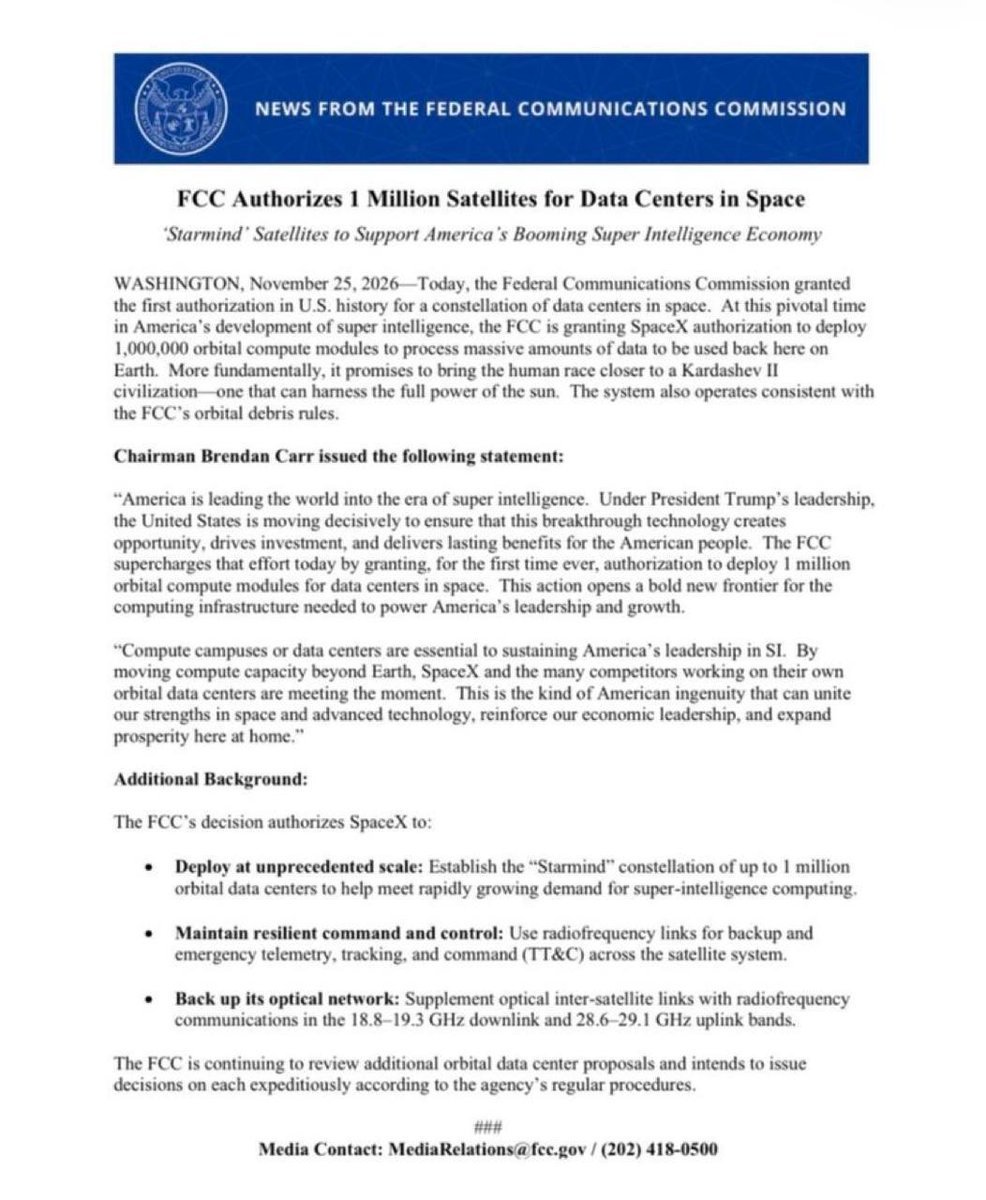
The Federal Communications Commission granted SpaceX authorization on November 25, 2026, to launch up to 1 million orbital compute modules for a space-based data center network named Starmind. The FCC designated the approval as the first in U.S. history for an orbital data center constellation, designed to process massive quantities of data in space for use on Earth amid surging demand for artificial intelligence computing capacity.[5][3][1]
FCC Chairman Brendan Carr called the approval a historic first to create data centers in space, stating that moving compute campuses beyond Earth opens a new frontier for super-intelligence infrastructure while complying with orbital debris standards. SpaceX Chief Executive Elon Musk responded to the news by writing that the network will be "a great asset to America and the world." The regulatory order permits SpaceX to supplement optical laser links between satellites with radiofrequency transmissions in the 18.8–19.3 GHz downlink and 28.6–29.1 GHz uplink bands for backup and emergency telemetry, tracking, and command.[5][1][8]
Under the regulatory terms, SpaceX must begin deploying the constellation by November 2033, reach 10% deployment with 100,000 satellites by November 2035, and reach 50% deployment by November 2038. The FCC noted that it is also reviewing additional orbital data center proposals, while observers and astronomers have pointed to potential challenges involving night-sky visibility and space debris.[7][6][5][2]
Key facts
- The FCC authorized SpaceX on November 25, 2026, to deploy up to 1 million orbital compute modules for a data center constellation named Starmind.
- The FCC described the decision as the first authorization in U.S. history for a constellation of data centers in space.
- The authorization allows SpaceX to back up optical inter-satellite links using radiofrequency communications in the 18.8–19.3 GHz downlink and 28.6–29.1 GHz uplink bands for emergency telemetry, tracking, and command.
- SpaceX is required to begin deployment by November 2033, launch 10% (100,000 satellites) by November 2035, and reach 50% deployment by November 2038.
- SpaceX CEO Elon Musk publicly responded to the approval, calling it "a great asset to America and the world."
- The FCC announced that it is continuing to review additional orbital data center proposals under its regular procedures.
Sources · 8 sources
- CN
CBS News@CBSNewsPost on X ·
The Federal Communications Commission on Wednesday greenlit SpaceX’s request to put 1 million satellites in space that will create orbital data centers, bringing CEO Elon Musk closer to his goal of harnessing the sun to generate computing power. “Today, in a historic first, the FCC approved SpaceX’s request for 1 million satellites (orbital compute modules) to create data centers in space,” FCC Chairman Brendan Carr said in a post on X. Musk responded by saying, “Much appreciated. This will be a great asset to America and the world.” Read more: https://t.co/eFfp0zjJO2
Open source - TI
Tech in Asia@techinasiaPost on X ·
SpaceX has received approval to deploy up to 1 million satellites as data centers in space. The plan faces technical and financial challenges. Astronomers have also raised concerns about its impact on the night sky and the risk of space debris. https://t.co/FmfON0Y5Ev
Open source - ET
Economic Times@EconomicTimesPost on X ·
One million satellites, one orbital data-centre plan | The Federal Communications Commission is authorizing Elon Musk's SpaceX to deploy a constellation of 1 million satellites for data centers in space, the agency said. SpaceX earlier this year sought permission to deploy up to 1 million orbital compute modules to process massive amounts of data to be used on Earth. The FCC said it was approving the SpaceX “Starmind” constellation to help meet rapidly growing demand for AI computing. Full Report Here 👇 https://t.co/AcJHM8UzY0 #SpaceX #Technology #Space #Business #Satellites
Open source - TE
TechmemeArticle ·
The US FCC authorizes SpaceX to deploy its "Starmind" constellation of 1M satellites for data centers in space (David Shepardson/Reuters) David Shepardson / Reuters : The US FCC authorizes SpaceX to deploy its “Starmind” constellation of 1M satellites for data centers in space — The Federal Communications Commission on Wednesday said it was authorizing Elon Musk's SpaceX (SPCX.O) to deploy 1 million satellites for data centers in space.
Open source - CO
Cointelegraph@CointelegraphPost on X ·
🇺🇸 JUST IN: The FCC has authorized Elon Musk’s SpaceX to deploy up to 1 million satellites for AI data centers in space, a first in U.S. history. https://t.co/DThzWqdXNx
Open source - BU
businessline@businesslinePost on X ·
Elon Musk's SpaceX has secured FCC approval for an ambitious constellation of up to 1 million satellites to support AI computing in space, with deployment milestones stretching through November 2038. https://t.co/GcVUX0wBGa
Open source - UW
unusual_whales@unusual_whalesPost on X ·
BREAKING: The FCC has authorized SpaceX, $SPCX, to deploy up to 1 million satellites for Starmind, its planned orbital data center network. The FCC calls it the first authorization in US history for a constellation of data centers in space. SpaceX has to begin deployment by November 2033, deploy 10% of the satellites (100,000) by November 2035, and reach 50% by November 2038.
Open source - CB
Coin Bureau@coinbureauPost on X ·
🚨HUGE: SpaceX receives its first-ever U.S. approval to deploy up to 1 MILLION satellites for Starmind, a network that would process data in orbit for use on Earth. The satellites would share data through laser links, with radio links for tracking, emergency commands and backup. $SPCX is pursuing the project as demand for AI computing power grows and data centers on Earth face limits on electricity, cooling and land.
Open source