

Google DeepMind uses AlphaProof Code to verify Signal protocol down to machine code
Google DeepMind researchers used a multi-agent AI system named AlphaProof Code to mathematically verify key security properties of Signal's cryptographic protocol implementation in four weeks.
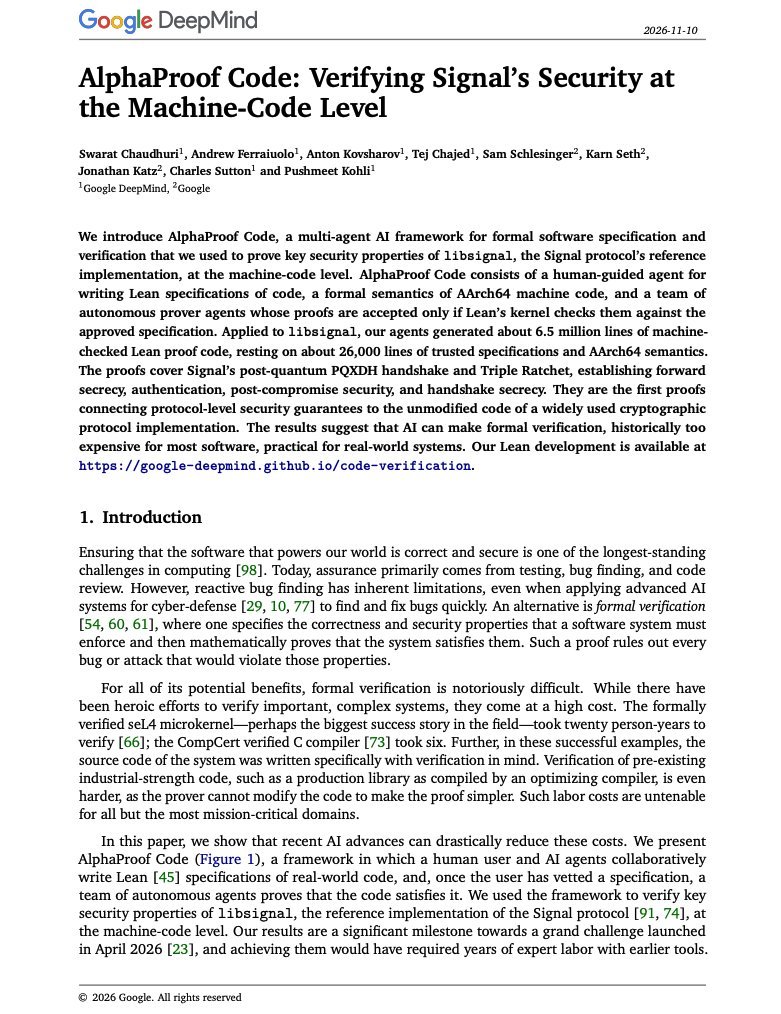
Google DeepMind researchers have formally verified the cryptographic guarantees of Signal's reference implementation, libsignal, using an agentic artificial intelligence framework called AlphaProof Code. First reported by Lily Hay Newman for Wired and detailed in a DeepMind research paper, the four-week proof-of-concept mathematically verified that the protocol operates securely as intended down to compiled AArch64 machine code.[2][3][4]
The verification system relied on autonomous prover agents powered by Gemini 4 Carbon alongside human-guided specification agents. The prover agents generated roughly 6.5 million lines of Lean proof code verified by Lean's kernel, resting on approximately 26,000 lines of trusted specifications and AArch64 semantics. The resulting proofs covered Signal's post-quantum PQXDH handshake and Triple Ratchet, proving properties including forward secrecy, post-compromise security, authentication, and handshake secrecy.[4]
A team of five completed the project in four weeks, a timeline DeepMind contrasted with landmark formal verification efforts such as the seL4 microkernel, which required roughly twenty person-years. To test the system's sensitivity to real-world flaws, researchers reintroduced two known past Signal bugs, and the framework successfully proved that the buggy versions were insecure. Separate reporting from 9to5Mac highlighted that the DeepMind security analysis extends to WhatsApp's encryption protocol as well.[1][4][5]
Key facts
- Google DeepMind verified the security properties of Signal's libsignal reference implementation down to compiled AArch64 machine code using an agentic framework called AlphaProof Code.
- A team of five completed the formal verification work in four weeks, utilizing prover agents powered by Gemini 4 Carbon.
- The autonomous agents generated around 6.5 million lines of machine-checked Lean proofs built on roughly 26,000 lines of trusted specifications and AArch64 semantics.
- The proofs cover the PQXDH handshake and Triple Ratchet, confirming authentication, handshake secrecy, forward secrecy, and post-compromise security.
- When researchers reintroduced two past Signal bugs into the code, AlphaProof Code proved that the flawed versions were insecure.
- 9to5Mac reported that DeepMind's encryption analysis also confirmed the security of WhatsApp.
Sources · 5 sources
- 9T
9to5Mac@9to5macPost on X ·
Google DeepMind analysis proves Signal and WhatsApp encryption is secure https://t.co/CJOXfUEHYS by @benlovejoy
Open source - TE
Techmeme@TechmemePost on X ·
Google DeepMind researchers used agentic AI framework AlphaProof Code to verify the Signal protocol's cryptographic guarantees, in a four-week proof-of-concept (@lilyhnewman / Wired) (Visit Techmeme dot com for the link and full context!)
Open source - TE
TechmemeArticle ·
Google DeepMind researchers used agentic AI framework AlphaProof Code to verify the Signal protocol's cryptographic guarantees, in a four-week proof-of-concept (Lily Hay Newman/Wired) Lily Hay Newman / Wired : Google DeepMind researchers used agentic AI framework AlphaProof Code to verify the Signal protocol's cryptographic guarantees, in a four-week proof-of-concept — DeepMind researchers were able to formally verify that the widely used encryption protocol works as intended. Their stretch goal?
Open source - EL
elvis@omarsar0Post on X ·
Banger report from Google DeepMind. This is also a good example of the type of ambitious work you can now do with frontier models. (bookmark it) They used AI agents to prove key security properties of Signal's code, down to the compiled machine code. Agents powered by Gemini 4 Carbon wrote about 6.5 million lines of Lean proofs on the unmodified libsignal code. A team of five finished the proof work in four weeks. Verifying the seL4 microkernel took twenty person-years. In this work, humans and agents write the security specs, prover agents write the proofs, and Lean checks every proof before it is accepted. When they reintroduced two old Signal bugs, the system proved the buggy versions were insecure. Paper: https://t.co/aKJlFHMn5y
Open source - PO
Polymarket@PolymarketPost on X ·
JUST IN: Google DeepMind announces its Gemini agents have “mathematically verified” Signal's cryptographic protocol in just 4 weeks.
Open source