

CFTC staff allows derivatives exchanges and clearinghouses to count crypto toward operating cost reserves
Staff at the Commodity Futures Trading Commission issued an advisory permitting regulated exchanges and clearinghouses to hold bitcoin, ether, and payment stablecoins toward their 12-month operating cost requirements, subject to valuation haircuts.
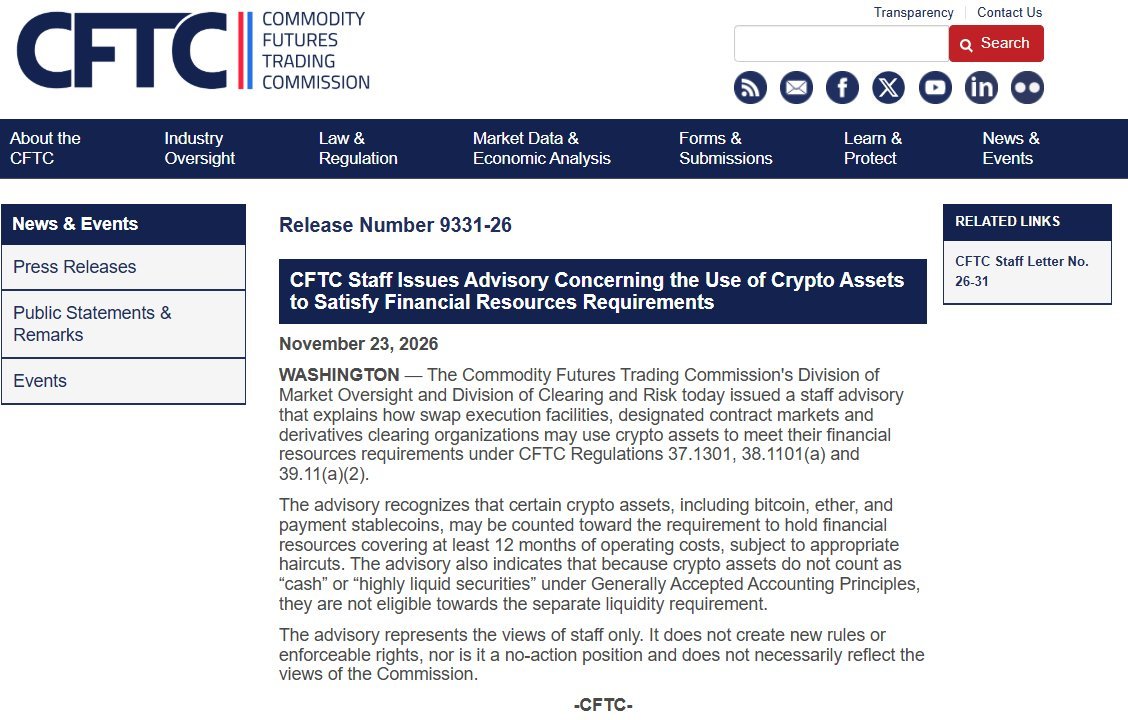
Regulated U.S. derivatives venues can now use bitcoin, ether, and payment stablecoins to help cover mandatory operating reserves, according to a staff advisory issued by the Commodity Futures Trading Commission on November 23, 2026. The guidance from the Division of Market Oversight and Division of Clearing and Risk applies to swap execution facilities (SEFs), designated contract markets (DCMs), and derivatives clearing organizations (DCOs), which must hold financial resources to cover at least one year of operating costs.[2][3][4]
The advisory permits these assets to count toward reserve buffers only after applying regulatory discounts to account for market risk. Holdings in bitcoin and ether face a minimum haircut of 20%, while qualifying payment stablecoins carry a 2% haircut. Unchained reported that non-readily marketable tokens that are not payment stablecoins generally receive a 100% haircut and cannot count, while venues seeking to use other tokens must consult staff beforehand.[1][4]
Crypto holdings remain barred from fulfilling a separate requirement to hold liquid reserves. Because crypto assets do not qualify as cash under generally accepted accounting principles or as highly liquid securities, they cannot satisfy the cash cushions mandated for market operators, which require DCMs and DCOs to maintain six months of operating expenses in cash or liquid securities and SEFs to hold three months. Staff also advised platforms to evaluate wrong-way risk before relying on digital assets.[1][2][4][5][6]
The guidance is not a formal rule or no-action position and reflects only the views of staff rather than the Commission itself. CFTC Chairman Michael Selig posted on X that he was pleased staff provided clarity for crypto assets in derivatives markets, while Chainlink Labs legal head Katherine Kirkpatrick Bos noted the move would help alleviate the capital costs associated with holding venue licenses.[1][2][4]
Key facts
- CFTC staff issued an advisory on November 23, 2026, permitting SEFs, DCMs, and DCOs to count bitcoin, ether, and payment stablecoins toward their 12-month operating cost requirement.
- Eligible crypto assets face mandatory haircuts of at least 20% for bitcoin and ether and 2% for qualifying payment stablecoins.
- Crypto tokens, including payment stablecoins, do not qualify as cash under GAAP or as highly liquid securities and cannot be used toward separate liquidity requirements.
- Tokens that are not readily marketable and not payment stablecoins generally receive a 100% haircut and cannot be counted.
- Because DCMs and DCOs must keep six months of operating expenses in cash or liquid securities, crypto can make up at most half of their one-year reserve requirement.
- The advisory represents only staff views and does not constitute a new binding rule or no-action position.
Sources · 6 sources
- TM
That Martini Guy ₿@MartiniGuyYTPost on X ·
The CFTC has just opened another door for Bitcoin and Ethereum in traditional financial markets. Staff guidance says regulated derivatives exchanges and clearinghouses can now count BTC, ETH and qualifying payment stablecoins towards the financial resources they must hold to cover 12 months of operating costs. There are haircuts: 20% minimum for BTC and ETH. 2% for qualifying payment stablecoins. They still need separate liquid assets to meet liquidity requirements. This isn't a new binding rule, but it's another step towards crypto being treated as usable financial infrastructure rather than simply something institutions trade.
Open source - LD
Lark Davis@LarkDavisPost on X ·
Huge quiet win for crypto today 👀 The CFTC just dropped a new staff advisory saying regulated exchanges and clearinghouses can officially count BTC, ETH, and payment stablecoins toward their 12-month operating reserve requirements. LFG! 🚀 https://t.co/vtW5vQ1cqY
Open source - TB
The Block@TheBlockCoPost on X ·
THE BLOCK: CFTC staff released an advisory on Monday explaining how certain regulated market entities, including designated contract markets, may use cryptocurrencies such as bitcoin, ether, and stablecoins to satisfy financial resource requirements covering at least one year of operating costs. Crypto would be subject to "haircuts," a regulatory discount applied to its market value to account for potential losses, the agency said.
Open source - UN
UnchainedArticle ·
Crypto Can Fill Up to Half of a Futures Exchange’s Reserve Under New CFTC Staff Advisory Derivatives exchanges and clearinghouses regulated by the Commodity Futures Trading Commission (CFTC) can count bitcoin, ether and payment stablecoins toward the reserves they must hold against their operating costs, agency staff said Monday, as long as they discount those holdings and keep a separate cushion. The CFTC’s Division of Market Oversight and Division of Clearing and Risk issued the staff advisory to swap execution facilities (SEFs), platforms where swaps trade, designated contract markets (DCMs), which are regulated futures exchanges, and derivatives clearing organizations (DCOs), the clearinghouses that stand between buyers and sellers. Under CFTC Regulations 37.1301, 38.1101(a) and 39.11(a)(2), each must keep financial resources worth more than a year of operating costs, measured on a rolling basis. Get Unchained’s crypto news in your inbox with the free Unchained Daily newsletter . What Counts, and at What Discount The advisory says staff “would not object” if a venue values its tokens with the haircuts staff already accepted for crypto that futures brokers hold on their own books for capital purposes: at least 20% for bitcoin and ether and 2% for payment stablecoins . A token that isn’t readily marketable and isn’t a payment stablecoin would generally take a 100% haircut, so it can’t count at all. Venues that want to use other tokens should talk to the divisions first. By Unchained’s math, that means a venue needs at least $1.25 of bitcoin or ether for every $1 of reserves it counts, and at least about $1.02 of a payment stablecoin. Those haircuts come from staff’s answers to frequently asked questions (FAQs) about crypto, first published in March and updated in September . The Cash Cushion Stays By Unchained’s count, crypto can make up at most half of the one-year reserve at a futures exchange or clearinghouse, and nine months of it at a SEF, unless the SEF is also a clearinghouse or its wind-down costs exceed three months of expenses. The limit comes from a liquidity rule each venue already follows. DCMs and DCOs must keep six months of operating costs in “cash and/or highly liquid securities,” and SEFs three months. Staff concluded that tokens fit neither category: under generally accepted accounting principles (GAAP) they aren’t cash, and that goes for payment stablecoins too, while as non-security crypto assets they don’t count as “highly liquid securities” either. Before relying on crypto at all, staff said, a venue should weigh wrong-way risk, the chance that its business losses and a slide in token prices strike at once. The advisory is silent on the separate pool a clearinghouse holds in case a member defaults. Reactions CFTC Chairman Michael Selig wrote on X that he was “pleased to see [CFTC] staff continue to provide important clarity around crypto assets in US derivatives markets” with the advisory. Katherine Kirkpatrick Bos, head of legal at Chainlink Labs and a former chief legal officer of Cboe Digital, called the advisory “significant,” adding that people don’t realize “one of the impediments to these licenses is the cost of holding a lot of $” and that the change “will help.” The advisory reflects the two divisions’ views only; it isn’t a rule or a no-action position and may not reflect the Commission’s views. Related Listen: What the 2026 Midterm Elections Mean for Crypto Regulation and the Clarity Act The post Crypto Can Fill Up to Half of a Futures Exchange’s Reserve Under New CFTC Staff Advisory appeared first on Unchained .
Open source - DE
Decrypt@DecryptMediaPost on X ·
CFTC Staff Say Bitcoin, ETH And Payment Stablecoins May Count Toward Operating Costs. A Nov. 23 staff advisory said they may count, with appropriate haircuts, toward at least 12 months of operating costs at exchanges and clearinghouses, but not a separate liquidity requirement. https://t.co/WPN4A13T6V
Open source - CB
Crypto Briefing@Crypto_BriefingPost on X ·
🇺🇸NEW: The CFTC says bitcoin:native, Ether, and payment stablecoins may count toward the 12-month operating cost reserve requirement, though haircuts apply and they don't qualify for the liquidity requirement. https://t.co/KCfSJknmmI
Open source